Skip to content



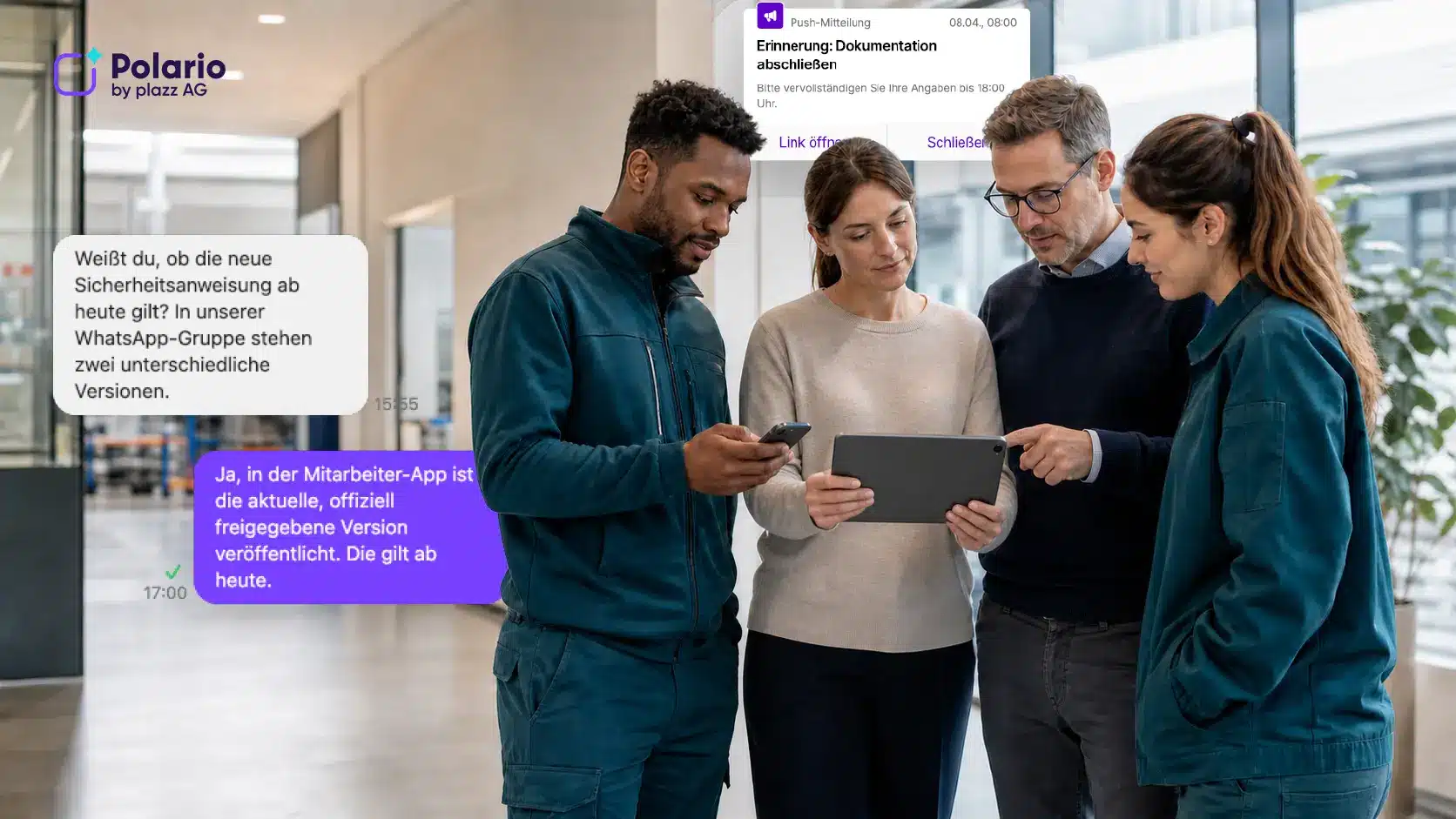

WhatsApp is quick to set up, familiar to many employees and constantly available in everyday life. This is why informal WhatsApp groups often spring up in companies – particularly where staff do not have a work email address or a dedicated computer workstation. However, as usage grows, questions arise: Who manages the groups? Which phone numbers are visible? What happens when someone leaves the company? And where can important information be found in the long term?
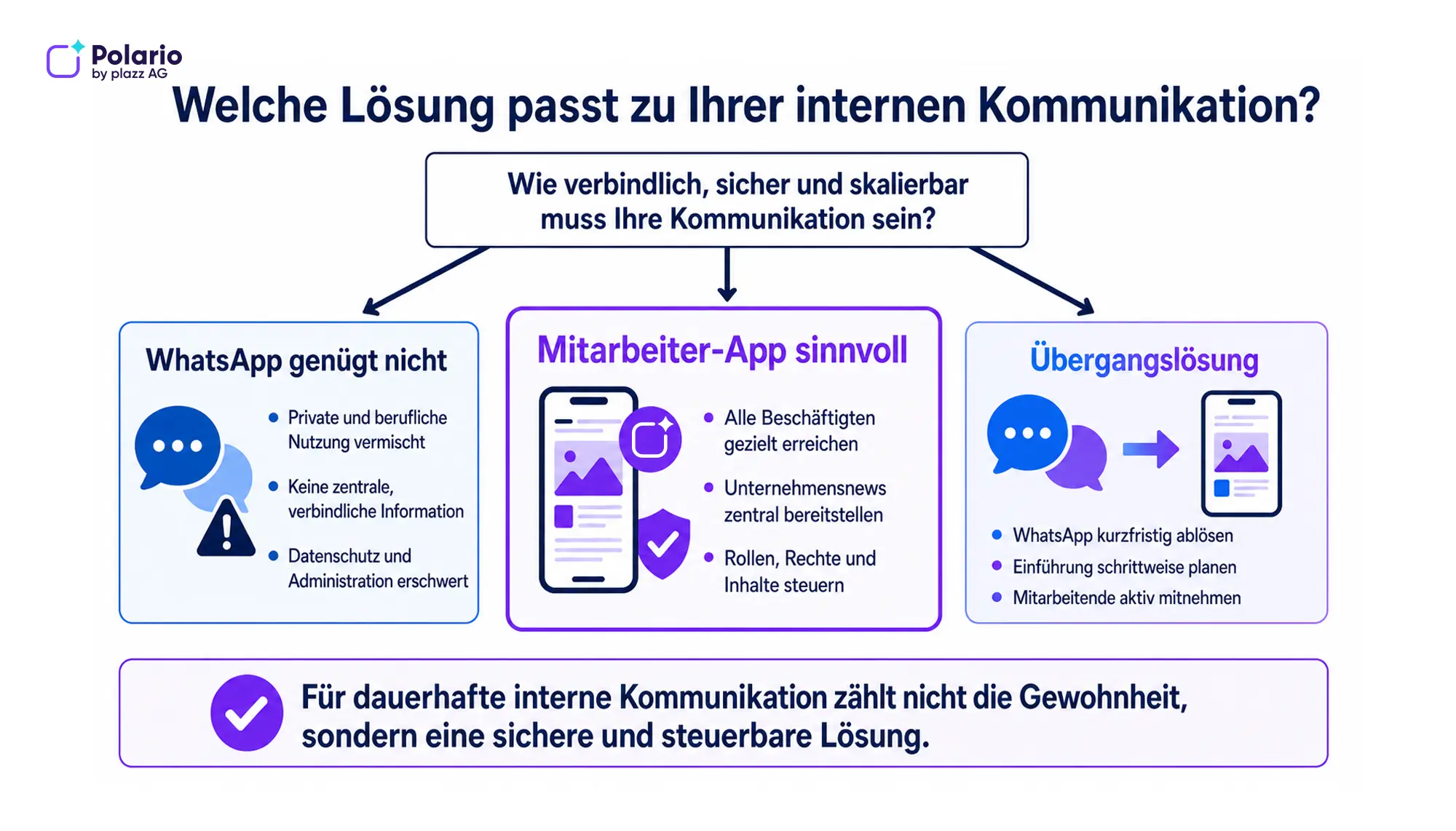
In short: WhatsApp is suitable for quick, informal coordination within small groups. An employee app makes more sense when companies need to reach all staff with official information, tailor content to specific target groups, and control access, roles, data deletion and offboarding. For sensitive or binding communication, the specific use of such an app should also be assessed in terms of data protection legislation. <
Employee app or WhatsApp: What is the fundamental difference?
WhatsApp is a messaging app. Its strength lies in instant communication: messages, images, files, voice messages, and audio and video calls can be shared quickly between individuals or in groups. According to WhatsApp, personal messages and calls are always end-to-end encrypted. (WhatsApp Privacy Policy for the EEA)
An employee app, on the other hand, is a platform provided by the company for internal communication. It brings together official company news, push notifications, documents, calendars, directories, feedback and other systems in a centralised environment. Content can be managed editorially and displayed according to roles, locations or employee groups.
The key difference, therefore, does not lie in whether both solutions can send messages, but in their main function:
- WhatsApp facilitates instant communication: Who’s chatting to whom right now?
- An employee app organises company-wide communication: what official information does each target group need, and where can it be found permanently?
Our comparison of internal communication channels shows which other channels companies can use.
Employee App
Increase the communication in your company with the help of an employee app and reach everybody directly & independent of their location.

Employee app and internal communication channels in comparison
Comparison of internal communication channels: analyse the pros and cons to find the best solutions for your company.
What are WhatsApp’s strengths?
Its widespread use and ease of use make WhatsApp an attractive option for spontaneous polls. Many people are already familiar with the app and do not need to learn how to use it from scratch.
WhatsApp can be useful when:
- a small group wants to coordinate something at short notice,
- the content is informal and lacks sensitivity,
- no long-term documentation is required,
- all those involved use the channel voluntarily,
- there is an alternative means of communication available for non-users,
- the company does not expect any binding publication or audience measurement.
End-to-end encryption of personal messages is also an important security mechanism. However, it does not address all the organisational and data protection issues associated with its use in a business context. Encryption protects the content of messages whilst they are in transit, but it is no substitute for a policy on access rights, device management, data deletion or offboarding.
When does WhatsApp become problematic in staff communication?
Problems usually arise not from a single message, but from the long-term use of a private messaging app as a corporate communication system.
Private telephone numbers and contact details
A mobile phone number is required to set up a WhatsApp account. Depending on the privacy settings, account information may be visible to people who know a phone number or username. In groups and communities, information may also be visible to other participants. WhatsApp also describes an optional contact upload feature that allows address book contacts to be synchronised regularly. (WhatsApp Privacy Policy)
This therefore raises specific questions for businesses:
- Are employees required to use a private telephone number?
- Are work and private contacts being mixed up?
- Who can see phone numbers and profile information?
- Is participation really voluntary?
- Are people who do not use WhatsApp at a disadvantage when it comes to information?
Personal devices and the lack of centralised management
In ‘bring-your-own-device’ scenarios, business information is stored on personal devices. The company must clarify how access is protected, how data is segregated, how device changes are handled, and how information is deleted when an employee leaves the organisation. Group administration alone is no substitute for centralised device and identity management.
Offboarding and group memberships
If a person leaves the company, they must be removed from all company groups. In addition, a check must be carried out to determine what content, files and contacts remain on their personal device. WhatsApp points out that a phone number may continue to appear in the list of former participants for up to 60 days after leaving a group. (WhatsApp Privacy Policy)
Important information disappears from the chat history
Messenger apps are organised chronologically. When activity levels are high, important messages, documents and decisions get lost amongst queries, replies and private posts. Furthermore, new employees do not automatically receive a structured knowledge base containing guidelines, contact details and information that remains relevant over time.
Formal and informal communication are becoming intertwined
In a WhatsApp group, it is not always clear whether a message constitutes official company information, a personal opinion or a spontaneous poll. Editorial processes, approvals, target audience management and version control can only be implemented to a limited extent.
Is WhatsApp compliant with the GDPR in a business context?
The blanket statement “WhatsApp is always prohibited” would be just as inaccurate as the claim that “end-to-end encryption automatically makes any use of it GDPR-compliant”.
Whether a messaging app can be used in a way that complies with data protection regulations depends, amongst other things, on:
- Purpose and legal basis of the processing,
- The nature and sensitivity of the data exchanged,
- Voluntary participation and alternative means of communication,
- Contact details and device management,
- Roles and responsibilities,
- Data deletion and retention policy,
- technical and organisational measures,
- Documentation of data flows and the services used.
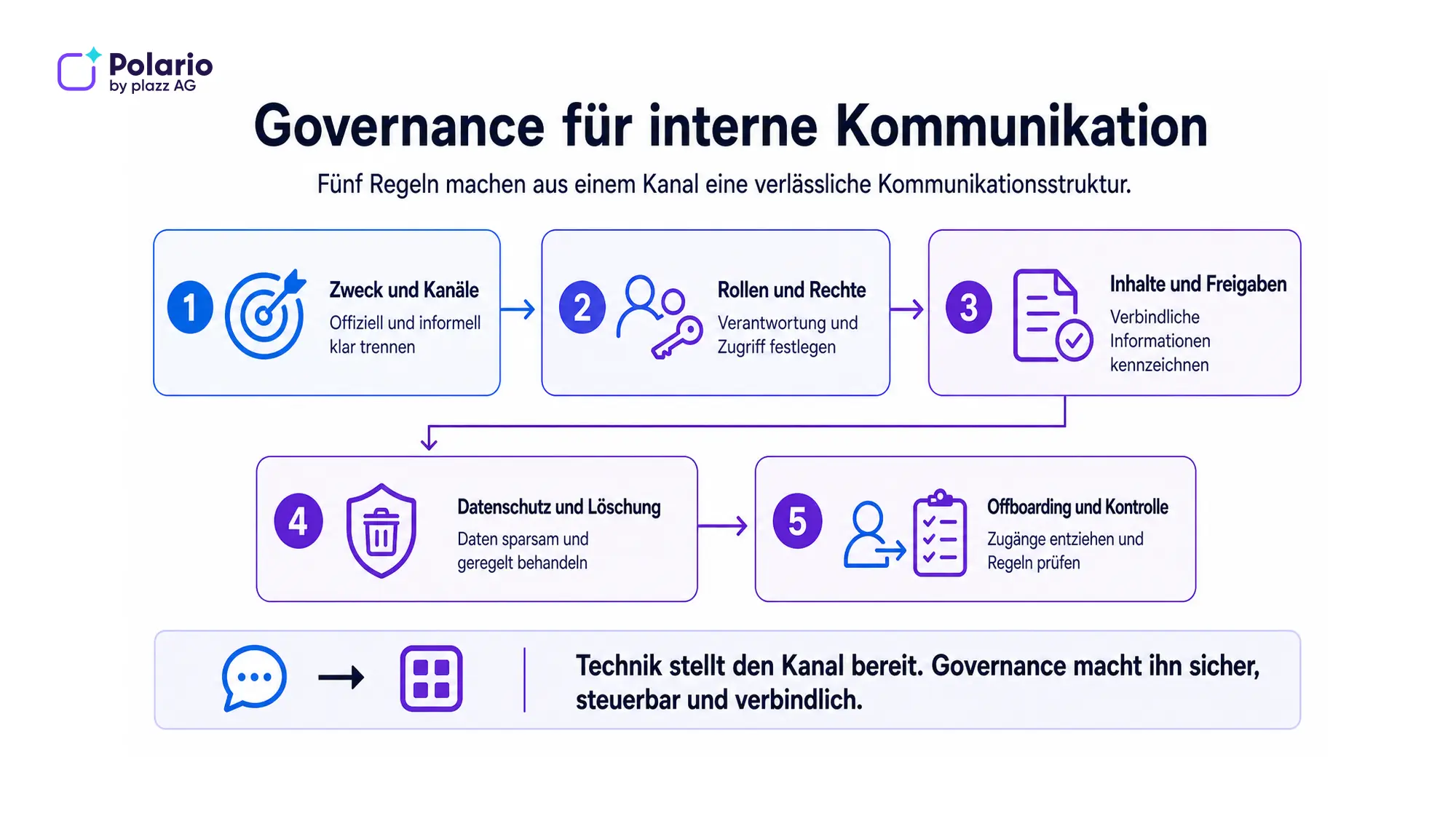
The Data Protection Conference highlights, amongst other things, end-to-end encryption, controlled processing of contact details, authentication, data deletion, authorisation policies and careful selection of the service for messenger apps used for professional purposes. It sees significant problems with the business use of widely used private messenger apps in particularly sensitive sectors such as hospitals. (DSK: Technical data protection requirements for messaging services in the hospital sector)
Companies should therefore have their specific use case reviewed by data protection officers and, where necessary, by legal experts. This article does not constitute legal advice.
What makes an employee app different?
An employee app is designed to provide a controlled corporate communication environment. To this end, Polario provides, amongst other things, news, push notifications, groups, a social feed, documents, calendars, directories, roles and permissions, as well as a centrally managed content management system.
An employee app is particularly useful when:
- all employees should receive official company information,
- many people do not have a dedicated PC workstation,
- Content must be organised by location, role or employee group,
- important information should remain accessible in the long term,
- the company wishes to manage roles, logins and logouts centrally,
- communication and feedback are to be analysed,
- existing systems should be accessible via a central mobile portal.
The relevant solutions page shows how Polario implements these requirements for internal communication via the app. Details regarding hosting, encryption and other security measures should also be checked against the latest Polario compliance information prior to publication.


What makes an employee app different?
| Decision criterion | Dedicated staff app | |
|---|---|---|
|
Main task |
direct messaging |
structured internal communication |
|
Typical application |
small groups and spontaneous coordination |
entire workforce, sites and target groups |
|
Access |
WhatsApp account and mobile phone number |
depending on the provider and identity model |
|
Company News |
as a chat, group or channel post |
as a core function managed by the editorial team |
|
Findability |
Chronological chat history and search |
Structured sections, navigation and search |
|
Target audience targeting |
About contacts, groups and communities |
on roles, groups, locations and visibility settings |
|
Personal and business use |
may get mixed up on personal devices |
designed as an enterprise platform |
|
Roles and rights |
Group and Community Administration |
A differentiated authorisation scheme is possible |
|
Offboarding |
Removal from all relevant groups is required |
Can be planned centrally via user and rights management |
|
Range measurement |
limited to internal communication management |
Can be analysed via Analytics, depending on the provider |
|
Knowledge and documents |
Content in the message history |
information areas that can be permanently organised |
|
Introduction |
low technical barrier to entry |
in-house implementation and governance project |
The table does not assess the overall quality of the products. It shows the main organisational task for which each approach is designed.
When is WhatsApp enough?
WhatsApp may be sufficient when a small group is communicating on a voluntary basis, at short notice and without sharing any sensitive or binding content. An example would be a spontaneous vote amongst colleagues regarding a voluntary private activity.
However, when used as an official channel for duty rosters, staff information, health data, binding instructions or company-wide announcements, the requirements become significantly more stringent. In such cases, the company must be able to control not only the message itself, but also access, the recipient group, documentation, deletion and responsibilities.
When is an employee app a better option than WhatsApp?
An employee app is usually the more robust solution if several of the following statements apply:
- Employees must not miss any important information.
- Frontline workers should be contacted without using a company computer.
- Official announcements must be clearly distinguished from discussions.
- New and departing staff must be managed centrally.
- Documents, contact details and guidelines should always be easy to find.
- Content must be delivered according to target groups or locations.
- Data protection, IT and internal communication require clearly defined responsibilities.
- The organisation is growing, and more and more WhatsApp groups are being set up.
Before making a decision, companies should document their requirements for an employee app. This makes it possible to assess which features are actually needed and which organisational issues cannot be resolved by software alone.
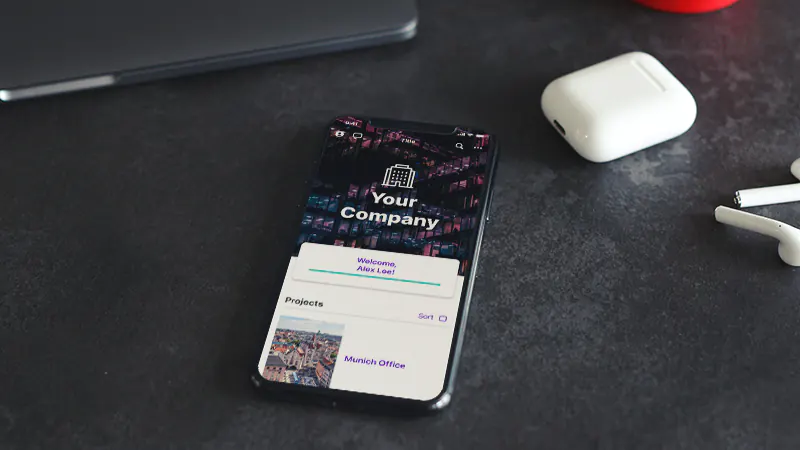
Requirements of an employee app
Learn about the requirements of an employee app and what needs to be considered in order to realize them in the best possible way.
Can WhatsApp and the staff app be used at the same time?
A transition period may be advisable if WhatsApp groups are already firmly established as part of everyday working life. However, the parallel use of these groups should not remain unplanned in the long term, as otherwise information will be spread across multiple channels and staff will be unsure which channel is the official one.
A possible transitional model:
- The staff app will become the official channel for company news, documents and official information.
- WhatsApp will remain in use for the time being for clearly defined, informal consultations.
- For each channel, the purpose, the persons responsible and the permitted content are documented.
- Employees receive training, support and an alternative means of access.
- WhatsApp groups that are no longer needed will be closed in an organised manner following the roll-out.
A structured plan for rolling out an employee app helps to bring together communication, data protection, IT and the relevant employee groups.
Introducing an employee app: How to ensure successful planning, pilot and roll-out
Successfully rolling out an employee app: planning step by step – objectives, project team, data protection, content, pilot, go-live and measuring success.
In practice: What companies can learn from implementing MVB
Magdeburg Transport Authority introduced a Polario staff app, primarily to improve communication with transport services, administration and maintenance teams. According to the published interview, more than 80 per cent of staff had downloaded the app within the first six months. At the same time, usage subsequently fell by around 20 per cent; this was attributed to integrations that were not working properly. (MVB interview on Polario)
This example illustrates two important points:
- A company communication channel can also reach staff who are not in the office.
- An introduction and downloads alone are not enough; relevant content, effective integrations and ongoing maintenance are what determine long-term usage.

Interview: Effective internal communication through the MVB employee app
With the Polario employee app, MVB improves internal communication, reduces information loss and increases operational efficiency.
MVB Employee App
At Magdeburger Verkehrsbetriebe, Polario connects employees in real time, increases efficiency and saves time – digitally and sustainably!
Conclusion: It is not brand awareness but the communication objective that matters
WhatsApp is a powerful messaging app for quick personal communication. It is precisely this simplicity that explains why informal groups also spring up within companies. However, a private messaging app is often not sufficient for structured internal communication involving large numbers of employees, official information, roles, documents and a controlled offboarding process.
An employee app is particularly useful when companies wish to reach all staff via an official mobile channel and organise communication on a long-term basis. The decision should be taken jointly by the internal communications, HR, IT and data protection teams, as well as the staff concerned – based on specific use cases rather than generalised judgements about the product.
Would you like to find out which communication solution is right for your organisation? In a Polario demo, you can work with us to assess target audiences, content, access channels and integration requirements.
Sources and editorial basis
- WhatsApp Privacy Policy – European Region: https://www.whatsapp.com/legal/privacy-policy-eea
- WhatsApp Terms of Service – European Region: https://www.whatsapp.com/legal/terms-of-service-eea
- Data Protection Conference – Technical data protection requirements for messaging services in the hospital sector: https://www.datenschutzkonferenz-online.de/media/st/20210429_DSK_Stellungnahme_Messengerdienste_Krankenhausbereich.pdf
- Hesse Data Protection Commissioner – Criteria for choosing a messaging app: https://datenschutz.hessen.de/datenschutz/hochschulen-schulen-und-archive/die-nutzung-von-messenger-diensten-durch-elternbeiraete
- Polario employee app: https://polario.app/de/mitarbeiter-app/
- Polario MVB interview: https://polario.app/de/interview-mvb-mitarbeiter-app/
Frequently asked questions (FAQ)
Can an employer require staff to use WhatsApp for internal communication?
It is not possible to provide a general answer without examining the specific employment and data protection context. In particular, organisations must take into account the legal basis, necessity, voluntary nature, alternative means of access, personal devices and the data being processed. Employees should not suffer any unjustified disadvantage as a result of not using a personal messaging app. A specialist review is recommended.
Is WhatsApp problematic despite end-to-end encryption?
End-to-end encryption protects the content of personal messages from being accessed by third parties during transmission. However, for business use, questions remain regarding contact details, telephone numbers, personal devices, roles, group management, deletion, offboarding and documentation.
Can companies use WhatsApp Business for staff communication?
WhatsApp Business is primarily designed for communication between businesses and customers. Whether it is suitable and permissible for a specific internal employee process must be assessed on the basis of the version used, contractual relationships, data flows, functions and organisational requirements. The product name alone does not answer these questions.
Which alternative to WhatsApp is suitable for businesses?
The right choice depends on the task at hand. For individual confidential chats, a business-grade messaging app may suffice. For company-wide news, documents, target-group-specific content and centralised mobile access, an employee app is usually more suitable. Communication within member or external communities, on the other hand, has different requirements; these are covered in our article on Polario as an alternative to WhatsApp Community.
Do employees need a work mobile phone to use a staff app?
Not necessarily. It depends on the app, the access model, the works agreement and the security policy. Options include personal devices, company-issued devices, shared devices or browser-based access. Before the roll-out, issues relating to data protection, IT security, employment law, availability and support must be clarified.
How can you make the switch from WhatsApp to an employee app?
The transition begins with clearly defined use cases and communication guidelines. This is followed by a pilot group, a content strategy, defined roles, technical set-up, training and a phased roll-out. It is important to set a firm deadline by which official information will be published exclusively via the new platform.