Skip to content





On the first day of the event, everything looks promising. The app has been launched, the programme is complete and the first push notification has been sent out. Lena, who in this article represents a typical participant, opens the app, saves two sessions and puts her smartphone away again.
On the second day, activity falls short of expectations. The survey has received hardly any responses, key partner content is rarely viewed, and it’s always the same people posting in the social feed. The project team asks the obvious question: How can we get more people to use the app?
The quick answer is often: more memories, more points, a prize draw. The better question is: what behaviour do we want to encourage – and what benefits will participants gain from it? This is precisely where effective gamification begins.
In short: Good gamification does not reward as many clicks as possible, but rather meaningful actions. A clear trigger, a simple action, immediate feedback and a recognisable benefit encourage repetition. Points and leaderboards can support this cycle. However, engagement only arises when the desired behaviour aligns with the goals of both the users and the project.
Gamification is not a points system, but behavioural design
Gamification refers to the targeted use of game-like principles in a non-gaming context. This can include points, progress bars, challenges, immediate feedback or leaderboards. However, these elements are merely the visible surface.
Underlying this is a design task: to make a desired behaviour understandable, achievable and rewarding. In an event context, this might mean, for example, discovering a relevant session, giving feedback, getting to know an exhibitor or initiating a professional exchange. Within a community, the aim might be to share knowledge, answer a question or return regularly to a particular topic.
A good gamification strategy therefore does not begin with ‘What do we award points for?’, but with three questions:
- 1. What effect do we want to achieve?
- 2. What specific behaviour contributes to this effect?
- 3. What personal benefit does the participant recognise?
Only then is a decision made as to whether a game-like element is actually helpful.
Why the first click does not necessarily mean engagement
An app launch can be counted. But that does not answer the question of whether it has any effect. Lena might open a partner’s page because she receives points for doing so, and then close it again after a second. The statistics show activity, but the partner does not receive any additional attention.
This example highlights the difference between three levels:
| Level | Key question | Example |
|---|---|---|
|
Activity |
What was done? |
A page was opened. |
|
Behaviour |
What did the person actually do? |
They engaged with an offer. |
|
Impact |
What improved as a result? |
A relevant conversation or genuine interest was generated. |
Gamification can trigger activity. For this to translate into valuable behaviour, the rewarded action must be closely linked to the project’s objective. The metric must not be allowed to replace the actual impact.
The second click needs a recognisable benefit
After her first visit to the app, Lena needs a reason to return. A simple score may spark curiosity in the short term. The impulse becomes more sustainable when four conditions are met:
- Relevance: The action fits her circumstances and interests.
- Ease: She understands immediately what to do.
- Feedback:The response to her action is immediately visible.
- Benefit: She gains guidance, knowledge, connections or influence.
This is what the second interaction might look like: Lena isn’t simply encouraged to ‘discover more in the app’. Instead, she is presented with a clearly defined task, rates a session she has just attended, and receives immediate feedback on her progress. At the same time, her rating helps the event team to improve the programme. The point is a signal; the purpose lies in the feedback.
From initial engagement to repeat participation
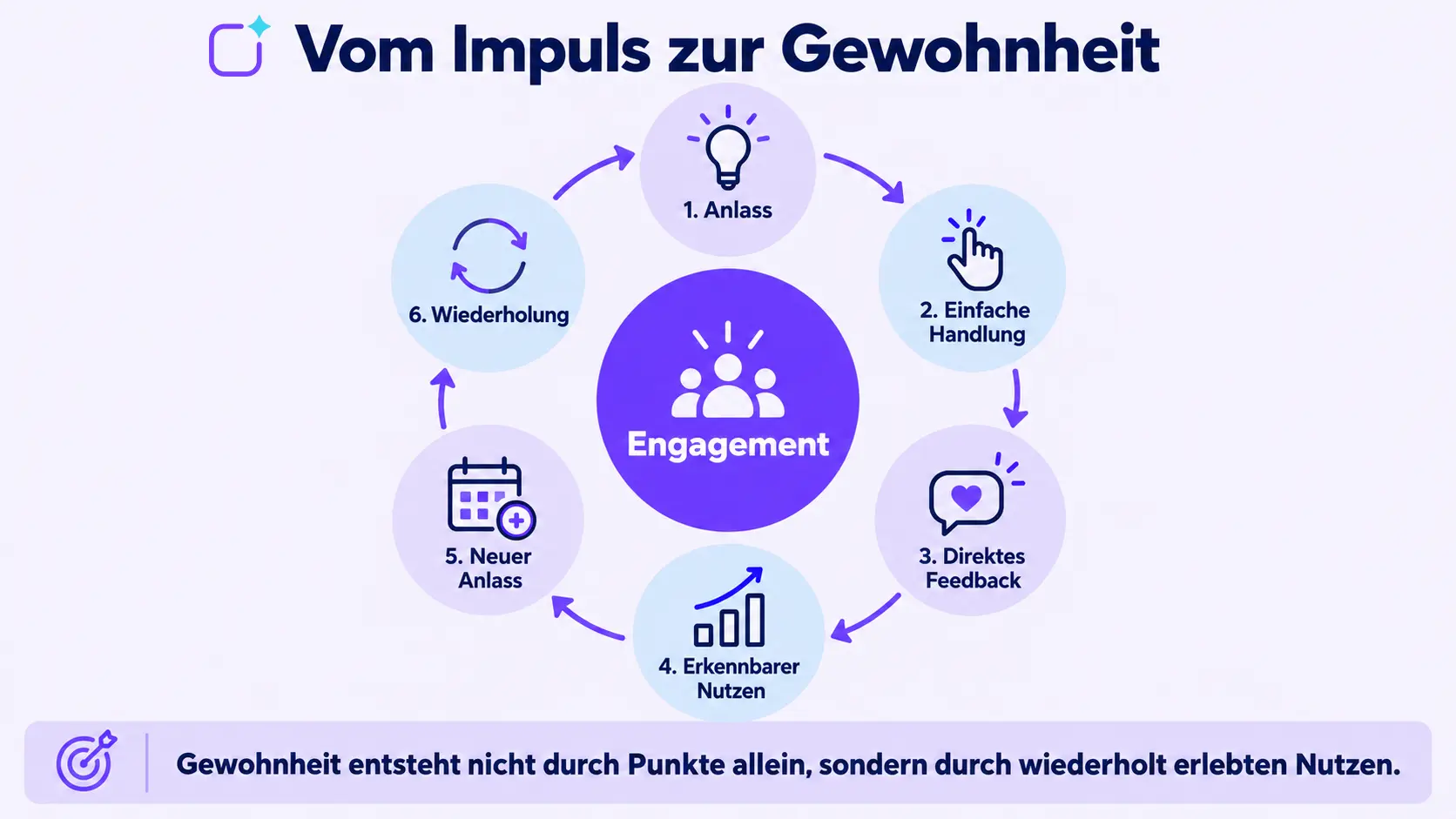
Habits are not formed by a single stimulus. They develop when a behaviour is repeated in a suitable context and proves to be useful. A recent systematic review on habit formation also shows how much the time taken varies depending on the behaviour and the individual. The often-cited fixed number of days is therefore not a reliable guarantee – certainly not when it comes to using an app.
For digital engagement scenarios, a simple cycle is more helpful:
Trigger → simple action → immediate feedback → recognisable benefit → new trigger → repetition
In the case of a one-day event, this does not yet result in a lasting habit. However, the pattern can make it easier for users to engage with the app repeatedly across several programme items. In a long-term community or staff app, it can help establish a more stable routine over a period of weeks – provided that the content and benefits remain consistent.
Five effective examples of gamification
Examples of gamification are only applicable if the objective, target audience and context are taken into account. The following scenarios therefore illustrate not only the mechanics, but also the intended effect.
1. Get more and better feedback
- Objective: The events team needs a broader basis for programme planning.
- Action: Participants rate a session they have attended shortly afterwards.
- Incentive:A one-off reward is given for each fully submitted evaluation.
- Benefit: The participant can reflect on their experience; the team can improve future content.
- Important limitation: It is not just the number of evaluations that counts. Quality, distribution across sessions and representativeness must also be taken into account.
2. Highlight relevant partners
- Objective: Sponsors and exhibitors should be noticed by the relevant target groups.
- Behaviour: Participants discover selected content or visit a themed area.
- Trigger: A clearly defined task highlights relevant partner offers.
- Benefit:The individual finds solutions relating to their professional interests.
- Important limitation: A mere page view does not necessarily indicate engagement. Supplementary quality indicators such as saved content, requests for discussions or feedback are more meaningful.
3. Facilitating networking
- Objective: To foster meaningful connections from a list of participants.
- Behaviour: A person completes their profile, discovers suitable contacts or initiates a conversation.
- Impetus: Progress becomes visible; a challenge provides a manageable starting point.
- Benefit:The person finds conversation partners with shared interests more quickly.
- Important limitation: Quantity of contacts does not equal quality of contacts. Voluntary participation and respectful engagement remain more important than a ranking system.
Anyone wishing to actively support networking can combine playful prompts with matchmaking. The mechanics should facilitate getting to know one another, not generate random contact requests.
4. Harnessing knowledge within a community
- Objective: Expertise should not merely be consumed, but shared.
- Behaviour:Members answer open questions or share helpful experiences.
- Impetus:Recognition highlights constructive contributions.
- Benefits: Those asking questions receive help; contributors experience a sense of competence and belonging.
- Important limitation: The number of posts must not be given greater weight than their relevance. Moderation and quality criteria are essential.
For long-term scenarios, embedding the platform within a community app is a good option. There, recurring exchanges and long-term relationships are more important than short-term competition.
5. Helping people find their way around a wide-ranging programme
- Objective:Participants should be able to find key content and features early on.
- Behaviour: They put together their agenda, read organisational notes and enable relevant settings.
- Prompt: A brief introductory challenge highlights progress and the next steps.
- Benefit: The user gains a sense of direction and misses less.
- Key constraint: Essential information must never be hidden behind a game mechanic or made accessible only in exchange for points.
An event app can combine this sense of direction with the agenda, communication and interaction. Gamification complements the process; it does not replace intuitive navigation or relevant content.
When points reward the wrong behaviour
Back to Lena: initially, the team awards an unlimited number of points for every post in the social feed. Within a short space of time, activity increases. At the same time, there is a proliferation of short, content-poor posts. The rule works technically – but runs counter to the actual objective.
This is not a minor issue. Research into points, levels and leaderboards paints a nuanced picture: such elements can increase the volume of work produced without automatically improving intrinsic motivation, autonomy or a sense of competence. Other studies show that different design elements appeal to different psychological needs. What matters, therefore, is not just the mechanics and visibility, but also the context, meaning and design.
Before launch, every rule should pass a ‘misincentive’ test:
- Can the action be repeated as often as one likes without any additional benefit?
- Is quantity rewarded, even though quality is what counts?
- Can a small number of very active individuals dominate the competition?
- Does the rule put people at a disadvantage who have less time, limited access or other usage constraints?
- Does participation remain voluntary and transparent?
- Is it clear which usage data is processed for evaluation and scoring?
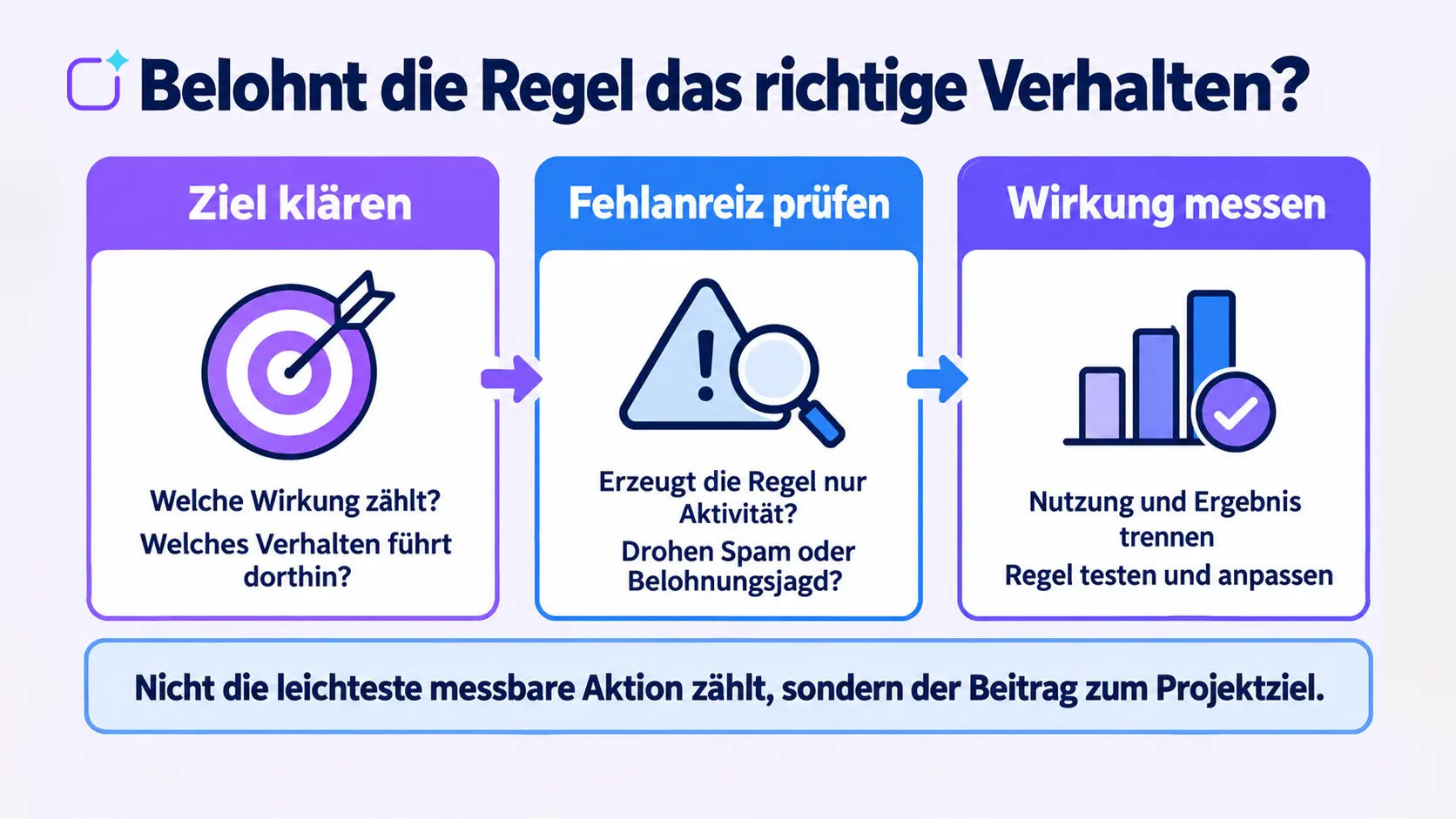
How an idea develops into a robust gamification concept
A concept doesn’t have to start with a large-scale competition. A small, testable use case usually yields more insights.
Step 1: Define the effect
Formulate an outcome, not a function. ‘Awarding more points’ is not an outcome. ‘More actionable feedback from previously under-represented target groups’ is more precise.
Step 2: Define the target behaviour
Describe an observable action. It should be simple enough for the usage context and relevant enough to the outcome.
Step 3: Understanding the obstacles
Is it a lack of time, guidance, trust, access or a clear benefit? An incentive doesn’t overcome every hurdle. If a form is too long, a badge doesn’t automatically make the experience any better.
Step 4: Structuring the prompt and feedback
Choose the smallest possible element that makes the behaviour easier to understand and progress visible. This could be a challenge, a tick, a progress bar or immediate feedback.
Step 5: Setting boundaries
Define the frequency, time period, target group and safeguards against abuse. Limited rules are often more meaningful than unlimited points-based systems.
Step 6: Assessing efficacy and side effects
Distinguish between early signs of use and the actual result:
| Measurement scope | Suitable questions | Examples |
|---|---|---|
|
Early indicators |
Is the desired action initiated and completed? |
Engagement, completion rate, retention |
|
Outcome |
Is the project objective improving? |
Quality of feedback, relevant contacts, reach of key content |
|
Protective metrics |
Are any undesirable effects arising? |
Spam, drop-off, focus on top users, deactivations |
Step 7: Test on a small scale and make adjustments
Start with a clear hypothesis, a limited target group or a manageable timeframe. Don’t just compare the before and after; check whether other factors might have influenced the result.
What role does Polario play?
In Polario, gamification can be configured within an existing project. According to the information on the features page, selected actions can serve as triggers. The project team sets point values and determines whether an action is scored once, a limited number of times or an unlimited number of times. Participants see new points immediately; their score and ranking remain visible.
Important for acceptance: according to Polario, participation is voluntary. Users can opt in and opt out again via their account settings. The feature is managed centrally in the CMS and is designated as a premium feature.
The technology thus provides the building blocks. Which actions make sense, how often they count, and how success is measured remain conceptual decisions. The Polario feature overviewhighlights additional functions such as the social feed, notifications, surveys and analytics, which can be used to integrate an engagement scenario into the overall workflow.
The SCM success story provides a documented example of using an event app without any gamification elements. It illustrates that up-to-date information and reliable communication already create value in their own right. Gamification should reinforce such fundamental benefits, not overshadow them.
How can you recognise good gamification?
Good gamification is often less spectacular than the term suggests. It does not come between the user and the task. It makes a relevant action easier, provides clear feedback and allows progress to be tracked.
A robust concept fulfils six conditions:
- 1. The project objective is defined before the mechanics are established.
- 2. The desired behaviour is specific and voluntary.
- 3. The participant recognises a personal benefit.
- 4. Rules, points and evaluation are transparent.
- 5. Barriers, data protection and fairness are taken into account.
- 6. Success is measured by impact and side effects.
Then Lena’s story changes too. She doesn’t open the app again simply because the system demands more screen time. She returns because she finds guidance, her feedback is visibly valued, and a meaningful interaction is being set up. Gamification provides the impetus. The perceived benefit drives repeat usage.
Conclusion: No longer just a game, but greater meaning
Points, badges and leaderboards are not a strategy in themselves. They can draw attention, make progress visible and make it easier to get started. Whether this leads to engagement is determined elsewhere: by the connection between the project’s objective, meaningful behaviour and recognisable benefits.
The most important rule is therefore: do not reward what is easiest to measure. Encourage what really matters to users and the project.
Sources and editorial basis
- Gamification Feature: https://polario.app/de/features-gamification/
- Polario Update 5.11: https://polario.app/de/polario-update-5-11/
- Event App: https://polario.app/de/event-app/
- Community App: https://polario.app/de/community-app/
- Features: https://polario.app/de/features/
- SCM Event App: https://polario.app/de/scm-event-app/
- Hamari, Koivisto & Sarsa (2014), *Does Gamification Work? A Literature Review of Empirical Studies on Gamification*: https://doi.org/10.1109/HICSS.2014.377
- Mekler et al., *Towards understanding the effects of individual gamification elements on intrinsic motivation and performance*: https://edoc.unibas.ch/entities/publication/ccec8ccc-aa54-417d-b205-334b518d6eed/full
- Sailer et al. (2017), *How gamification motivates: An experimental study of the effects of specific game design elements on psychological need satisfaction*: https://opus.bibliothek.uni-augsburg.de/opus4/frontdoor/index/index/docId/109059
- Singh et al. (2024), *Time to Form a Habit: A Systematic Review and Meta-Analysis of Health Behaviour Habit Formation*: https://pmc.ncbi.nlm.nih.gov/articles/PMC11641623/
Frequently asked questions (FAQ)
What is gamification?
Gamification is the application of game-like design principles in a non-gaming context. These include, for example, points, progress, challenges and leaderboards. The aim is not merely to entertain, but to make a particular behaviour understandable, motivating and visible.
What examples of gamification are suitable for events?
Suitable scenarios include clearly defined activities such as session feedback, discovering relevant partner content, an introductory challenge to help participants find their feet, or voluntary networking tasks. The mechanics should be aligned with the event’s objective and must not encourage activities that lack substance.
Does gamification automatically increase engagement?
No. Game-like elements can increase engagement, but they do not guarantee motivation or valuable outcomes. Relevance, ease of use, immediate feedback, voluntary participation and a clear benefit are crucial.
Can points create a habit?
Points alone do not create a stable habit. Repetition is more likely to occur when a reliable cue, a simple action, immediate feedback and a perceived benefit all come together. How long it takes to form a habit varies greatly depending on the individual, the context and the behaviour in question.
When are leaderboards unsuitable?
Rankings can be problematic when a small number of highly active individuals pull so far ahead early on that they become uncatchable, when sensitive performance data is compared publicly, or when cooperation is more important than competition. In such cases, personal progress, team goals or non-public recognition may be more appropriate.
How do you measure the success of gamification?
Don’t just measure clicks or page views. Combine early usage indicators with performance metrics and protection metrics. Relevant metrics include, for example, conversion rates, the quality and distribution of feedback, valuable contacts, as well as spam, abandonments and deactivations.
How does gamification work in Polario?
Project managers select eligible activities as triggers, set points and, where necessary, limit the frequency. Users can view their points and ranking in the app. Participation is voluntary and can be deactivated, according to Polario.