Skip to content





The cost of an event app does not depend solely on the number of attendees. The key factors are the delivery model, the number of events, branding, features, integrations, service and internal project effort. A browser-based app for a single event is priced differently from a native white-label app for an international series of events.
In short: Polario currently quotes starting prices from 2,500 euros per event for a web app and from 3,000 euros per event for the Hub version, which includes both a web app and a native app. A bespoke app is quoted on request. To ensure a fair comparison, factors such as set-up, branding, integrations, premium features, support and internal working hours must also be taken into account.
This article outlines the standard pricing models, the cost categories that should be included in the budget, and how to calculate the total cost of ownership. Published prices are starting points, not binding offers. The agreed scope of services and the specific quotation remain decisive.
Why do event app prices vary so much?
The term ‘event app’ covers a wide range of very different products. A simple web app displays the programme, speakers and venue map in a browser. A native hub app links several events within an existing app. A bespoke custom app appears under its own name in the app stores. Comprehensive event platforms add registration, check-in, lead capture, streaming or complex integrations. The guide to event management software sets out the differences between the various software categories in more detail.
The biggest differences in price stem from six factors:
- 1. How will the app be delivered?As a web app, an existing hub app or via its own store listing?
- 2. How many events will be featured? A single event, a series of events or a year-round programme?
- 3. How many people will use the solution?Participants, editors, exhibitors, speakers and administrators?
- 4. Which features are actually required?Basic information, interaction, networking, booking appointments, multilingual support or streaming?
- 5. Which systems will be integrated? Registration, CRM, check-in, identity providers or marketing automation?
- 6. How much support does the provider offer? Self-service, workshops, content set-up or on-site support?
The question of cost therefore does not begin with a price list, but with a clear usage scenario. The overview of the different types of event apps helps you choose between web, hub and custom apps.
What pricing models are available for event apps?
Price per event
A project-based price applies to a specific event and a defined period. This model is suitable for individual conferences, meetings or corporate events. It is important to check what preparation and follow-up time is included, and whether trial access, archiving or extended availability will incur additional costs.
Price based on the number of participants
Under this model, the price is determined by the number of registered, invited or active users. The precise definition is important: a quota for 1,000 invited users is not the same as 1,000 actually active users. Tiered pricing and costs for exceeding the quota should also be included in the offer.
Function or package price
Providers bundle features into packages. These may include the agenda, content and basic interaction, whilst matchmaking, multilingual support, live streaming, lead capture, SSO or advanced analytics may require additional packages. You should therefore compare not the package name, but the extent to which essential requirements are covered.
Annual licence or multi-event model
Organisations running multiple events can opt for an annual licence or an event package. This can be more cost-effective and easier to organise than managing many individual projects. The key factors to consider are whether events can run concurrently, how new projects are set up, and what user or data limits apply.
White-label or custom app
A standalone app with its own name, icon, app store description and corporate design is often priced on a case-by-case basis. In addition to the cost of using the platform, there are costs associated with branding, developer accounts, app store materials, publication and subsequent releases.
Personal development
When developing an app in-house, development costs are just the start. Product management, UX, quality assurance, hosting, security, support, operating system updates and app store requirements are ongoing costs. The separate guide ‘Creating an event app: buy, configure or develop in-house?’ explains this ‘build or buy’ decision in detail.
Which cost categories should be included in the event app budget?
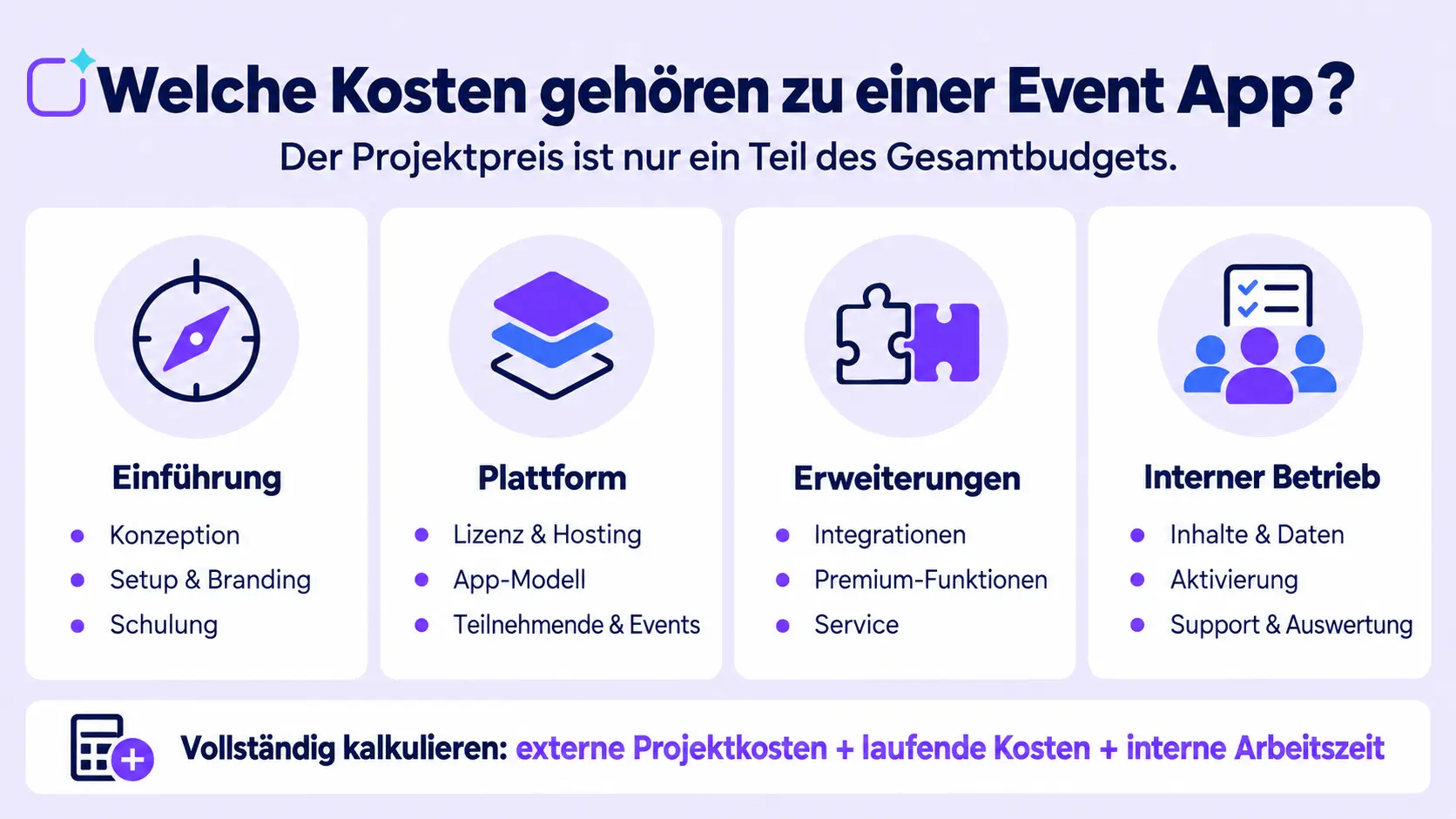
A robust cost estimate distinguishes between one-off external project costs, ongoing external costs and internal expenditure.
Concept development and project management
Before the set-up, the objectives, target audiences, roles, timetable, content and success criteria must be established. Workshops and project management may form part of the package or be provided as a separate service. Internal coordination with marketing, the events team, IT, data protection and procurement also involves a significant amount of work.
Setup and configuration
These include project setup, navigation, roles, groups, modules, design and basic settings. The more target groups, languages, parallel areas and authorisations are required, the greater the effort involved in configuration and testing.
Branding and app release
A web or hub app typically requires less effort to publish. With a custom app, you also need to provide the app name, icon, screenshots, store descriptions, privacy policy, developer accounts and go-live processes. Subsequent technical updates also need to be organised.
Content and data maintenance
The agenda, sessions, speakers, exhibitors, sponsors, documents, site maps and news must be organised, entered and checked. The amount of work involved depends heavily on data quality, the frequency of changes and the available import options.
Integrations and data flows
Registration, CRM, ticketing, check-in and identity providers can be integrated. The existence of an API alone does not make integration free of charge. Data mapping, authentication, testing, error handling, monitoring and clear lines of responsibility are required. Polario describes the technical options under ‘API’ and ‘Integration’; for invitations and login details, the ‘registr’ participant management feature is also relevant.
Premium features
Additional costs may arise for, amongst other things, multilingual support, matchmaking, appointment booking, streaming, video-on-demand, SSO, white labelling or project-specific enhancements. The current service specification for the specific package shall prevail.
Service and on-site support
Self-service, a knowledge base and ticket support are not the same as having a dedicated contact person, a content service or on-site support. Check which workshops, response times and support services are included. Polario explains its services on the Service and Support page.
Hosting, security and compliance
With SaaS offerings, hosting and product updates are often included in the licence. Specific requirements regarding dedicated environments, service levels, security audits or documentation may incur additional costs. Polario provides details on hosting in Germany and further security information in the Compliance section.
In-house event management
Even once the technical set-up is complete, there are still internal tasks to be carried out: updating content, scheduling push notifications, answering support enquiries, moderating interactions, producing reports and documenting findings. The time spent on this work forms part of the overall costs.
How much does Polario cost as an event app?
Polario lists three event app options in its current price guide:
| Option | Public entry price | Provision | Classification |
|---|---|---|---|
|
Event App Web |
from 2,500 euros per event |
Web app in a browser |
suitable for small events with up to 250 participants |
|
Event App Hub |
from 3,000 euros per event |
Web app plus native Polario app |
Fast native access without the need for a separate app store process |
|
Event App Custom |
Price on request |
Custom web and native white-label app |
own name, icon and shop listing |
According to the Polario price guide, the published event packages include basic features and API access. Premium features and white labelling may incur additional charges. A custom app requires dedicated developer accounts. The exact price depends on the scope of the project, features, integrations and services.
The prices quoted are not flat-rate total costs for each event. A web app with well-prepared content and a standard interface has a different scope of work to a multilingual custom app with multiple target audiences, registration, check-in and on-site support.
Sample budgets without made-up total prices
Flat-rate sample quotes would be misleading as long as the number of participants, features, services and integrations are not specified. It makes more sense to provide three budget frameworks that can be filled in with specific quotes.
Scenario 1: Small conference using a web app
Typical requirements:
- up to 250 participants,
- agenda, speakers, documents and site map,
- browser-based access,
- one event and one language,
- content is managed internally,
- no complex system integration.
With Polario, the starting point can be the Event App Web, from 2,500 euros per event. Additional factors to consider include setup, the required service and internal content management.
Scenario 2: Corporate event with a native hub app
Typical requirements:
- Web app and native app,
- push notifications and interaction,
- customised branding within the Hub app,
- import of participant data,
- project workshop and support.
With Polario, the starting point can be the Event App Hub, from 3,000 euros per event. Additional services and premium features must be specified in the quotation.
Scenario 3: International series of events as a custom app
Typical requirements:
- a bespoke name and App Store listing,
- multiple events, countries and languages,
- roles and target-group-specific content,
- registration, check-in and other integrations,
- enhanced service and security requirements.
It is not possible to provide a fixed-price quote for this scenario. The event portfolio, data flows, branding, modules and services must be calculated as part of a bespoke quotation.
How to calculate the Total Cost of Ownership
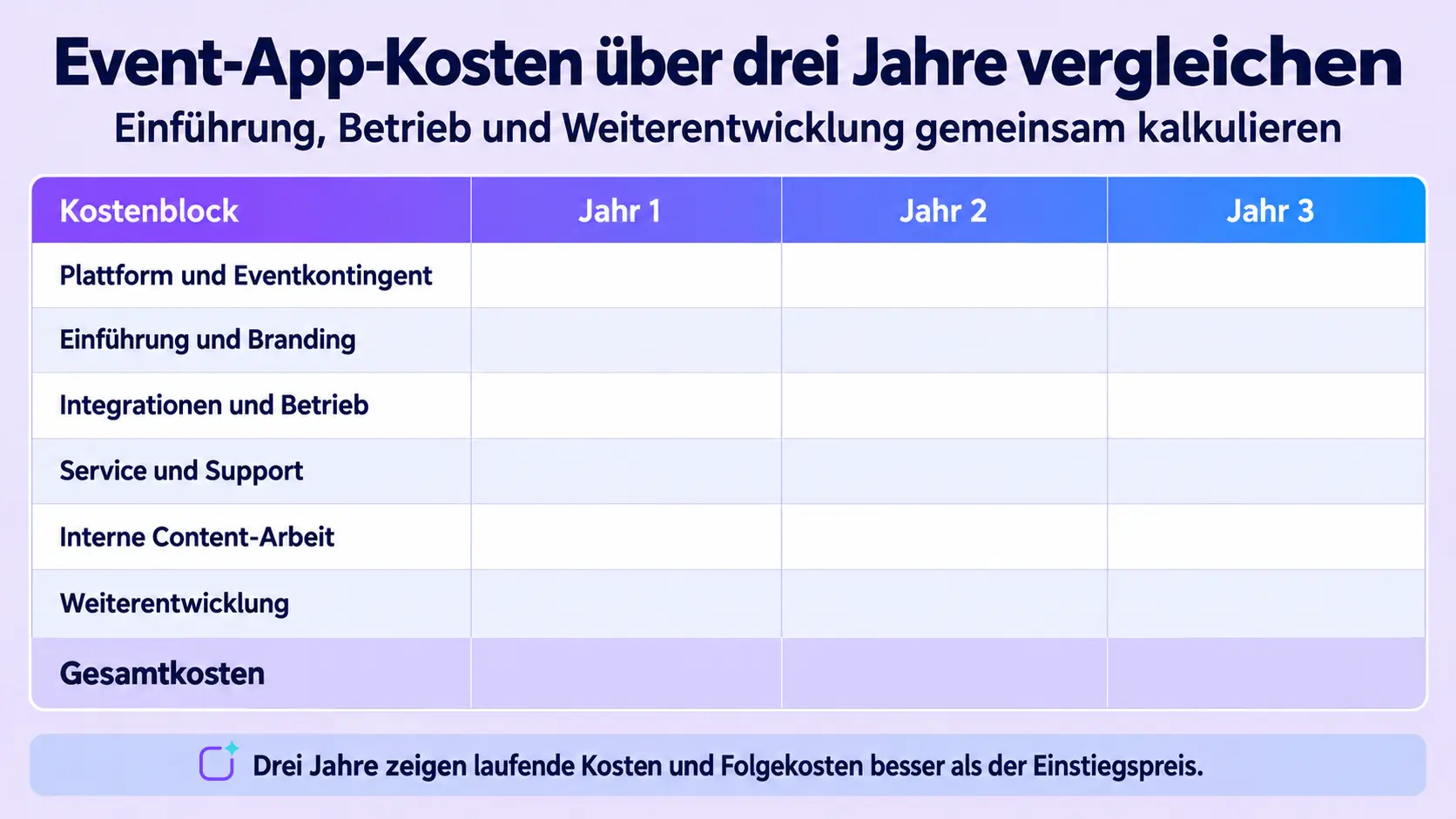
When comparing quotes, a standardised time frame should be selected. For a one-off project, the duration of the event may be sufficient. For recurring events, a three-year period provides a more meaningful comparison.
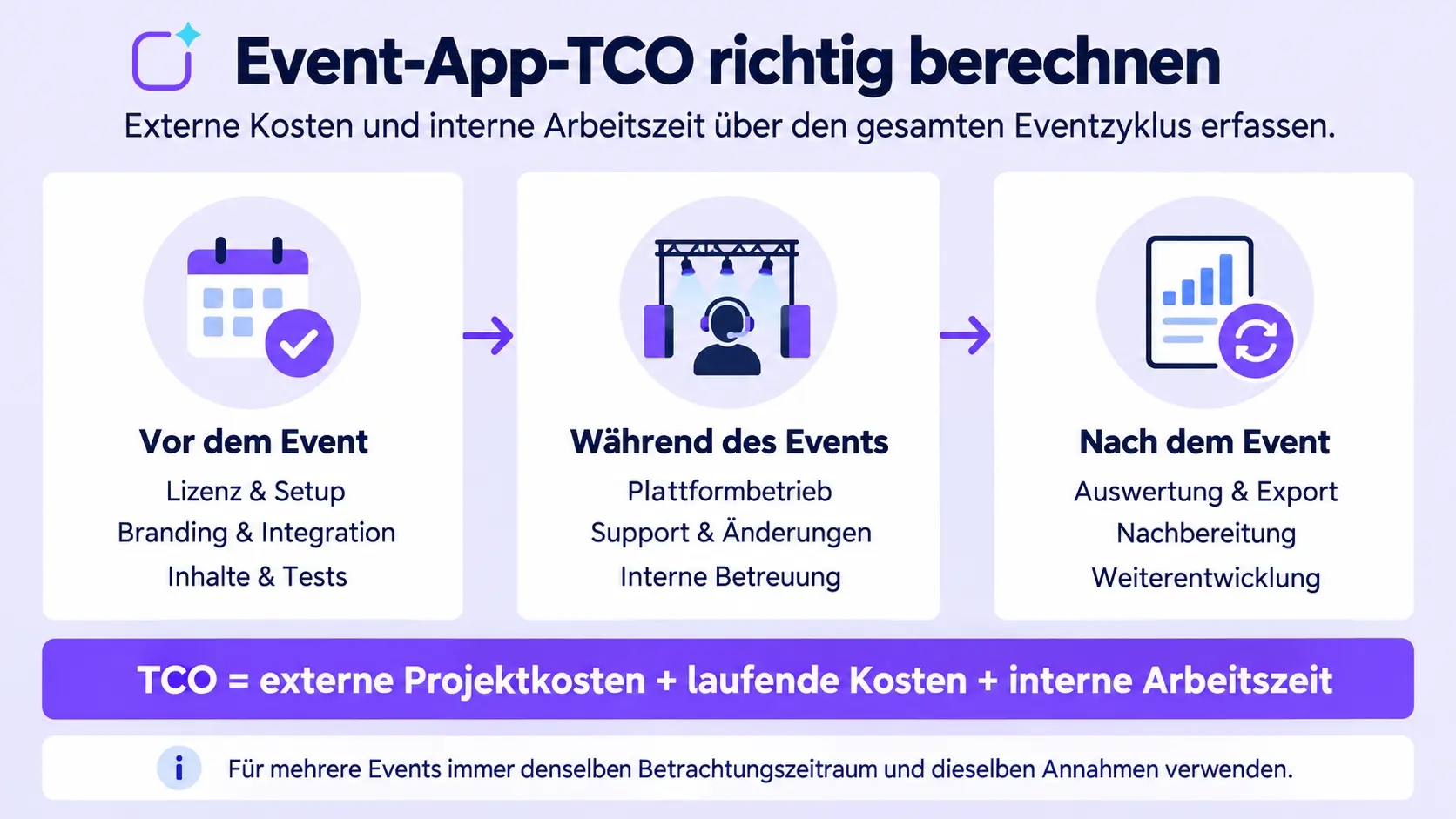
TCO = one-off external costs + ongoing external costs + internal project and operating costs
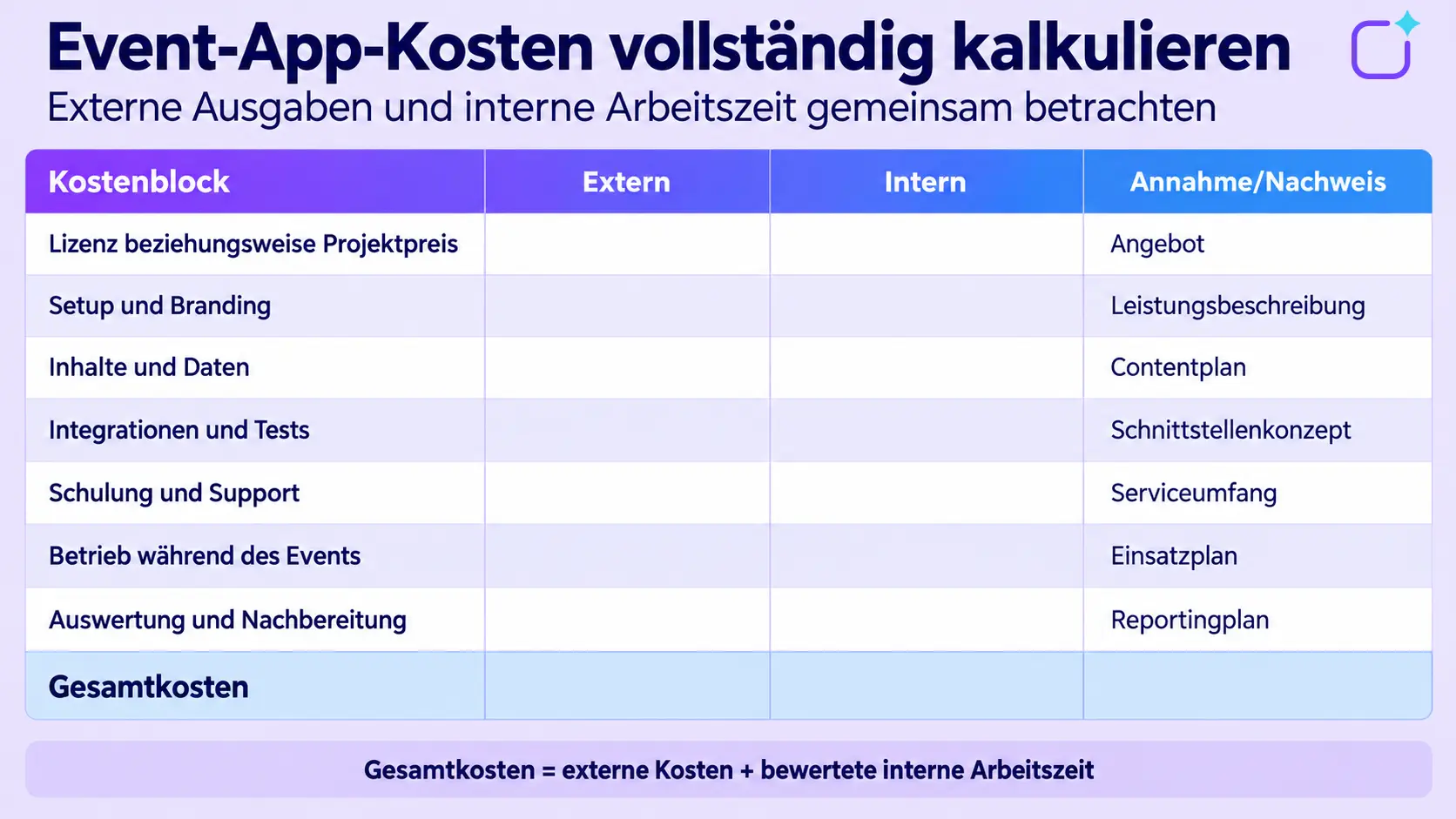
Calculation for a single event
Costing for multiple events
The following formula can be used for internal working hours:
Internal costs = hours worked × internal full-cost rate
Use the same assumptions for all quotations. This is the only way to see whether a favourable licence price is offset by high internal costs, additional modules or integration costs.
Which costs are often overlooked?
Changes made shortly before the event
The agenda, venues, speakers and participant details are often subject to change right up until the last minute. If imports, workflows or responsibilities have not been prepared in advance, this results in additional work in terms of content and support at short notice.
Data Cleaning
Inconsistent names, missing consents, duplicate entries or incomplete profiles delay imports and personalisation. The interface itself may work from a technical point of view, whilst data preparation still takes up a considerable amount of time.
App activation
Just because an app is available does not mean it will be used automatically. Email communications, QR codes, notices in the programme, announcements by the presenter and relevant content all require planning. Its implementation must be factored into the project and budget.
On-site support and fallbacks
For time-sensitive events, responsibilities for queries, service outages, network issues and last-minute changes must be clearly defined. On-site support, hire equipment or additional network technology may incur separate costs.
Streaming and media production
A live-streaming feature is no substitute for camera, sound, directing or production services. Platform costs and media production must be calculated separately.
Recurring store and release tasks
A custom app requires more than just its initial release. Technical updates, changes to guidelines and new operating system versions can trigger subsequent releases.
Exit and Data Export
Before signing the contract, clarify how content, participant data and reports are exported, and what deadlines apply once the project has ended. An unplanned export or a change of provider may result in additional work.
How do Web, Hub and Custom apps differ in economic terms?
Web-App
A web app reduces the effort involved in publishing and can be accessed via a link or QR code. It can be cost-effective if quick access to a single event is more important than having a native app or a dedicated store listing.
Hub-App
A hub app combines native functionality with an existing provider app. It avoids the need for a separate store process and can be a good compromise for one-off or recurring events. The brand experience takes place within the hub app.
Custom app
A custom app offers the most visible brand presence, but involves additional project and launch costs. It becomes particularly cost-effective if the app is used for several events, over a longer period of time, or as a permanent event community.
The decision should not be based solely on the price difference. The article ‘Why we don’t need an event app’ explains which delivery model suits different objectives.
How can event app offerings be compared fairly?
- 1. Use the same event profile:Define the format, number of participants, languages, duration and number of events.
- 2. Identify essential requirements: Distinguish between basic functions, premium functions and optional features.
- 3. Standardise the delivery model:Do not directly compare a web app with a dedicated store app.
- 4. Distinguish between one-off and ongoing costs:Do not include set-up, branding and integration within the licence fee.
- 5. Specify the service in detail:List workshops, content services, support hours and on-site services separately.
- 6. Describe integrations: Document the data source, direction, frequency, error handling and operation.
- 7. Supplement internal work:Assess content, testing, activation, support and evaluation.
- 8. Compare TCO rather than the entry-level price: Add up all costs over the same period.
If you need a shortlist to start with, the 2026 Event App Provider Comparison provides an overview of the market organised by app model, features, hosting, service and prices. The article on smart event processes explains the end-to-end workflow from invitation to check-in.
What economic benefits can an event app generate?
Costs should be weighed against the expected benefits. An event app can reduce printing and amendment costs, distribute information more quickly, minimise queries and make interactions measurable. For sponsors, digital profiles, banners or sponsored content can enable additional benefits. However, the actual value depends on the event model and how the app is used.
Useful key performance indicators include:
- Activation and usage rates,
- Reach of time-sensitive information,
- Number and quality of interactions,
- Support and enquiry workload,
- Printing, postage and amendment costs,
- Use of sponsors and booked digital services,
- Participation in sessions, surveys and networking,
- Repeat attendance and satisfaction.
No single metric automatically proves a positive ROI. Objectives and baseline figures must be defined before the event so that a reliable assessment can be made afterwards. The article on event feedback forms shows how feedback can be collected and analysed in a structured manner.
Conclusion: The entry price is only the starting point for the calculation
The question “How much does an event app cost?” can only be answered properly once the app model, number of attendees, event portfolio, features, integrations and service have been finalised. Published starting prices provide a guide, but are no substitute for a project cost estimate.
A good comparison distinguishes between one-off set-up costs, ongoing external costs and internal working hours. For individual events, a project-specific calculation is sufficient. For multiple events, the total cost of ownership should be considered over several years. This reveals which solution is not only affordable to start with, but also economically suited to the actual event process.
Sources and editorial basis
- Event App: https://polario.app/de/event-app/
- Prices and versions:https://polario.app/de/preise/
- Types of event apps: https://polario.app/de/event-app-varianten/
- Comparison of event app providers: https://polario.app/de/event-app-anbieter-vergleich/
- Eventmanagement Software: https://polario.app/de/event-management-software/
- API and Integration: https://polario.app/de/api-integration/
- Participant management registr: https://polario.app/de/registr/
- Service and Support: https://polario.app/de/service-support/
- Compliance: https://polario.app/de/compliance/
- Smart event processes: https://polario.app/de/smarte-eventprozesse/
- Event feedback form: https://polario.app/de/feedbackbogen/
Frequently asked questions (FAQ)
How much does an event app cost?
Polario currently offers starting prices from 2,500 euros per event for the web app and from 3,000 euros per event for the Hub version. Prices for custom apps are calculated on a case-by-case basis. Across the market, prices depend on the number of participants, the range of features, the app model, events, integrations and services.
Is a web app cheaper than a native event app?
A web app often requires less effort to launch. However, a native hub app can be deployed without the need for a separate app store process. Whether it is more expensive overall depends on the package and the features required.
How much does a white-label event app cost?
White-label apps are often offered on a bespoke basis, as branding, store presence, project scope and integrations vary. In addition to the licence, factors such as set-up, developer accounts, store materials and future releases should be taken into account.
Are event apps billed per event or on an annual basis?
Both approaches are common. One-off events can be priced on a project-by-project basis. For recurring events, providers offer annual licences or volume discounts. The key factors to consider are concurrent usage, participant limits and the services included.
Are hosting and updates included in the price?
With SaaS solutions, hosting and general product updates are often included in the fee. Special hosting models, bespoke service levels or project-specific developments may be charged for separately. The quotation must explicitly set out this distinction.
How much do integrations cost?
The costs depend on the system, data model, authentication, direction, update frequency, testing and operation. ‘API available’ does not constitute a price quote. A specific scope of services should be set out for each integration.
What internal costs are involved?
Typical internal costs arise in relation to design, coordination, content, data maintenance, testing, activation, support and evaluation. These can be included in the TCO based on the number of hours worked and the internal full-cost rate.
Is an event app worth it even for a single event?
That depends on the complexity, the number of participants and the communication requirements. If there are many changes to the programme, several target groups, or opportunities for networking or interaction, an app may be a good idea even for a single event. For a small, simple event, a basic web app may suffice.