Skip to content





Anyone wishing to introduce an employee app needs to have a realistic budget in mind at an early stage. However, a simple price per user is rarely sufficient. In addition to the ongoing licence fee, there may be one-off costs for set-up, branding, data migration and integrations, as well as internal costs for project management, content, roll-out and operation.
In short: The cost of an employee app depends primarily on the number of users, the deployment model, the range of features, integrations, branding, hosting and support. According to Polario’s published pricing page, the Hub version starts at €1.90 per user per month for a 12-month contract. A bespoke white-label app is offered on a project-by-project basis. The overall budget must also take into account set-up, roll-out and ongoing operation.
The price quoted is based on the information publicly available as at 22 July 2026. Terms and conditions and the scope of services are subject to change; the individual quotation is binding. (Polario prices)
What are the costs involved in an employee app?
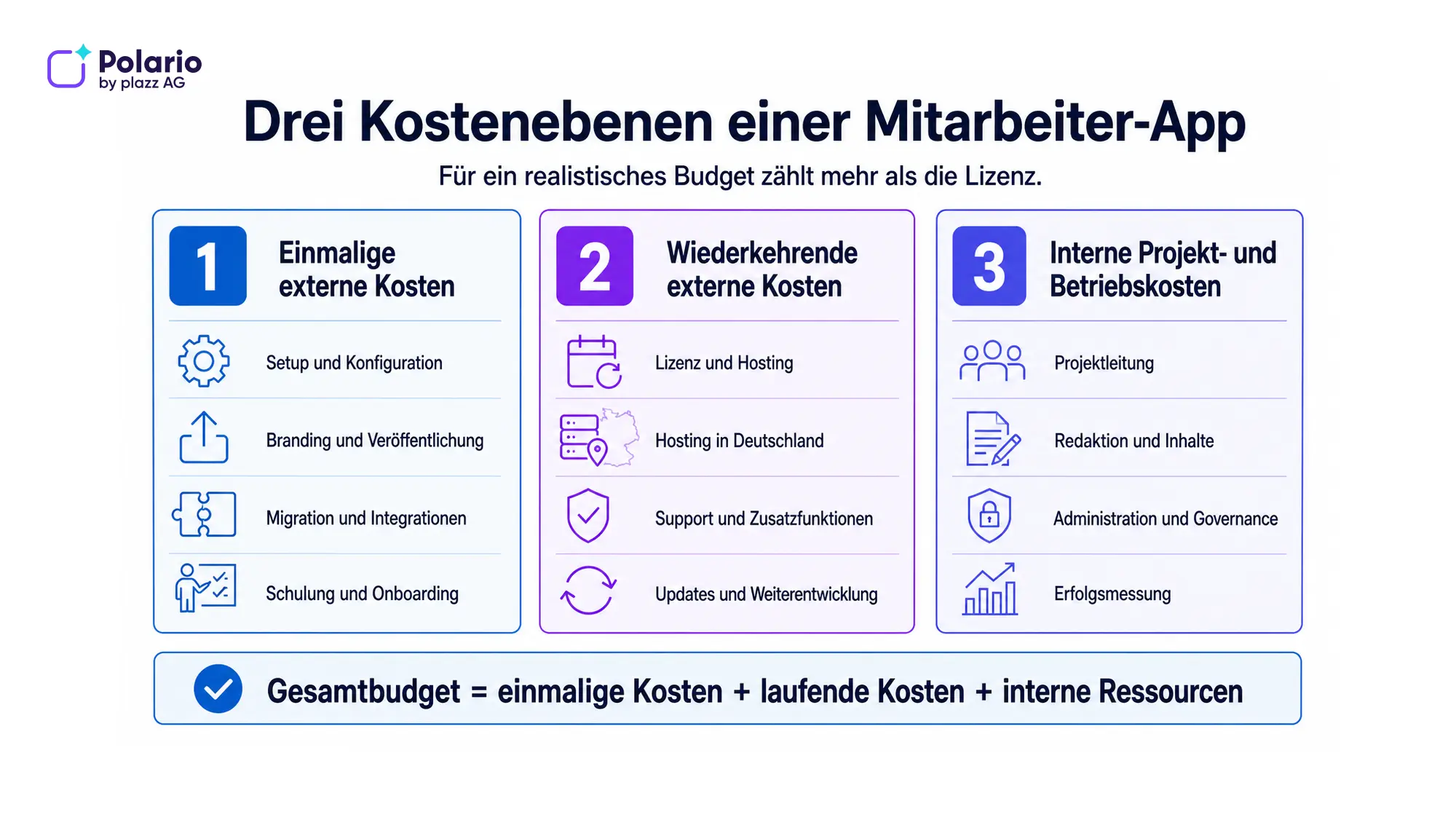
To ensure their cost estimates are robust, companies should distinguish between three levels:
- 1. One-off external costs: set-up, configuration, branding, data migration, integrations and training.
- 2. Recurring external costs: licence or usage fees, hosting, support and any additional features purchased.
- 3. Internal costs: project management, technical coordination, content creation, editing, moderation, communication and performance measurement.
The cheapest licence is therefore not automatically the most cost-effective solution. The decisive factors are the total costs incurred over the planned period of use and whether the solution fulfils the defined communication requirements.
What pricing models are available?
Price per user per month
With this model, the recurring fee is based on the number of licensed or active users. The price per person often decreases as the number of users increases. Before making a comparison, it is important to clarify who counts as a user and how new sign-ups, cancellations, seasonal staff or inactive accounts are billed.
Package price or tiered pricing
A provider can bundle user groups or feature sets into packages. This simplifies planning if the organisation falls within a defined size category. It is important to check what happens if a tier is exceeded.
Platform or basic fee
Some models combine a fixed monthly basic fee with costs that depend on usage or modules. This means that hosting, administration or a specific basic package may already be covered.
Pricing by module or function
Core functions are supplemented by paid modules. Typical additional features may include translation, single sign-on, advanced integrations, live streaming or specialised services. The specific offer always takes precedence.
Bespoke white-label or custom app
A standalone app with its own name, app icon, store listing and advanced customisation options is usually priced on a project-by-project basis. In addition to the licence fee, there may be additional costs for branding, publication, technical requirements and bespoke development.
Custom development rather than SaaS
When developing a solution in-house, the company is not only responsible for the initial development. It must also take care of product management, quality assurance, hosting, security, app store maintenance, updates, bug fixing and further development. A comparison with a SaaS solution should therefore be made over a period of several years.
How much does Polario cost as an employee app?
Polario has announced a starting price of 1.90 euros per user per month for the Hub version of its staff or community app. According to the pricing page, the offer is aimed at small and medium-sized organisations or communities with up to 500 users and is valid for a period of twelve months. For more than 500 users, the price per user decreases in line with the stated pricing structure.
The custom version is quoted on request. It includes a standalone white-label app and is suitable for organisations with specific branding and publishing requirements. Premium features and white-labelling may incur additional costs. (Polario prices and versions)
These figures are starting points and do not represent a flat-rate total price for every project. Polario also describes its commercial model as a combination of a one-off set-up and onboarding fee and a recurring monthly usage fee. Modules, integrations, support, service and customised extensions all influence the specific quote. (Polario platform)


An overview of the key cost factors
| Cost factor | Typical statement | What companies should clarify |
|---|---|---|
|
Number of users |
per user, tier or package |
Who needs access, and how are users counted? |
|
Hosting and data centre location |
usually included in the licence; in some cases, this depends on the package |
Where is the data processed, which subcontractors are involved, and what evidence is available? |
|
Deployment model |
Hub, standard app or custom app |
Is an existing app environment sufficient, or is a dedicated store app required? |
|
Scope of functions |
Basis plus Module |
Which functions address a proven use case? |
|
Setup and configuration |
one-off |
What structures, roles, groups and areas need to be put in place? |
|
Branding |
one-off or package-dependent |
What are the requirements regarding colours, fonts, the app name and the store listing? |
|
Data transfer |
one-off or charged at cost |
Which users, documents and content will be migrated? |
|
Integration |
one-off plus potential operation |
What systems, interfaces and data flows are required? |
|
Identity and Registration |
depending on the project or package |
Are SSO, SAML, directory services or alternative login methods required? |
|
Introduction and training |
one-off plus internal time |
Which target groups, key influencers and administrators are being prepared? |
|
Support and Service |
included, on a sliding scale or separate |
What response times and services are included? |
|
Content and Editorial Team |
mainly internal costs |
Who creates, checks, publishes and updates content? |
|
Operation and optimisation |
ongoing |
Who analyses usage and develops the platform further? |
A list of requirements for the staff app prevents features from being purchased as a precautionary measure, even though there is no specific need for them.

Requirements of an employee app
Learn about the requirements of an employee app and what needs to be considered in order to realize them in the best possible way.
One-off costs before launch
Concept development and project management
Before the technical set-up can take place, objectives, target groups, use cases, responsibilities and success criteria must be clarified. This work is carried out internally or is partly supported by consultants.
Layout and Information Architecture
Menus, home pages, news sections, groups, roles and visibility settings must be tailored to the organisation. The more complex the structure of sites, companies and target groups, the greater the effort required for configuration.
Branding and app release
An app within an existing hub environment usually requires less customisation and effort to publish than a standalone white-label app. With a custom app, developer accounts, store materials and approval processes must also be taken into account.
Migration and data import
User accounts, contacts, documents and existing content may need to be cleaned up, organised and imported. Transferring old content without checking it not only increases costs but also impairs the user experience.
Interfaces and registration
HR systems, Microsoft 365, SharePoint, directory services, calendars or other specialist applications can be integrated. Each integration should be assessed in terms of data source, update direction, permissions, error handling and operation.
Training and launch communications
Administrators, editors, managers and support staff require different levels of preparation. A structured plan for rolling out an employee app helps to budget for technical and communication tasks together.

Ongoing costs following the launch
Licence and hosting
With SaaS offerings, usage, hosting and product updates are often covered by a recurring fee. Companies should check which services are actually included and which are charged for separately.
Support und Customer Success
The following points need to be clarified: support hours, contact channels, response times, available training materials and support with future developments. A low licence fee may be offset by high internal support costs.
Editorial and Community Management
An employee app requires a regular supply of relevant content. This involves planning topics, creating content, approving it, translating it, moderating it and updating it. These internal staff costs are often underestimated in budgets.
Governance and Administration
User accounts, roles, groups and former employees must be managed. Automated identity and HR integrations can reduce manual work, but may incur their own implementation and operational costs.
Optimisation and further development
Following the launch, usage, reach, search behaviour and feedback should be analysed. This may lead to new content, training programmes, integrations or features.
Why hosting in Germany is an important factor in terms of cost and choice
For many organisations, the hosting location is not merely a technical detail. Public sector bodies, regulated industries and companies handling sensitive employee data, in particular, take into account the data location, jurisdiction, subcontractors and security certifications as early as the provider selection stage.
Polario states that it operates its platform on servers in Germany. According to the published facts page, hosting takes place in the Google Cloud region in Frankfurt; data is therefore stored exclusively within the European Union. According to Polario, development and support also take place in Germany. (Polario Compliance), (Polario Facts)
Hosting in Germany can simplify procurement if a German or European data centre location is specified internally. However, the location alone does not address all data protection and security issues. Companies should also consider the following:
- what personal data is processed,
- who is the data controller and who is the data processor,
- which subcontractors and other service providers are involved,
- whether data processing or support access takes place in third countries,
- what technical and organisational measures are in place,
- how encryption, roles, logging and deletion are implemented,
- what evidence, certifications and contractual arrangements are in place.
The Federal Data Protection Commissioner points out that, when transferring personal data to third countries, additional requirements set out in Chapter V of the GDPR must be observed. The BSI identifies data location and jurisdiction as relevant transparency information when assessing cloud services. (BfDI: International Data Transfers), (BSI: Cloud Computing Compliance Criteria Catalogue)
How does German hosting affect the budget?
With a SaaS employee app, hosting is often included as part of the ongoing licence. Nevertheless, the quotation should clearly state which hosting, backup, security and availability services are included. Additional costs may arise if specific requirements are made regarding dedicated environments, bespoke security audits, enhanced service levels, interfaces or customer-specific documentation.
When comparing offers, the question “Hosting in Germany: yes or no?” is therefore not sufficient. It is better to draw up a verifiable list of requirements covering data location, data flows, subcontractors, security certifications, availability, backups, recovery and exit provisions.
How to calculate the total cost of ownership
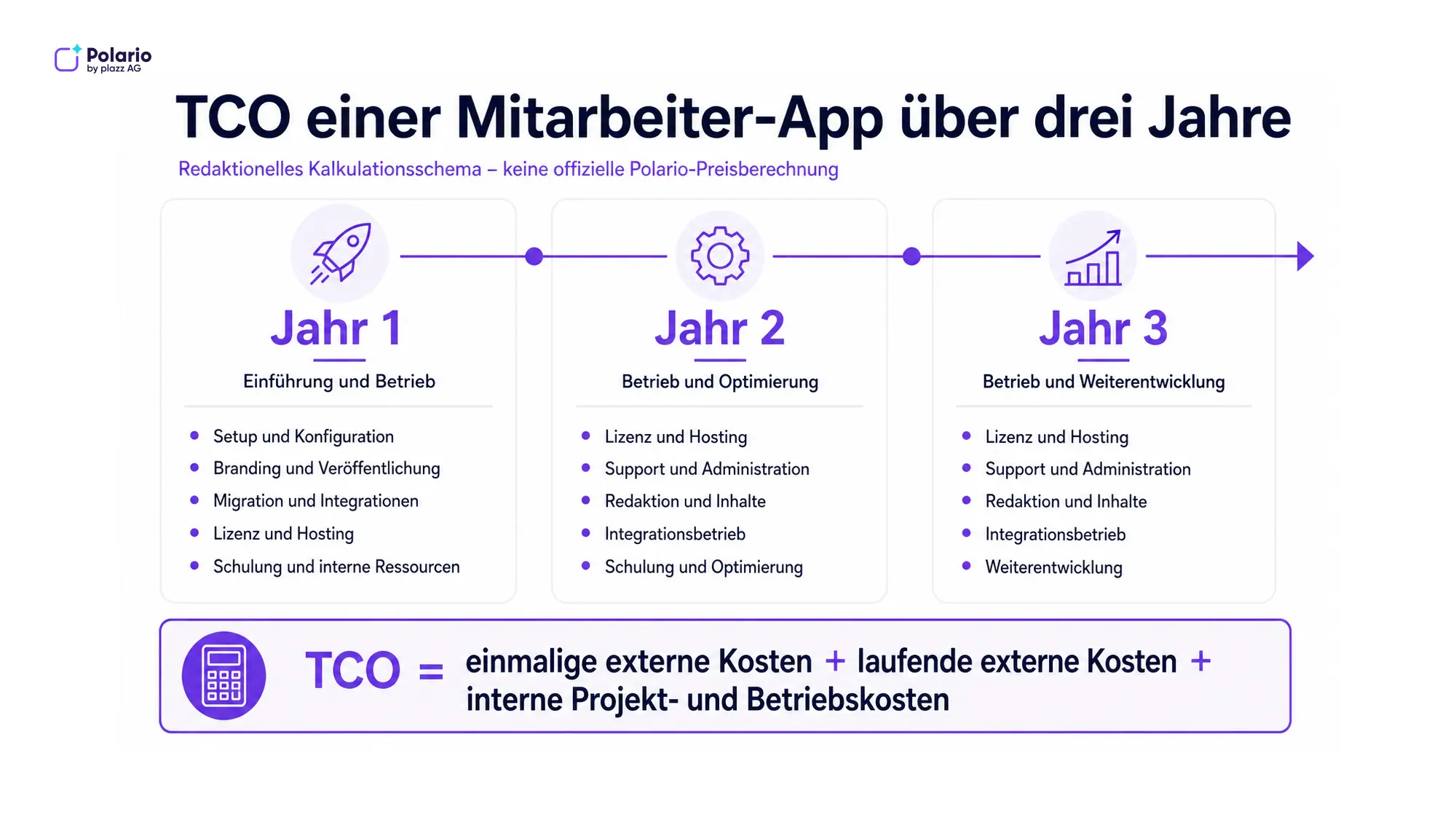
To ensure a fair comparison of quotes, it is advisable to use a standardised period for the comparison, for example three years.
TCO over three years = one-off external costs + recurring external costs over 36 months + internal project and operating costs
It is only on this basis that offers with different licence and service components can be meaningfully compared.
Which costs are often overlooked?
Unclear or rising user figures
Seasonal staff, subsidiaries, external staff and future growth may trigger a different pricing structure. The target scenario should not only take the current staffing levels into account.
Parallel systems
If newsletters, old intranets, messenger groups or other tools continue to run in parallel indefinitely, this will result in duplicate licence and maintenance costs. Before the roll-out, it should be clarified which channels are to be replaced, integrated or deliberately retained.
Lack of responsibility for content
Without a dedicated editorial team, the platform will become outdated. The necessary roles and time allocations should be established before procurement takes place.
Individual special requests
Customised developments do not just increase the initial cost; they can also make testing, maintenance and subsequent adjustments more expensive. Before undertaking any customisation, it should be assessed whether a configuration or process adjustment would suffice.
Poor data quality
Out-of-date user, location or organisational data complicates the import process and target group management. Data cleansing and responsibilities for leading systems should be included in the project planning.
Insufficient implementation budgets
Just because an app is technically ready doesn’t mean it will automatically be used. Communication, training, management buy-in and support all require time and funding.
Standard app or custom app: which is more cost-effective?
A hub or standard version is often the most cost-effective option when a quick launch, tried-and-tested features and predictable costs are the main priorities. A bespoke app may be the right choice if a standalone brand, a dedicated store presence or specific technical requirements are essential for your business.
| Decision | Hub app or standard app | Custom-App |
|---|---|---|
|
Introduction |
usually faster |
additional coordination and publication work |
|
Branding |
within the constraints of the available options |
Option to have a unique name, icon and store listing |
|
cost model |
more standardised |
depending on the project |
|
Customization |
mainly configuration and modules |
Further adjustments are possible |
|
Suitable for |
clearly defined standard requirements |
specific brand, integration or platform requirements |
The right option should not be chosen solely on the basis of appearance. The decisive factor is the verifiable benefit that the additional customisation brings.
How can you compare offers effectively?
Please ask all suppliers to use the same assumptions:
- 1. Number and type of user accounts
- 2. Contract term and price tiers
- 3. Basic functions included
- 4. Additional modules required
- 5. Scope of setup and configuration
- 6. Branding and Publication Model
- 7. Data migration and integrations
- 8. Authentication and user management
- 9. Training, Support and Service Levels
- 10. Costs for upgrades, updates and the end of the contract
The guide to choosing an employee app helps you evaluate providers not only on the basis of price, but also in terms of your requirements and long-term suitability.

The best employee app: how to make the right choice
The search ends here: Discover the top employee app for your company from our comparison of well-known providers!
When is an employee app worth the investment?
The costs should be weighed against the specific benefits. Potential economic effects arise, for example, from:
- less manual distribution of information,
- less maintenance required for parallel channels,
- faster access to documents and contact persons,
- fewer enquiries thanks to information that is easy to find,
- digitised forms or processes,
- faster communication with remote staff.
These effects vary from organisation to organisation and should not be promised across the board. Define measurable baseline figures and assess which changes can actually be attributed to the app. Our article shows how the ROI of an employee app can be assessed in a structured way.

Calculating the ROI of an employee app: formula, KPIs and example
How cost-effective is an employee app? Calculate ROI, TCO and payback period using formulas, KPIs and a clear example calculation.
Conclusion: Don’t just compare licence prices
The costs of an employee app comprise the licence, set-up, integrations, roll-out and ongoing operation. A price per user provides an initial point of reference, but is not sufficient to base an investment decision on.
Companies should therefore define standardised usage scenarios, compare all offers over the same period and take internal resources into account. This will reveal which solution is not only cost-effective initially, but can also be operated economically in the long term.
Would you like to know which Polario model suits your user numbers and requirements? Together, we’ll assess the feature set, deployment, integrations and implementation effort.
Sources and editorial basis
- Polario prices and versions: https://polario.app/de/preise/
- Polario Platform: https://polario.app/de/
- Polario pricing structure – Interview: https://polario.app/de/die-polario-preisstruktur-mit-stephan-rode/
- Polario Compliance: https://polario.app/de/compliance/
- Polario facts: https://polario.app/de/fakten/
- BfDI – International data transfers: https://www.bfdi.bund.de/DE/Fachthemen/Inhalte/Europa-Internationales/Internationaler_Datentransfer.html
- BSI – Cloud Computing Compliance Criteria Catalogue: https://www.bsi.bund.de/SharedDocs/Downloads/DE/BSI/Publikationen/Broschueren/C5_2020.pdf?__blob=publicationFile&v=3
- Requirements for an employee app: https://polario.app/de/anforderungen-mitarbeiter-app/
- Launch of an employee app: https://polario.app/de/einfuehrung-mitarbeiter-app/
- ROI of an employee app: https://polario.app/de/wie-der-roi-einer-mitarbeiter-app-effektiv-berechnet-wird/
Frequently asked questions (FAQ)
How much does an employee app cost per user?
This depends on the provider, the number of users, the package, the contract term and the range of features. Polario quotes a starting price of 1.90 euros per user per month for the Hub version. To arrive at a reliable calculation, setup costs, additional features and internal overheads must be factored in.
Are there any one-off set-up costs?
Many projects involve one-off costs for set-up, onboarding, branding, migration or integrations. The specific quote must clearly state which services are included.
Is a white-label app more expensive?
A standalone app typically involves more work in terms of branding, launch and project-specific requirements than a standardised hub solution. The cost depends on the provider and the scope of the project.
How many internal resources are required?
That depends on the organisation’s size and governance structure. At a minimum, responsibilities are required for project management, technical coordination, editorial work, user management and performance measurement. In complex organisations, local editors or community managers are also required.
Should billing be based on registered or active users?
Both models can be useful. It is important that the definition is clear and fits the organisation’s staffing structure. You should also review the rules governing inactive accounts, staff leaving the organisation, seasonal staff and growth.
What other contract costs should be checked?
Key factors include the contract term, renewal, minimum purchase requirements, price changes, the scope of support, data export, the end of the contract, and any costs for additional modules or services.
Is Polario hosted in Germany?
According to Polario, the platform is operated in Germany within the Google Cloud region in Frankfurt; data is stored exclusively within the EU. Organisations should review the relevant details, subcontractors, contractual documents and security certifications applicable to their project as part of the procurement process. (Polario Compliance), (Polario Facts)