Skip to content


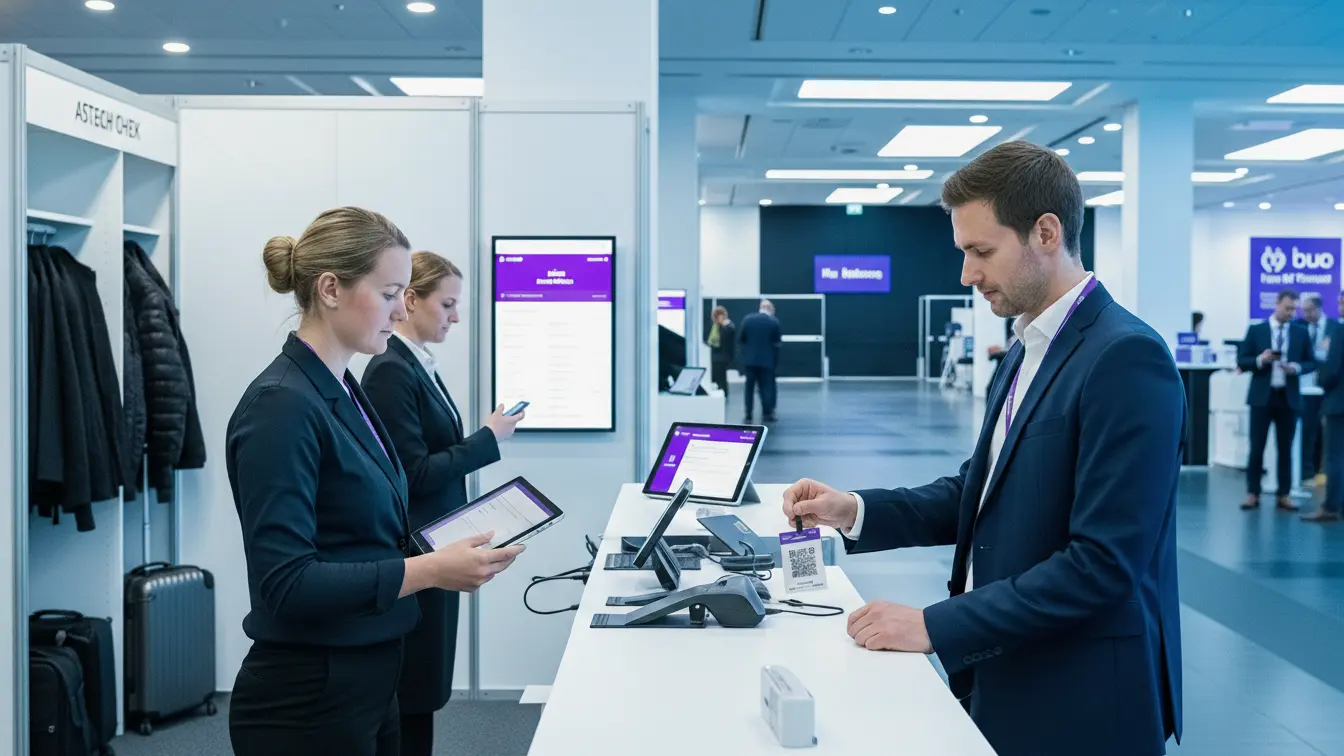

Events consist of a multitude of individual processes that are often considered separately: participant management, check-in, cloakroom, luggage, catering, session access or hotel coordination. Each of these steps is manageable when viewed individually. Taken together, however, they determine efficiency, cost structure and service quality.
Anyone who wants to digitise an event process today should not consider isolated functions, but rather think about smart event processes holistically. This is precisely where added value is created when Polario, the Check-in App and registr do not exist side by side, but are used as an interconnected system.
registr – Participant registration & management
Participant registration for events made easy: ✅ GDPR-compliant, ✅ corporate look, ✅ mobile-friendly. Request a demo now!
Check-In App
With the Check-In app, you can reduce waiting times, keep track of participant numbers in real time, and start events smoothly and professionally.
The basis for smart event processes
The digitisation of event processes begins with a platform that connects content, participant data and operational processes. A uniform content management system and open API interfaces allow different systems to be seamlessly integrated. The result is smart event processes that can be planned, controlled and implemented more efficiently.
The basis for smart event processes: Polario, Check-in App and registr.
The starting point for any smart event process is a clean database. This is created in registr. Here, participants are recorded, categorised, enriched with individual information and prepared for further processes. Hotel assignments, authorisations, sessions or special requirements are not isolated data records, but components of a consistent participant profile.
The Check-in App acts as an operational interface between digital planning and real-life events. The QR code from registr is scanned, making each participant uniquely identifiable. Crucially, this scan is not only used for admission, but can also trigger further process steps.
Polario, in turn, forms the interface where these processes become visible. This is where status changes are displayed, information is presented and operational processes are digitally mirrored. Polario is therefore not only an information platform, but also a control tool for smart event processes.
When registr, Check-in App and Polario are used together, they create a system that can digitise event processes in a structured manner.
Smart event processes using real-life use cases as examples
Digital cloakroom at SPOBIS
At SPOBIS, the cloakroom was not viewed as an isolated service point, but rather as an integral part of the overall event process. When coats or suitcases were handed in, the QR code on the participant badge was scanned. The item was then digitally assigned a number or storage location.
When collecting items, all that was required was another scan of the badge. Staff could immediately see where the relevant item was located. This completely eliminated the need for traditional cloakroom tokens.
The process became significantly more efficient: participants were able to drop off and pick up their items more quickly, while staff had an overview of allocation and storage at all times. A typical analogue process was thus transformed into a transparent, digital workflow.
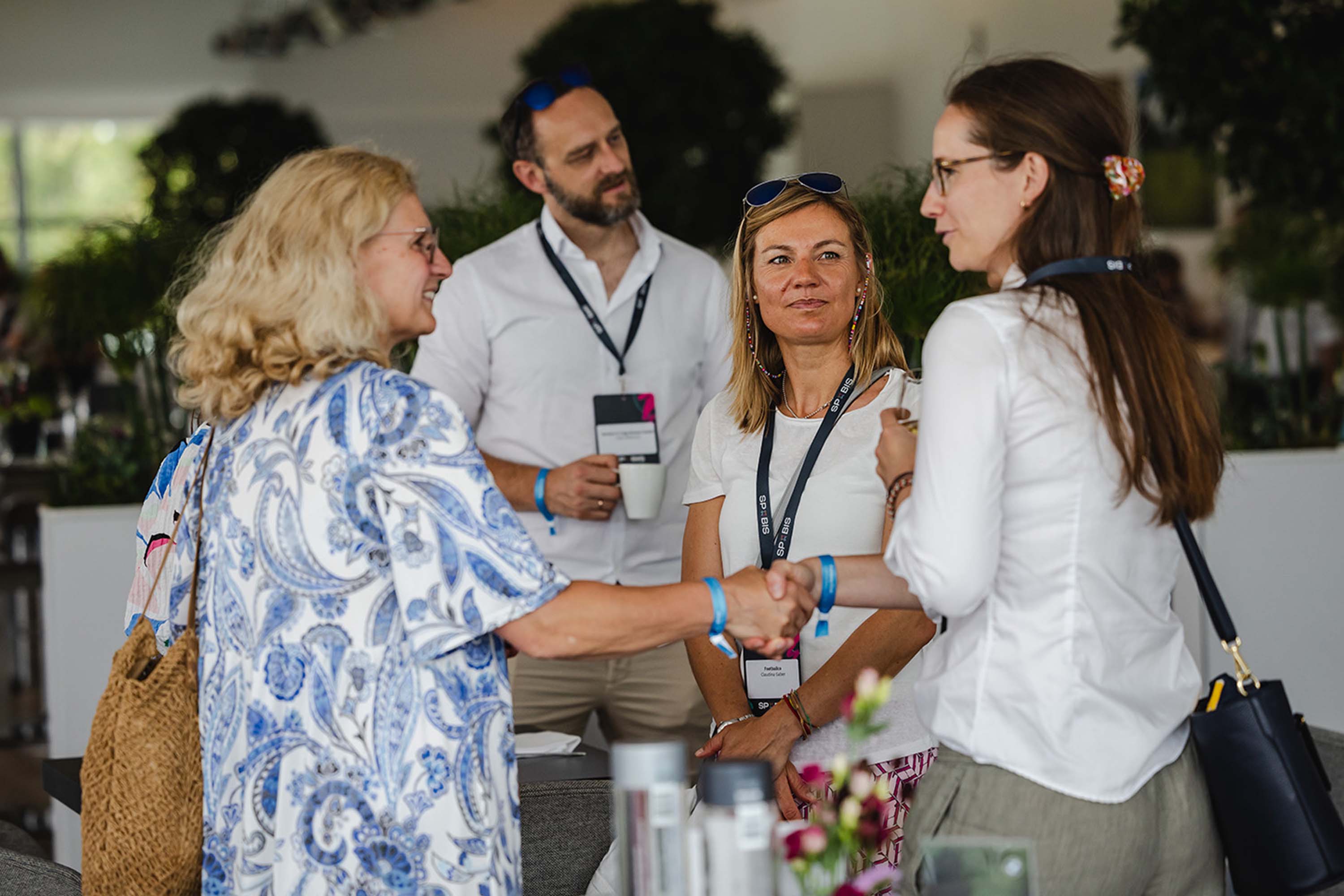
Interview: Efficient networking and exclusive knowledge exchange for the SPOBIS Club
Find out how the SPOBIS Club is redefining networking and knowledge sharing in the sports business with the Polario Community App.
Digital cloakroom lockers at KPMG
At KPMG, physical cloakroom tags were completely dispensed with. The respective compartment was displayed in the participant profile within Polario. The assignment was based on the data from the registration.
The event process was digitally mapped and made transparent for participants. The combination of registr, check-in app and Polario replaced analogue interim solutions.
Luggage and hotel allocation at Roland Berger in Lisbon
Another example shows how event processes can be digitised beyond the actual event site. In Lisbon, the QR code from the personal profile in Polario was used to display hotel information.
Hostesses scanned the code with the check-in app and immediately saw which hotel a participant was assigned to. The luggage was assigned directly to the correct vehicles and transported to the respective hotel.
Polario acted as the central information system, while registr provided the database and the check-in app enabled operational implementation. A logistical process was thus transformed into a smart event process with a clear data structure.
Understanding and taking members’ needs seriously
In addition to the examples mentioned, numerous other use cases can be implemented:
Loan items such as power banks or headsets can be scanned when issued via the check-in app and stored in the participant profile in Polario. When returned, the status is changed. Responsibilities are clearly documented.
Catering quotas can be managed through scanning processes. The data from the register defines authorisations or special requirements. The check-in app checks these in real time, while Polario documents the status.
Access zones, e.g. for masterclasses, workshops, VIP areas, partner areas, backstage, media or press areas, etc., can be controlled flexibly. Instead of physical wristbands, the check-in app is used to verify whether authorisation has been granted. Polario displays these authorisations and documents access.
Alle diese Use Cases basieren auf derselben Systemlogik. Sie sind klein, klar definiert und dennoch wirkungsvoll. In ihrer Gesamtheit formen sie smarte Eventprozesse.
Smart event processes designed holistically
Smart event processes do not only arise from classic usage scenarios. They also arise when products are deliberately rethought.
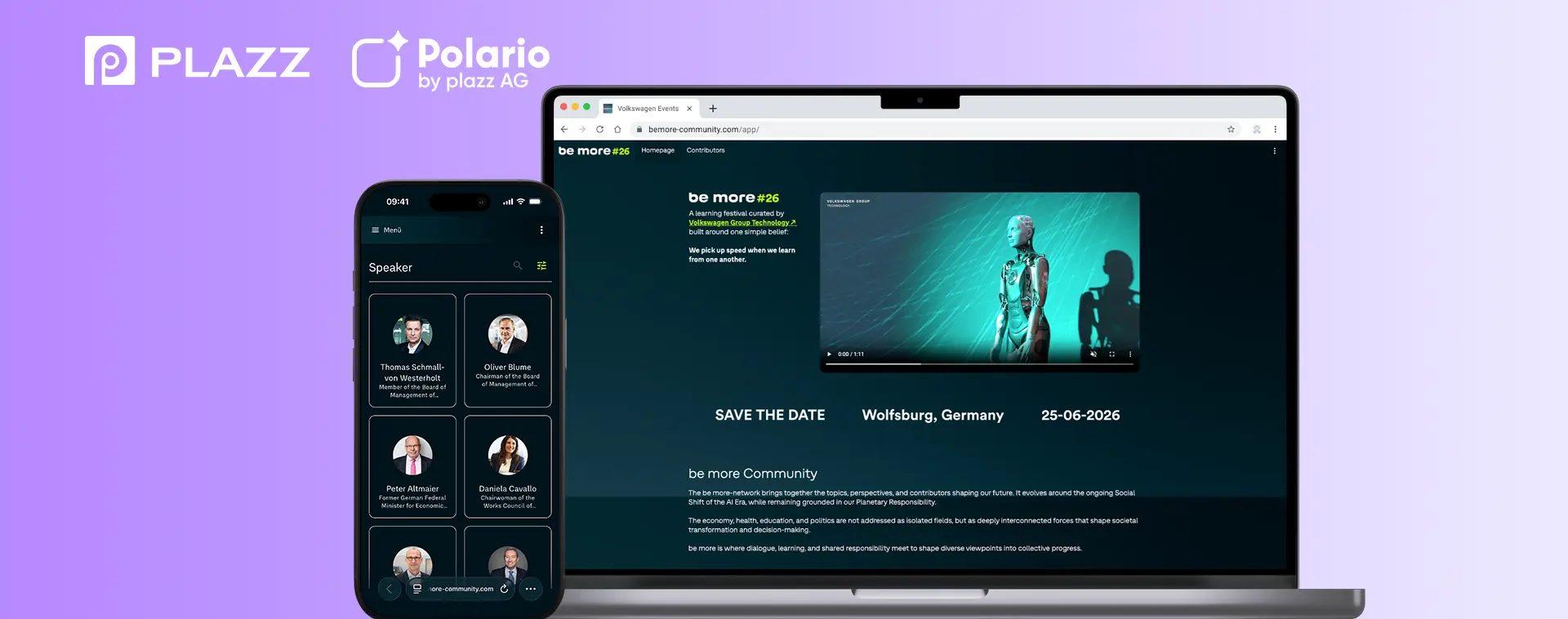
Examples of this include the German Real Estate Award and Volkswagen. Both used Polario primarily as a pre-event page rather than a traditional event app. All event information was displayed there centrally: agenda in calendar view, speaker section with profiles, detailed information on programme items. This was the case, for example, at the Volkswagen event “be more”. “be more” is the title of the Volkswagen Group Technology Leadership Summit, which focuses on the technological transformation of the brand.
The key advantage was the reduction in duplicate content maintenance. Content did not have to be created separately for the website and event platform. Polario took on the role of a structured, digital event interface even before the actual event took place.
Here, too, it is clear that smart event processes arise when systems are used not only functionally, but also strategically.
Why digitised event processes are becoming increasingly important
Events have become significantly more complex in recent years. Participants expect smooth processes, personalised content and a high level of service – at the same time, organisational requirements on the part of event organisers are increasing. In addition to classic tasks such as participant management and programme planning, logistics, security, data management and participant experience must also work together optimally today.
However, many of these processes are still organised manually or using separate systems. Lists, Excel spreadsheets or physical tags quickly lead to media breaks and increase organisational effort. Especially at larger events, such analogue processes can lead to waiting times, sources of error or unnecessary staffing requirements.
Digitising event processes therefore means more than just using individual tools. Rather, it is about linking processes and building on a common database. When participant data, content and operational processes are linked, event processes can be planned more efficiently, managed more transparently and scaled much more easily.
Especially at events with many participants, multiple programme items or complex logistics, it becomes clear what a difference digitised processes can make. Organisers gain a better overview of their processes, while participants benefit from a much smoother event experience.
Advantages of digital event processes
When event processes are digitised and conceived as a coherent system, there are tangible benefits for organisers, participants and event management.
Smart event processes ensure more efficient workflows, reduce manual steps and create a transparent database for operational decisions. At the same time, the participant experience is improved as waiting times are reduced and services can be better managed.
The main advantages of digital event processes:
- Relieving the burden on event staff through automated processes
- Reduction of waiting times at check-in, cloakroom or access controls
- Fewer errors thanks to clear digital assignments
- Transparent processes for participants and organisers
- Scalable event organisation even with large numbers of participants
You are currently viewing a placeholder content from YouTube. To access the actual content, click the button below. Please note that doing so will share data with third-party providers.
More InformationDigital processes as the key to smart event management
Smart event processes rarely arise from a single major feature. In practice, it is often many small digital process steps that, when taken together, make a big difference.
A QR code scan at check-in, a digitally controlled cloakroom or automated access controls for certain programme items may seem insignificant when viewed in isolation. But it is precisely these small optimisations that ensure that an event runs much more smoothly behind the scenes.
The advantage of such digitised process steps is that they can improve individual procedures in a targeted manner without completely changing existing structures. Every digitised event process ensures that information is available exactly where it is needed – whether at the entrance, in logistics or in the management of programme items.
When several of these processes are linked together, a consistent digital event structure is created step by step. Participants move through the event more quickly, organisational processes become more transparent, and organisers maintain an overview of their processes at all times.
This is how many small process improvements result in stable, scalable event sequences that benefit both organisers and participants.
Conclusion
Digitising event processes means creating connections. A single scan does not digitise an event process. Only when regist structures the data, the check-in app triggers processes and Polario makes information visible does a continuous digital workflow emerge.
Digital smart process steps are not an add-on, but the actual foundation. They connect individual functions to smart event processes that can be planned, controlled and implemented more efficiently.
Anyone wishing to digitise event processes should therefore think in terms of networked processes rather than individual tools. It is precisely this interconnection that represents the real added value of modern event platforms.
Frequently asked questions (FAQ)
What does it mean to digitise event processes?
Digitising event processes means mapping and automating the organisational and operational procedures of an event using digital systems. This includes, for example, participant registration, check-in, access control, cloakroom processes and logistics procedures. The aim is to make processes more efficient, reduce errors and create a smooth event experience for participants and organisers.
Which event processes can be digitised?
Many processes related to an event can be supported digitally or mapped completely digitally. These include, among others:
- Participant registration and participant management
- Check-in and access control
- Cloakroom and luggage management
- Session and workshop access
- catering quotas
- Logistics processes such as hotel or shuttle assignments
Digitising these processes creates a structured and transparent event workflow.
What are the benefits of digitised event processes?
Digitised event processes help organisers to organise procedures more efficiently and make better use of resources. At the same time, participants benefit from a significantly more comfortable event experience.
The most important advantages include:
- Faster check-in and service point procedures
- fewer errors thanks to digital assignments
- Better overview of participants and event processes
- less organisational effort
- greater scalability for large events
How do QR codes work in digital event processes?
QR codes are often used at events as a unique identifier for participants. The code can be scanned during check-in, access control or service processes, for example. Scanning the code uniquely identifies a participant and automatically triggers or documents the corresponding event process.
For example, cloakroom spaces can be allocated, access rights checked or logistics processes controlled.
What role do Polario, registr and the check-in app play in digital event processes?
registr forms the basis for digital event processes, as participant data and event information are recorded here in a structured manner.
The check-in app connects this data with the real event environment. By scanning QR codes, participants can be identified and processes triggered.
Polario is the digital interface through which participants receive information and event processes become visible. Together, these components form a system that allows event processes to be digitised holistically.
Can digital event processes also be used before the event?
Yes, many event processes can already be digitally mapped before the actual event day. Platforms such as Polario can be used as a pre-event page, for example, where the agenda, speaker profiles and other event information are provided centrally.
This allows content to be managed efficiently and avoids duplicate content maintenance. At the same time, participants receive a structured overview of the programme before the event.