Skip to content





It is rarely possible to put a single monthly price on a community app. A standardised platform app can be relatively inexpensive to set up. A standalone white-label app, however, which includes interfaces, data migration and a bespoke implementation, is priced on a project-by-project basis. On top of this, there are internal costs for content, moderation and community management. The Polario Community App, for example, is available either as a ready-to-use hub or as a bespoke custom app.
In short: A community app, as a standardised SaaS solution, can cost anywhere from double-digit to low triple-digit monthly amounts. Organisational and enterprise platforms start at significantly higher prices, depending on the provider, or are priced on a bespoke basis. At Polario, the Community Hub starts at €1.90 per user per month for public use. However, for a fair comparison, the total cost of ownership must include set-up, the app model, integrations, support and internal operations.
This article explains the key pricing models, provides current public pricing examples and sets out a three-year TCO calculation method. The prices quoted are published starting points, not binding offers. The scope of services, number of users, contract terms, currency, taxes and the specific provider’s offer are the determining factors.
Why prices for community apps vary so much
The term ‘community app’ covers a wide range of different solutions. A creator platform with a generic provider app has a different pricing model to a bespoke app for an association with several sub-organisations, a CRM integration and its own store presence.
The biggest differences arise from five fundamental decisions:
- 1. Platform app or dedicated app: Do members use an app provided by the service provider or a standalone app developed by the organisation?
- 2. Standard or customisation: Are the existing modules sufficient, or are bespoke functions and workflows required?
- 3. Number of users and organisation size: Are 200, 2,000 or 20,000 accounts being managed – and are there regions, committees or parallel communities?
- 4. System architecture: Do you need to integrate CRM, membership management, an identity provider, event management or a payment provider?
- 5. Scope of service: Does your own team maintain the platform, or does the provider handle configuration, migration, training and ongoing services?
When comparing community app providers, one should therefore take into account not only features but also the deployment and operating model.

A comparison of community app providers: Which platform is right for your organisation?
A comparison of six community app providers: use cases, apps, branding, integrations, hosting and pricing. Find the right platform for you.
What pricing models are available for community apps?
Price per user per month
Under this model, the monthly or annual licence fee depends on the number of licensed, registered or active users. The offer must specify which definition applies. Other matters to be clarified include guest access, inactive accounts, seasonal fluctuations and tiered pricing as the number of users increases.
This model is easy to plan for if the number of members is known. In the event of strong growth, it should be checked whether the unit price falls or whether the total costs rise linearly.
Fixed platform price
Some self-service platforms charge a fixed monthly or annual fee for a package. This includes certain features, administration licences, automations or storage limits. Additional modules and higher quotas result in a different pricing tier.
A fixed price is not automatically independent of the size of the community. Limits on contacts, emails, administrators, groups, live streams or transactions may determine the tier actually required.
Package and tiered model
Providers bundle user quotas and features into packages. A basic package might, for example, include a web platform and a standard app, whilst single sign-on, APIs, audit logs, sub-organisations or a dedicated Customer Success Manager are reserved for higher tiers.
When making a comparison, it is therefore not the name of the package that matters, but which essential requirements it covers.
Tailored enterprise solution
For complex organisations, licensing and services are calculated on a case-by-case basis according to the number of users, modules, organisational structure, security requirements, integrations and support. The fact that a price is not publicly available does not necessarily mean higher costs; however, it does prevent immediate budget planning without a quotation process.
White-label or custom app
A standalone app with its own name, app icon, app store description and extended branding is often offered separately. In addition to licensing and set-up costs, there may be costs associated with design, app store publication, developer accounts, releases and customer-specific customisations.
Polario’s pricing overview distinguishes between the Hub, which is available immediately, and a bespoke custom app. This distinction is also important with other providers: mobile access via the general platform app is not the same as having your own app in the Apple App Store and Google Play Store.
Which cost categories should be included in the budget?
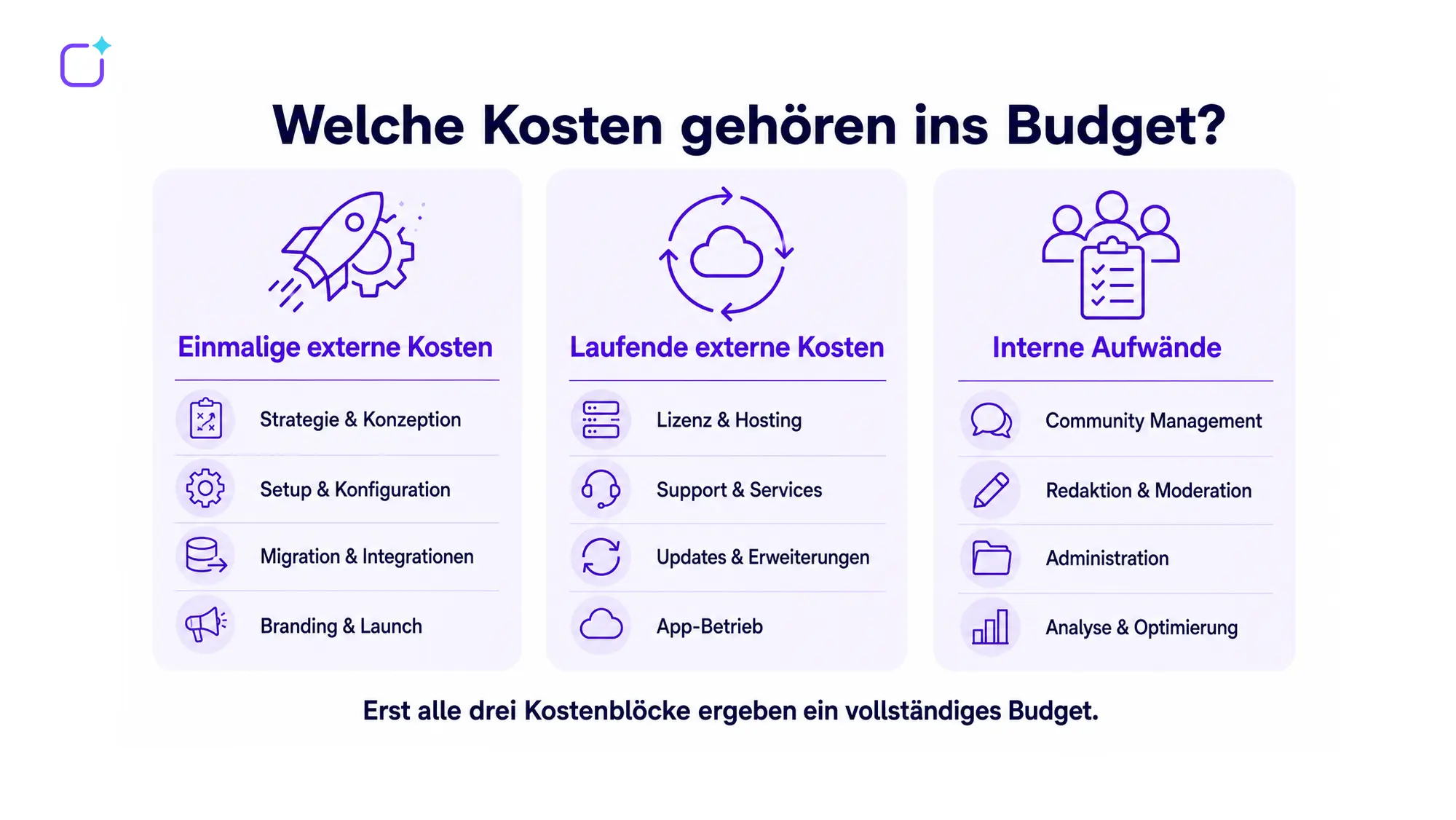
A robust cost calculation distinguishes between one-off external costs, recurring external costs and internal costs.
Strategy and Concept
Before configuration can take place, target groups, objectives, roles, content and key performance indicators must be defined. If this work is carried out with external support, workshop and consultancy costs will be incurred. If it is carried out internally, it will require working time from the community management, communications, IT, data protection and, where applicable, membership administration teams.
Setup and configuration
The setup includes the client, navigation, modules, groups, roles, permissions, design and basic settings. With a standardised platform, some of these may be included in the package. Complex structures or multiple communities increase the workload. Defining a process for planning and implementation at an early stage makes it easier to compare internal and external services in the quotation.
Branding and app release
A platform app usually requires less effort to set up. With a custom app, you also need to provide an app name, icon, screenshots, store descriptions, developer accounts and go through approval processes. Any subsequent changes may need to go through the store’s review process again.
Data migration and member import
Migrating profiles, groups, documents and historical content involves work in terms of data cleansing, mapping, testing and approval. A simple CSV file is more cost-effective than multiple inconsistent data sources containing duplicates and missing consents.
Interfaces and single sign-on
Integrations link the community app, for example, to CRM systems, membership management, newsletters, event management or identity providers. The costs depend not only on the existing API. Other relevant factors include data mapping, authentication, error handling, testing, operation and subsequent customisations.
Polario describes possible technical components on the API and Integrations page.
Content and Launch
An empty community does not generate activity. Before launch, information pages, news, groups, events, documents and onboarding content are required. In addition, there is the need for launch communications, a pilot group, moderation rules and, where appropriate, an activation campaign.
Training and change management
Administrators, editors, group leaders and moderators require different types of training. In decentralised organisations, sub-organisations or volunteers must be involved. It is important to check which workshops are included in the programme.
Licence, hosting and updates
With SaaS solutions, platform usage, hosting and product updates are typically covered by the recurring fee. Check which users, modules, and storage, email or streaming quotas are included, and which incur additional costs.
Support und Customer Success
A support portal or knowledge base is not the same as having a dedicated project contact. Costs may vary depending on the support channel, response time, service level, uptime and strategic support.
Internal community management
Following the launch, there will be ongoing internal costs associated with topic planning, content creation, moderation, member enquiries, data maintenance, events, analysis and optimisation. These staff costs are often higher than expected and should be included in the TCO.
How much does Polario cost as a community app?
Polario has announced a starting price of 1.90 euros per user per month for the Community Hub. The package is aimed at small and medium-sized communities with up to 500 users, has a term of twelve months and includes a web app, a native app within the Polario Hub, basic features and API access. According to the provider, for communities with more than 500 users, the price per user decreases in line with the tiered pricing structure.
The custom version is priced on a case-by-case basis. It includes a standalone white-label app with its own app icon, name and store listing. Premium features, extended white-labelling, set-up, integrations, services and bespoke development may incur additional costs. The specific quote will be decisive. (Polario prices and versions)
What prices do other community app providers publish?
Public prices can only be compared to a limited extent. A self-service tariff without a dedicated brand app serves a different purpose to a managed platform with white labelling, CRM integration and complex roles.
| Supplier | Published price anchor | Important context |
|---|---|---|
|
Polario |
Starting from €1.90 per user per month |
Up to 500 users; web app and native Hub app; custom app on request |
|
Circle |
Professional: US$89 per month; Business: US$199 per month |
Circle Plus, with an optional branded app, is priced on a case-by-case basis |
|
Mighty Networks |
Launch: US$79 per month; Scale: US$179 per month |
Custom-branded apps are included in Mighty Pro at a bespoke price |
|
Hivebrite |
Core from US$895 per month; Flex from US$1,995 per month, billed annually |
A branded mobile app and other add-ons are offered separately |
|
tixxt |
Price on request |
Packages differ in terms of user quotas, features, integrations and hosting models |
|
Connact |
Price overview or price at the time of booking |
According to the provider, the price depends, amongst other things, on the package and the number of members |
All information was checked on the official provider websites on 10 August 2026. US dollar prices have not been converted into euros, as exchange rates, taxes and billing terms would distort the comparison.
No ranking should be inferred from the table. Rather, it illustrates three market models: cost-effective self-service, a user-based organisational platform, and individually priced enterprise or white-label solutions.
How to calculate the total cost of ownership over three years
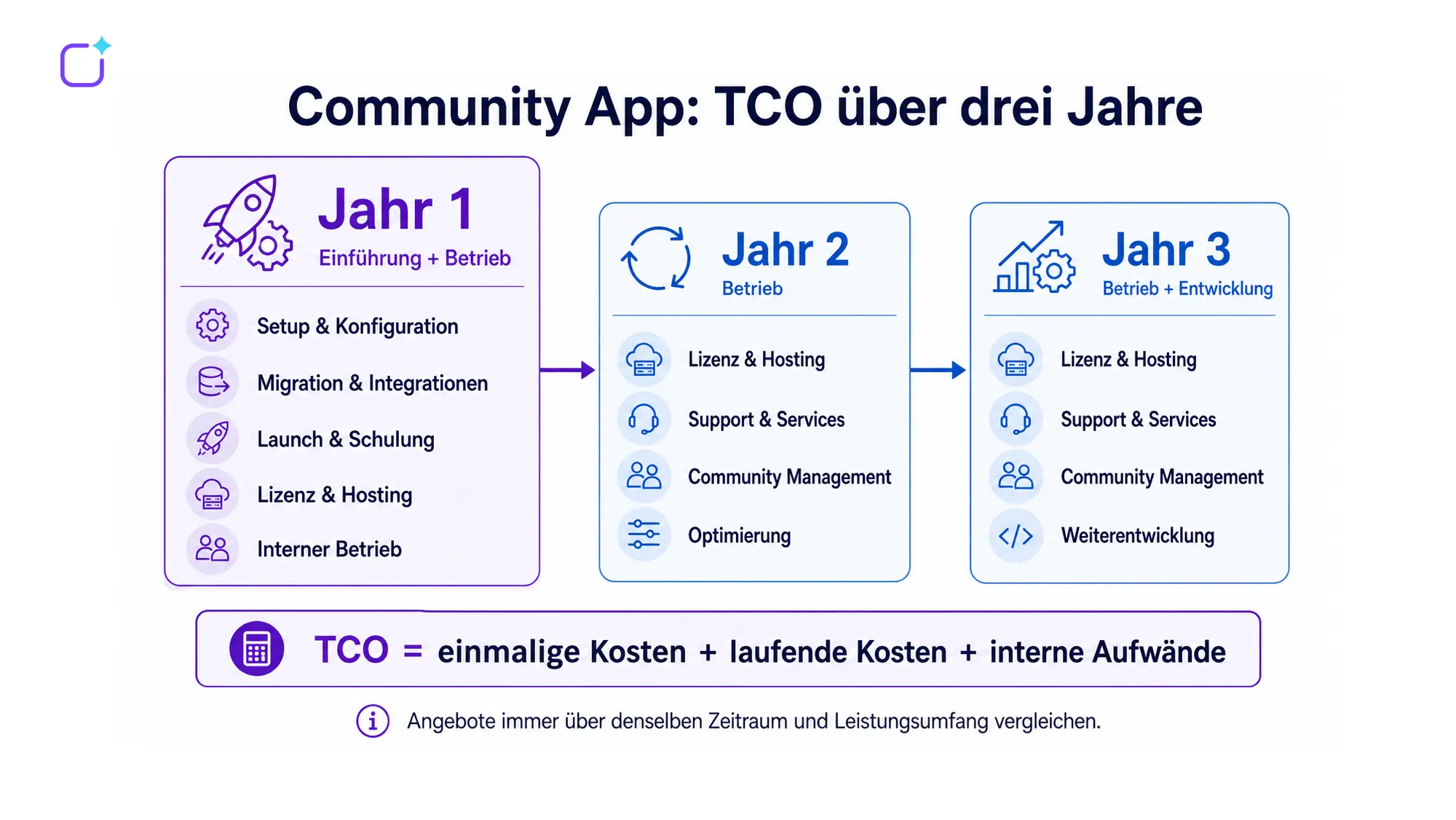
To ensure a fair comparison of quotes, it is advisable to use a standardised assessment period. A three-year period provides a better picture of the initial set-up and ongoing operation than a single monthly price.
TCO over three years = one-off external costs + recurring external costs over 36 months + internal project and operating costs
The following formula can be used for internal working hours:
Internal costs = hours per month × internal full-cost rate × 12 months
The full-cost rate should take into account not only the gross salary but also the cost calculation basis used within the organisation. If no reliable basis is available, the assumption should be clearly identified as an estimate.
Which costs are often overlooked?
Inactive accounts rather than an active community
A low price per user is of little value if a large proportion of accounts do not use the platform. In addition to the total costs, the price per monthly active member should therefore be taken into account.
Cost per active member = total monthly cost ÷ number of active members per month
Presentation and editorial continuity
A community needs regular opportunities for engagement. If content, events and discussions are only managed as an afterthought, the perceived value will decline. The level of community management required should be clarified before procurement takes place.
Additional tools will remain in place
If the newsletter, event management tool, file storage, chat and membership management continue to run as before, the new platform may deliver fewer savings than expected. The business case should specify which systems are to be replaced, supplemented or integrated.
App store and release processes
Creating your own custom app requires developer accounts, store materials and approvals. Changes to the app name, icon or technical requirements may involve additional work.
Growth and package limits
An increase in the number of members, emails, groups, administrators, storage space or livestream usage may necessitate a change of plan. Don’t just base your calculations on the current situation; factor in a realistic growth scenario as well.
Exit and Data Export
Switching to another provider also costs time and money. Data export, the end of the contract, archiving and migration should be clarified before the contract is signed.
How can the economic benefits be assessed?
A community app should not be justified solely on the basis of cost reduction. It can also improve engagement, participation, reach and knowledge transfer. Nevertheless, the decision requires measurable objectives.
Useful key figures include, for example:
- Activation rate by invitation,
- active members on a monthly and weekly basis,
- Proportion of target groups reached,
- Participation in groups, surveys and events,
- Time spent on mailings and data maintenance,
- Support enquiries that are answered using community knowledge,
- Renewal or retention rates for memberships,
- Number of valuable contacts, mentoring relationships or partnerships.
For an association, improving member retention may be more important financially than saving an hour’s work on the newsletter. For a customer community, the focus may be on avoiding support cases or increasing product usage. For an alumni network, activity, mentoring and events may be the key factors.
The strategy should therefore be established before choosing a platform. The guide ‘Building a Community’ and the overview of community platforms explore these conceptual issues in greater depth.

How associations and clubs build an active member community
Building a community within an association or club: practical explanations, strategies and association apps for active members.

Community platform: How to activate members in the long term
How to keep your community platform active in the long term: strategies, content, and measures for greater engagement and member retention.
Hub or custom app: Which option is more cost-effective?
A hub or platform app typically reduces implementation time and the effort involved in launching the app. It is a suitable option when a quick launch, existing core features and a manageable budget are more important than a fully independent store presence.
A custom app may be a good option if the app is intended to be clearly associated with the organisation, published under its own name and made more personalised. This branding benefit must be weighed against the higher set-up, publication and operational requirements.
Associations and member organisations should also check whether regional structures, events, directories and roles can already be mapped within the standard. Further information can be found on the Polario page about the Community App for associations.

App for associations
With an app for associations, you create simplified communication and offer your members a quick exchange.
Hosting in Germany as a pricing and procurement criterion
In professional communities, personal data, interests, roles, memberships and interactions are processed. The location of the data is therefore not merely a technical detail, but is often a factor in data protection assessments and procurement.
Hosting in Germany can simplify the coordination process, but it is no substitute for a proper audit. Among other things, information is required on subcontractors, data flows, backups, encryption, availability, data deletion and exit procedures. Specific requirements relating to dedicated environments, security audits, service levels or documentation may incur additional costs.
Polario outlines German hosting services and other security fundamentals in the area of compliance. When comparing quotes, the same requirements should be applied to all providers.
How to compare quotes properly
1. Use a standardised framework: Define users, administrators, groups, languages, storage and expected growth.
2. Identify essential features: Compare only the modules actually required across all offerings.
3. Separate one-off and ongoing costs: Do not mix setup, migration and development costs with monthly fees.
4. Standardise the app model: Do not directly compare the platform app with a bespoke white-label app.
5. Specify integrations: Describe data sources, direction, frequency, responsibility and operation.
6. Compare service levels: Document support hours, response times and personalised support.
7. Factor in internal work: Take into account community management, editorial work, administration and data protection.
8. Calculate the TCO over three years: Consolidate quoted prices, expected growth and internal costs.
Conclusion: The overall costs and benefits to the community are the key factors
The question “How much does a community app cost?” starts with the licence fee, but doesn’t end there. A standardised pricing plan can provide a quick and affordable way to get started. A bespoke app with integrations, custom branding and complex organisational structures requires a larger project budget.
A fair comparison therefore takes three aspects into account: the one-off set-up costs, the ongoing external platform operation, and the internal effort required to maintain an active community. Only the three-year TCO reveals which option is economically best suited to your own objectives.
Sources and editorial basis
- Polario prices and versions: https://polario.app/de/preise/
- Circle Pricing: https://circle.so/pricing
- Mighty Networks Pricing: https://www.mightynetworks.com/pricing/
- Hivebrite Pricing: https://hivebrite.io/pricing/
- tixxt Prices: https://www.tixxt.com/de/preise/
- Connact Prices: https://connact.app/preise
Frequently asked questions (FAQ)
How much does a community app cost per month?
The published prices range from double-digit self-service rates to enterprise platforms costing three or four figures in US dollars per month. Custom white-label apps are often priced on request. The scope of features and the level of service are not directly comparable.
How much does Polario cost as a community app?
According to the pricing page, the Polario Community Hub starts at €1.90 per user per month and is aimed at communities of up to 500 users. A tiered pricing structure applies for more than 500 users. The bespoke app, as well as premium features and project services, are priced separately.
Is a web app cheaper than a native app?
A web-based or platform app is often cheaper than a custom-branded native app. However, it all depends on the package: some providers combine web and mobile access, whilst offering their own app as an additional service.
What one-off costs are involved in the roll-out?
Typical one-off costs include design, set-up, branding, migration, integrations, training and launch support. For a bespoke app, app store preparation and, where applicable, custom development are also included.
What running costs are there in addition to the licence fee?
In addition, costs may be incurred for support, premium modules, interface operation, email or streaming quotas, and external services. Internally, costs are incurred for editorial work, moderation, administration, data maintenance and further development.
How do you calculate the TCO of a community app?
Add up all one-off external costs, the recurring external costs over the period under consideration, and the internal project and operating costs. When comparing quotes, a three-year period is usually more meaningful than a monthly amount.
Is it worth having your own white-label app?
A white-label app can be worthwhile if having your own store presence, brand loyalty and branded push notifications are of great value. For a quick start or a smaller community, a platform app may be more cost-effective.
Can funding be provided for the costs of a community app?
Depending on the federal state and the funding scheme, certain parts of a digitalisation project may be eligible for funding. The key factors are the company, the scope of the project, the timing and the type of cost. Ongoing SaaS fees are often excluded. Eligibility should be checked with the relevant authority before the project is commissioned.