Skip to content





Employee experience does not begin on the first day at work. It starts as early as the recruitment stage, shapes the onboarding process and continues through daily interactions, processes, digital tools, development opportunities and right up to the point of leaving the organisation. Companies cannot fully control this employee experience. However, they can consciously shape the conditions and key touchpoints.
In short: Employee Experience refers to the totality of perceptions and experiences that employees gain throughout their relationship with an employer. It is shaped by corporate culture, leadership, collaboration, working conditions, processes and technology. It can be improved by companies understanding key touchpoints, prioritising areas of friction, involving employees and measuring the impact of specific measures.
What does ‘Employee Experience’ mean?
Employee Experience, or EX for short, describes a person’s entire experience in their relationship with an employer. This includes first impressions prior to applying for a job, the selection and recruitment process, onboarding, day-to-day work, leadership and collaboration, development, and leaving the organisation.
Gallup defines Employee Experience as an employee’s complete journey with an organisation – from the first interaction right through to beyond leaving the organisation. Culture, day-to-day interactions and key moments in the employee life cycle shape how the employer is perceived. (Gallup: Employee Experience)
Employee experience is therefore more than just satisfaction. A person may be satisfied with individual aspects of their role yet still feel a lack of direction, a sense of belonging or opportunities for development. Similarly, employee experience cannot be reduced to benefits, an HR portal or a staff app. These elements influence the experience, but do not define it on their own.
Why is employee experience relevant?
The concept forces organisations to shift their perspective. Instead of viewing processes solely from the point of view of departments and systems, employee experience asks: how does an individual actually experience the entire process?
This perspective highlights gaps, for example:
- The employer brand promises openness, but information is only disseminated down the hierarchy.
- The recruitment process appears modern, but once an offer has been accepted, there is a lack of guidance and contacts.
- Numerous digital services are available in the office, but frontline workers have little access to them.
- Feedback is collected, but the results and the actions taken remain unclear.
- For simple tasks, employees have to be familiar with multiple systems, logins and areas of responsibility.
- Development opportunities are announced, yet learning programmes are hard to find or inaccessible.
A good employee experience cannot guarantee that employees will stay, remain engaged or work more productively. However, it creates clearer and more consistent conditions under which trust, participation and good work are more likely to flourish.
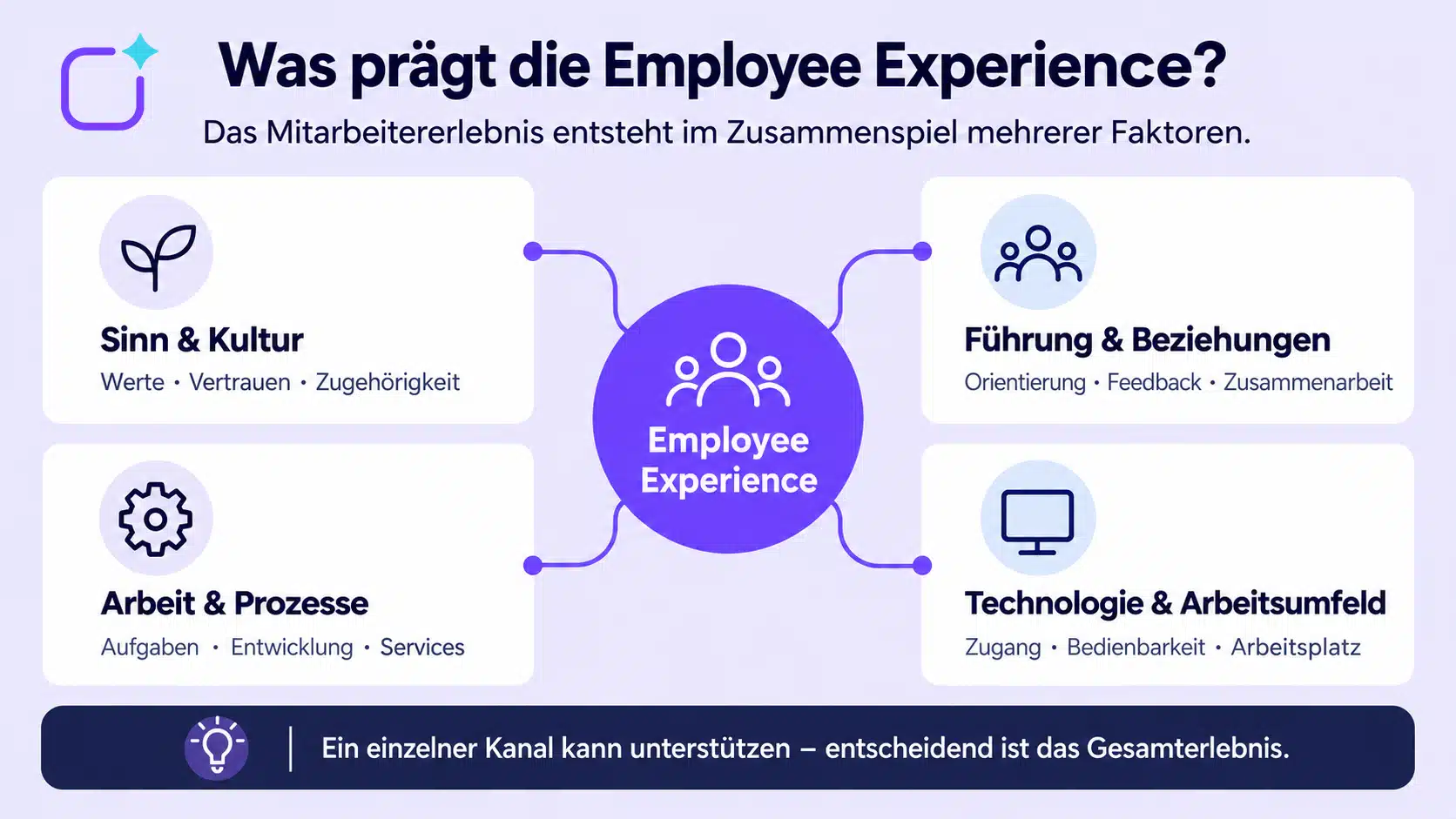
What factors shape the employee experience?
Purpose and corporate culture
Values, trust, fairness and a sense of belonging influence how employees perceive decisions and changes. The key factor is the alignment between what is communicated and what is experienced in day-to-day life. A glossy campaign cannot compensate for contradictory behaviour.
Leadership and Relationships
Managers provide direction, give feedback, resolve conflicts and shape teamwork. Gallup emphasises the particular importance of leadership experiences across the various stages of the employee life cycle. (Gallup: Manager Experience)
Work and Processes
Duties, scope for action, workload, development and internal services shape day-to-day life. Unclear responsibilities, unnecessary approvals or disjointed processes can undermine even an attractive corporate culture.
Technology and the working environment
Digital tools, devices, access points, physical workspaces and the availability of knowledge all influence the digital employee experience. Technology should simplify routine tasks and take account of different working situations. A concept designed for office workplaces does not automatically suit production, logistics, care or field work.
Employee experience, engagement and employer brand: what is the difference?
| Term | Key question | Perspective | Example |
|---|---|---|---|
|
Employee Experience |
How do employees perceive their relationship with their employer? |
The entire journey and day-to-day context |
Onboarding, leadership, processes, tools and development |
|
Employee Engagement |
How connected, motivated and involved do employees feel? |
Psychological response to work and the working environment |
Commitment, connection and initiative |
|
Digital Employee Experience |
What image of the employer should be cultivated internally and externally? |
Positioning and promises |
Employer values, communication and recruitment strategy |
|
Employee satisfaction |
How satisfied is a person with certain conditions? |
Assessment of individual or overall aspects |
Satisfaction with working hours, leadership or facilities |
Employee engagement is a potential state that is influenced by the working environment as experienced by employees. Gallup describes engagement as a response to the employee experience and the needs that are met or unmet within it. (Gallup: Employee Experience vs. Engagement)
Employer branding, on the other hand, articulates the employer’s promise. The employee experience reveals whether this promise is fulfilled in day-to-day working life. If there is a significant discrepancy between the employer’s external image and the actual experience, the employer brand loses credibility. The Polario article on employer branding and digital communication explores the link between the internal experience and external perceptions of the employer in greater depth.
What is the employee journey?
The Employee Journey maps an employee’s journey through defined phases and touchpoints. It makes the employee experience manageable without reducing the experience to a single metric.
Gallup distinguishes between seven phases of the employee life cycle:
- 1. Attracting talent:What expectations are created by the employer brand, recommendations and career information?
- 2. Recruiting: How transparent, fair and reliable is the selection process perceived to be? Even the period between signing the contract and starting work can be structured through a structured pre-boarding process.
- 3. Onboarding: Does the new employee receive guidance, contacts, knowledge and good access to the organisation? This section on the onboarding process in the ‘New Work’ world provides further context for the organisational and cultural induction.
- 4. Engagement:Do they understand the organisation’s goals, culture and their own role? Are opportunities for participation provided?
- 5. Enabling performance: Are tasks, processes, collaboration and resources designed in such a way as to enable good work?
- 6. Development: Is there clear support for learning, feedback, new perspectives and role changes?
- 7. Leaving: How are handover, knowledge transfer, access and the relationship managed after someone leaves?
The journey is not a standard, linear process. Employees change teams, locations or roles, return after a break, or experience reorganisations. That is why organisations must map out their actual target groups and pathways.
What are ‘Moments that Matter’?
‘Moments that Matter’ are touchpoints that have a particularly formative impact on an employee’s experience. These can include receiving a job offer, the first day at work, a change in leadership, a personal crisis, returning from parental leave, a promotion or a conflict.
Qualtrics describes Employee Experience Management as the deliberate analysis, design and evaluation of relevant experiences throughout the entire lifecycle. Key moments should not be assumed by HR alone, but identified in collaboration with employees. (Qualtrics: Employee Experience)
Meaningful prioritisation takes into account:
- the significance of the moment for the individual concerned,
- the number and type of target groups affected,
- the severity and frequency of existing friction,
- the organisation’s scope for influence,
- risks to trust, safety or equal treatment,
- the effort involved and the expected benefits of an improvement.
Not every touchpoint needs to be perfect or entirely digital. What matters is that particularly relevant moments are designed to be understandable, reliable and human.
How does Employee Experience fit in with Polario?
For Polario, Employee Experience is not a standalone product promise, but rather the overarching framework within which internal communication, digital employee communication and mobile access deliver their benefits.
Polario is particularly well-suited to the field of Digital Employee Experience. The Polario employee app can provide mobile access to news, notifications, pages, documents, calendars, directories, discussion forums and selected services. A social intranet can also serve as a digital hub for communication and knowledge sharing. Existing systems can be connected or made accessible via APIs and integrations.
Typical features contributing to the Employee Experience include:
- Orientation:bringing together relevant information, contacts and appointments in a single entry point;
- Reach: reaching frontline workers and staff without a dedicated PC workstation;
- Relevance: delivering content tailored to role, location, group or language;
- Engagement: facilitate feedback, surveys, comments and discussion;
- Access: link or integrate forms, HR services or specialist applications via mobile devices;
- Onboarding: provide new employees with plans, knowledge and key contacts;
- Consistency: consolidate communication and services across web and mobile platforms.
Polario does not replace leadership, work organisation, remuneration, staff development or specialised HR systems. Even a technically well-implemented employee app cannot, on its own, rectify a poor employee experience.
This follow-up article on the Employee Experience Platform explains when a unifying technology platform is appropriate and which features, integrations and governance issues should be taken into account.
Warum Frontline Worker eine eigene Perspektive benötigen
Viele Employee-Experience-Ansätze entstehen aus einer Büroperspektive: persönliches Notebook, Firmen-E-Mail, regelmäßige Meetings und Zugriff auf das Intranet. In Produktion, Logistik, Pflege, Filialen oder Außendienst gelten häufig andere Bedingungen.
Zu berücksichtigen sind beispielsweise:
- keine oder nur geteilte dienstliche Endgeräte,
- kein persönliches Firmenpostfach,
- begrenzte Zeit für digitale Inhalte während der Arbeit,
- wechselnde Schichten und Standorte,
- unterschiedliche Sprachen und digitale Vorkenntnisse,
- besondere Anforderungen an Sicherheit, Hygiene oder Netzabdeckung,
- klare Grenzen zwischen privater und beruflicher Gerätenutzung.
An inclusive employee experience therefore does not necessarily offer the same channel to everyone. It ensures that different groups of employees have comparable access to relevant information and services. Best practices for communicating with frontline workersdemonstrate how mobile access, relevant content and feedback channels can be combined. The specific implementation must be reviewed in collaboration with IT, data protection, information security and employee representative bodies.
An interview about the MVB staff app illustrates how this challenge plays out in a transport company: transport services, administration and maintenance all required a shared communication platform, even though their working conditions and digital touchpoints differ significantly from one another.
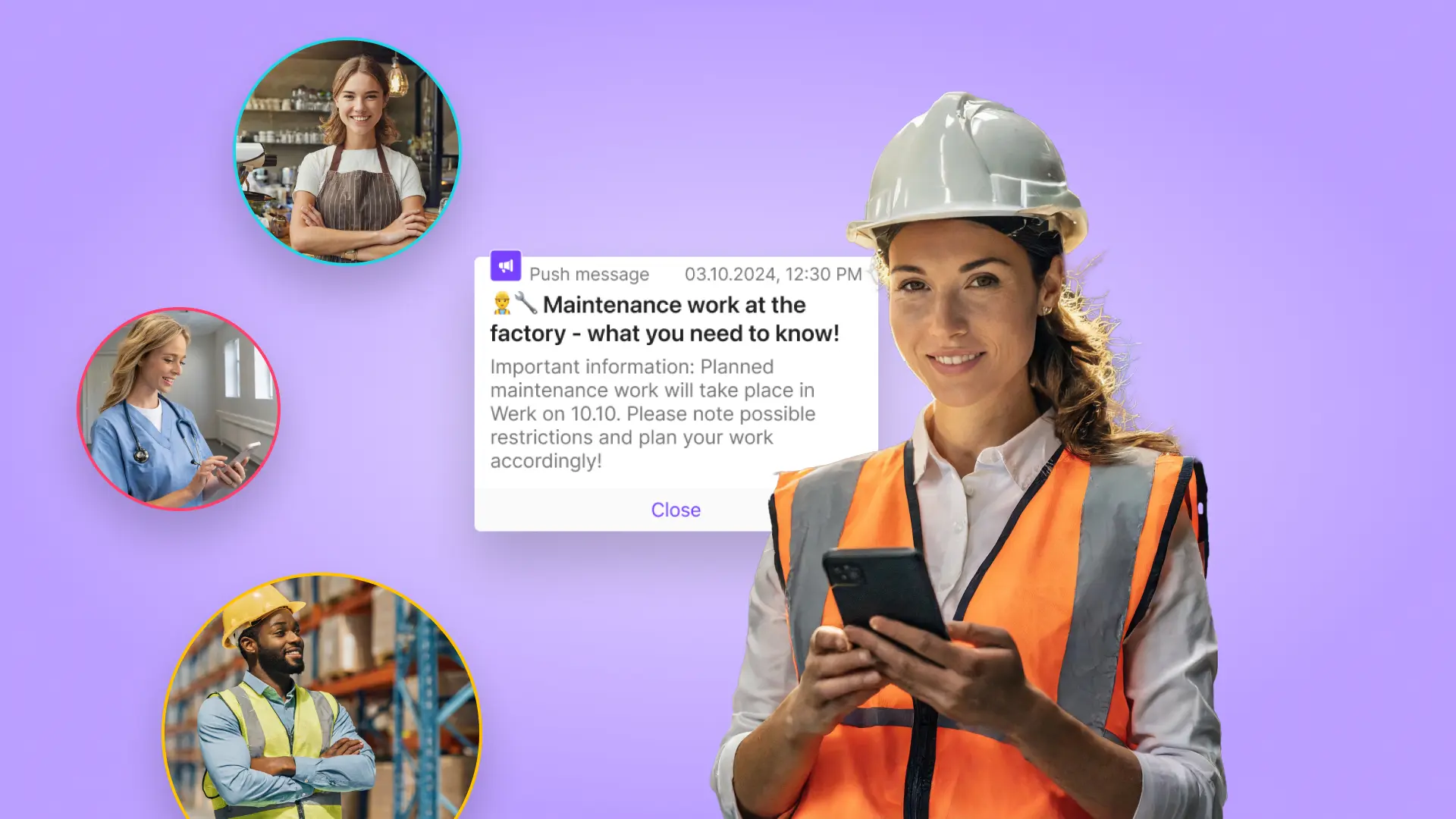
5 best practices for internal communication with frontline workers
Reach your frontline workers better! 5 smart best practices for fast, transparent & efficient internal communication.
Interview: Effective internal communication through the MVB employee app
With the Polario employee app, MVB improves internal communication, reduces information loss and increases operational efficiency.
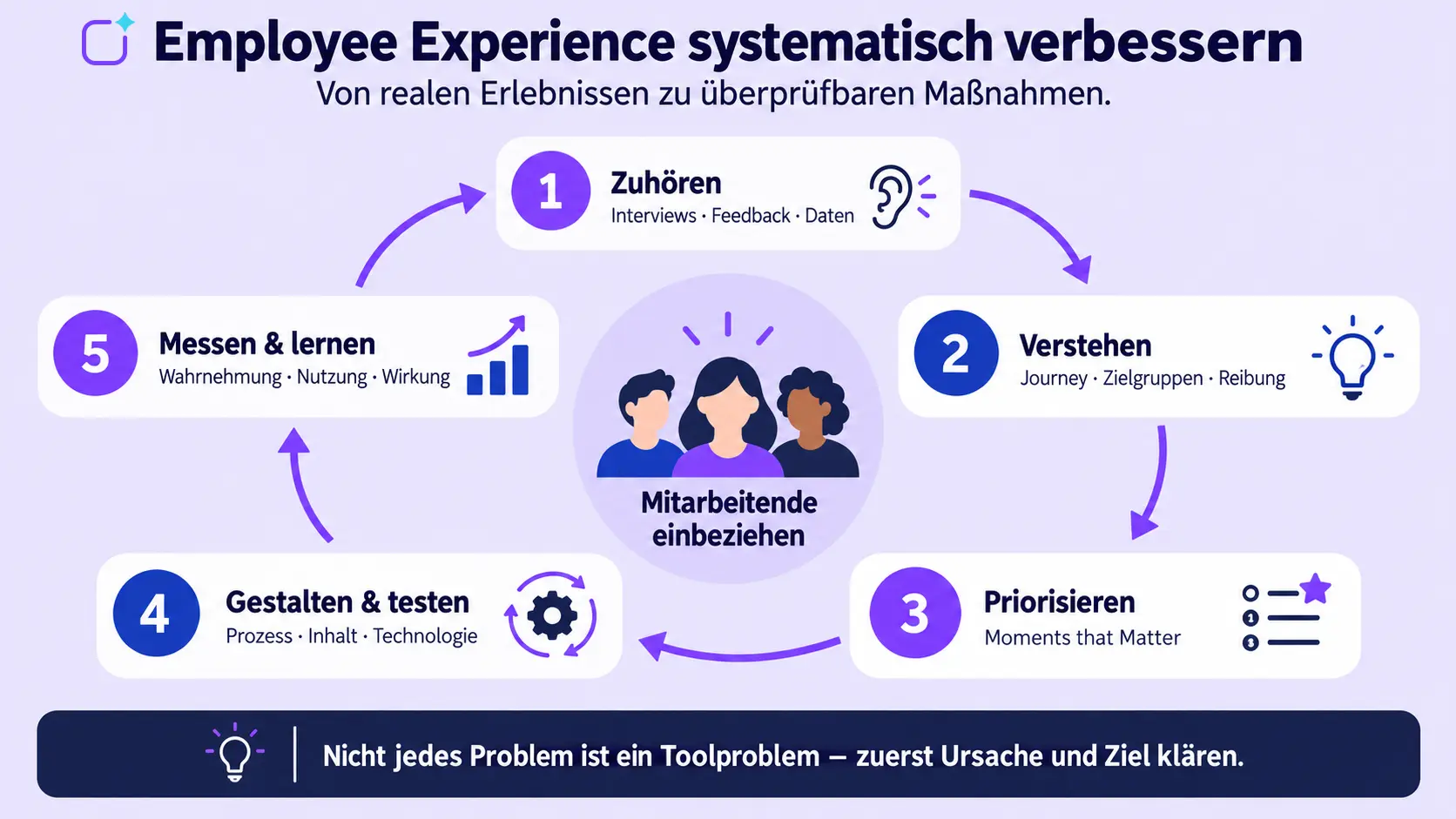
Systematically improving the employee experience
1. Listening
Combine interviews, workshops, existing feedback, support enquiries and relevant usage data. General satisfaction scores rarely reveal at which touchpoint a problem arises.
2. Understanding experiences and target audiences
Create employee journeys for specific groups of people and situations. A new care worker, a production worker on shift work and a manager working from home all experience the same organisation differently.
3. Moments that Matter priorisieren
Choose a few key moments that are of great significance and offer realistic scope for change. Avoid a long list of measures of equal importance without anyone assigned responsibility for them.
4. Address the causes rather than the symptoms
A communication problem can arise due to a lack of content, unclear processes, a lack of trust or an unsuitable channel. Only once the root cause has been analysed can a decision be made as to whether the process, leadership, content or technology needs to be changed.
5. Design and test together
Involve affected staff in prototypes, pilot schemes and user tests. Test real-world tasks under realistic conditions, rather than simply demonstrating functionality within the project team. For an employee app, the article ‘How the app is used – not just installed’ outlines key factors for building trust, encouraging adoption and ensuring long-term use.
6. Measuring impact and continuing to learn
Compare the baseline figure with the result. You should also document any undesirable side effects: for example, a faster digital process may create new barriers to access for certain target groups.
How can employee experience be measured?
Employee experience cannot be fully captured by a single metric. A combination of perception, observed behaviour, process quality and longer-term outcomes is the most effective approach.
| Exhibition floor | Examples | Key question | Limit |
|---|---|---|---|
|
Perception |
Surveys, interviews, focus groups |
How is a touchpoint experienced? |
Answers depend on context and trust | |
|
Usage |
Reach, search success, conversion rate |
Is an offering actually being used? |
Usage does not in itself prove a positive effect |
|
Process |
Duration, errors, abandonments, support cases |
Is a task completed more easily? |
Speed is not the only measure of quality |
|
Outcome |
Loyalty, turnover, absenteeism, word-of-mouth recommendations |
Is a relevant outcome changing? |
Numerous other factors come into play |
Gallup recommends examining key phases and moments through surveys, analytics, qualitative interviews and transition feedback. In doing so, organisations should not only look at average figures, but also understand the differences between target groups and locations. (Gallup: Measuring Employee Experience)
For digital touchpoints, the following metrics can also be helpful:
- Activation and usage rates by employee group,
- reach of key information,
- successful and unsuccessful search queries,
- time taken to find information,
- completion and abandonment rates for services,
- feedback on usability,
- number and type of support enquiries,
- perceived relevance of content.
Data collection requires clearly defined purposes, access rights and data protection rules. Key performance indicators must not be used to monitor individual performance or behaviour without a suitable basis.
Examples of specific improvement measures
Recruitment and pre-boarding
- Clearly outline expectations regarding the role and day-to-day work,
- provide details of the next steps and relevant contacts once the candidate has accepted the offer,
- tailor information to different locations and target groups,
- ensure that access is granted on a limited-time, data-minimal basis prior to the start date.
Onboarding
- Make induction plans, FAQs and contact details centrally accessible,
- combine organisational and social onboarding,
- involve managers and teams by assigning them clear tasks,
- seek feedback after key milestones.
An onboarding app can help to structure information and touchpoints. However, it is no substitute for a personal welcome or professional support.
Internal Communication
- Display content according to role, location and relevance,
- make important information available on mobile devices,
- facilitate queries and feedback,
- define editorial responsibilities and updating procedures.
The overview of internal communication tools explains which combination of channels, formats and tools is most appropriate.
Knowledge and Services
- structure common tasks from the employees’ perspective,
- use clear entry points rather than system names,
- integrate search, contacts and help functions,
- retain key systems and data sources.
Development and changing roles
- Make development opportunities and criteria transparent,
- Integrate learning opportunities into the workflow,
- Structure handover procedures when teams or roles change,
- Update access rights and content in good time.
Common mistakes in employee experience initiatives
Treating the employee experience as an HR campaign
The employee experience is shaped across virtually all areas. HR can coordinate, but leadership, communications, IT and line organisations must take responsibility.
Conduct surveys only
Feedback without any visible decisions undermines trust. Before a survey is carried out, it should be clear who will evaluate the results, prioritise actions and report on progress.
Start by choosing a piece of software straight away
Not every friction point is a tool-related issue. Without clearly defined target audiences, root causes and prioritised touchpoints, a new platform can quickly become just another channel.
Use average values for all
A good overall figure can mask significant problems at individual sites, in specific roles or amongst certain groups of employees. Segmentation must be meaningful, compliant with data protection regulations and free from discriminatory conclusions.
Frontline workers overlooked
If you only survey and test employees who are easily reachable digitally, you will get a distorted picture. Operational target groups must be actively involved using appropriate formats.
Confusing engagement with interaction
Likes, comments or app logins indicate activity, but do not automatically imply engagement, motivation or trust. Digital metrics need to be interpreted in a qualitative context.
Conclusion: Employee experience is a design challenge
Employee experience encompasses the entire relationship between employees and their employer. It is shaped by defining moments, but also by day-to-day routines: through leadership, collaboration, processes, communication, technology and working conditions.
This topic is relevant to Polario because digital communication and mobile access are key components of this experience. An employee app can improve guidance, reach, engagement and access to services – particularly for frontline workers. However, it remains a tool within a broader employee experience strategy.
Organisations should therefore not start with a platform, but with the experiences they wish to improve together with their employees.
Sources and editorial basis
- Gallup – Employee Experience: https://www.gallup.com/workplace/323573/employee-experience-and-workplace-culture.aspx
- Gallup – Employee Experience vs. Engagement: https://www.gallup.com/workplace/243578/employee-experience-engagement-difference.aspx
- Gallup – The role of managers: https://www.gallup.com/workplace/259469/why-managers-key-engagement.aspx
- Qualtrics – Employee Experience: https://www.qualtrics.com/de/articles/employee-experience/employee-experience/
- Microsoft – Employee Experience Platform: https://www.microsoft.com/de-de/microsoft-viva/employee-experience-platform
- Staff app: https://polario.app/de/mitarbeiter-app/
- Employee Experience Platform: https://polario.app/de/employee-experience-platform/
- Onboarding-App: https://polario.app/de/onboarding-app/
- API and Integration: https://polario.app/de/api-integration/
- Compliance: https://polario.app/de/compliance/
- Launch of an employee app: https://polario.app/de/einfuehrung-mitarbeiter-app/
Frequently asked questions (FAQ)
What is employee experience, explained simply?
Employee experience is the sum of all the perceptions and experiences that employees have with an employer. It ranges from the first point of contact, through onboarding and day-to-day work, to professional development and leaving the organisation.
What is the difference between employee experience and employee engagement?
Employee Experience refers to the overall work environment and journey as experienced by employees. Employee Engagement describes how connected, motivated and involved employees feel in response to these experiences. Engagement is therefore a possible state within the Employee Experience.
What makes for a good employee experience?
Key areas include a credible corporate culture, good leadership, fair processes, clear communication, collaboration, development, suitable working conditions and accessible digital resources. Which factors are particularly relevant depends on the target groups and working situations.
What is the employee journey?
The Employee Journey breaks down the relationship with the employer into phases and touchpoints. Typical phases include recruitment, hiring, onboarding, integration, enabling performance, development and leaving.
How can a company improve employee experience?
First, employees and data are taken into account, key touchpoints and friction points are identified, and a small number of ‘Moments that Matter’ are prioritised. Next, the root causes are addressed, solutions are tested with the relevant target groups, and their impact is measured.
How do you measure employee experience?
A combination of surveys, interviews, usage data, process metrics and longer-term results is advisable. A single metric cannot reliably reflect the entire employee experience.
What role does an employee app play?
An employee app can provide mobile access to communication, knowledge, collaboration and services. It therefore supports the digital employee experience, but does not replace leadership, culture, work design or specialised HR systems.
What is an employee experience platform?
An Employee Experience Platform connects digital touchpoints, content and services via a single point of access. It is a technological component of the employee experience. Depending on the provider, its scope ranges from communication to HR, feedback, learning and analytics functions.