Skip to content





Event app providers differ less in terms of basic functions such as the agenda, speaker profiles and push notifications than in their underlying business model. Some solutions are browser-based self-service apps. Others integrate native apps, registration, check-in, lead capture or global event programmes. A meaningful comparison therefore does not start with the longest list of features, but with your own event process.
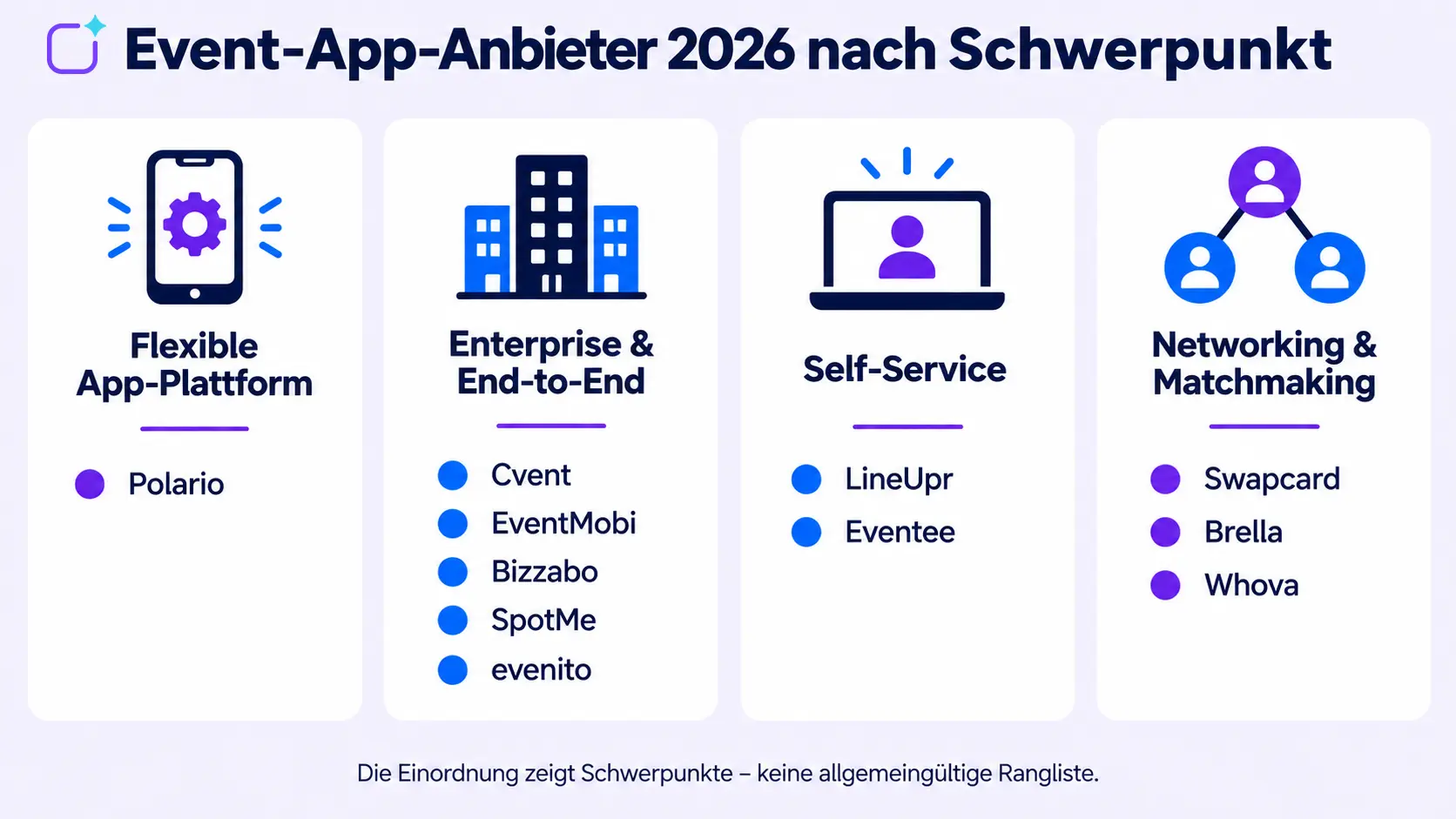
In short: the market ranges from specialised self-service apps such as LineUpr and Eventee, through networking specialists such as Brella, to comprehensive platforms such as Cvent, EventMobi, Swapcard, Bizzabo, SpotMe and evenito. Whova combines numerous conference features; Polario integrates web, hub and custom apps with modular registration, check-in, German hosting and personalised support. The key factors are the event portfolio, scope of processes, data requirements and total costs.
The comparison covers Polario, Cvent, EventMobi, LineUpr, Eventee, Swapcard, Bizzabo, Whova, SpotMe, Brella and evenito. The selection represents a range of app-based, self-service, networking and end-to-end models. It provides a structured overview of the market, but is not an exhaustive list of providers nor a definitive ranking.
What is an event app provider?
An event app provider offers a digital application through which participants can access programmes, personal schedules, speakers, exhibitors, documents and the latest updates. Depending on the platform, additional features may include networking, chat, surveys, Q&A, matchmaking, live streams, registration, ticketing, check-in and analytics.
The name does not in itself indicate how the solution is delivered. There are three common models:
- 1. Web app: Accessible via a browser, link or QR code, with no need to download it from an app store.
- 2. Native hub app: Multiple events are published within an existing iOS and Android app.
- 3. Personalised custom app: Your own name, your own icon and your own listing in the app stores.
The guide to the different types of event apps explains these deployment methods in detail. However, if you are looking for solutions for budget planning, resources, marketing and event organisation as a whole, you will find a more suitable overview of categories in the article ‘Event Management Software Compared’.
Why ‘We don’t need an event app’ is often the wrong decision
An overview of event app options: Polario Web App, Polario Hub as a container app, and a white-label custom app. Find the right solution for your event.

Event management software comparison: categories, use, and providers
Which event management software is right for your use case? We show you categories, possible applications, and suitable tools.
What criteria were used to compare the providers?
The comparison uses nine criteria that can be verified in a transparent manner through demonstrations, quotations and contract documents:
- Delivery: web app, native Hub app or bespoke store app
- Participant experience: agenda, content, guidance, personalisation and accessibility
- Interaction and networking: push notifications, chat, surveys, Q&A, events and matchmaking
- Process scope: registration, ticketing, check-in, badge printing and lead capture
- Editorial Management and Governance: CMS, Roles, Target Audiences, Templates and Multilingualism
- Integrations: API, webhooks, SSO, as well as CRM, marketing and ticketing systems
- Hosting and security: data centres, subcontractors, certifications and contracts
- Services: Implementation, training, project support and assistance
- Cost model: event, annual, participant, package and additional costs, as well as internal overheads
The assessment is based on published provider information as at 17 September 2026. Features and prices may vary depending on the package, country, scope of the event and contract. A published feature does not therefore constitute a guarantee of performance for a specific project.
A direct comparison of event app providers in 2026
| Supplier | Model and approach | Typical focus | Pricing logic |
|---|---|---|---|
|
Polario |
Web, hub or custom app |
Flexible app, modular registration and check-in, German hosting |
Standard entry-level prices; bespoke options available on request |
|
Cvent |
Enterprise suite with web and mobile |
Global event programmes, event marketing and on-site processes |
Quotation on request |
|
EventMobi |
Web and mobile event platform |
End-to-end modules and multi-event usage |
Event-based or annual model |
|
LineUpr |
Browser-based self-service app |
Streamlined event information and interaction |
Depending on the package and the participant |
|
Eventee |
Mobile app, web app and event website |
Simple self-service for in-person and hybrid events |
Public packages plus add-ons |
|
Swapcard |
Web and mobile platform, with optional white-label option |
Networking, exhibitors, lead generation and on-site |
Annual licence plus number of participants/exhibitors |
|
Bizzabo |
Event Experience OS with a mobile app |
Enterprise event marketing, data and event portfolio |
Annual subscription, bespoke quote |
|
Whova |
Mobile app and browser version |
Conferences, Agenda, Community and Organisation |
Customised by size and add-ons |
|
SpotMe |
Web, iOS and Android |
Enterprise engagement, content and regulated sectors |
Packages based on the number of events; quotes available on request |
|
Brella |
Native apps, web apps and white-label solutions |
B2B networking, matchmaking and hosted buyers |
Personalised quote |
|
evenito |
All-in-one event platform plus check-in app |
Registration, communication, website and check-in |
Plans based on event and registration volumes |
Note: This table summarises providers’ positioning. It is not a substitute for a product test or a service specification. Please check the package limits, data centres, integrations, support and total costs in the individual quote in particular.
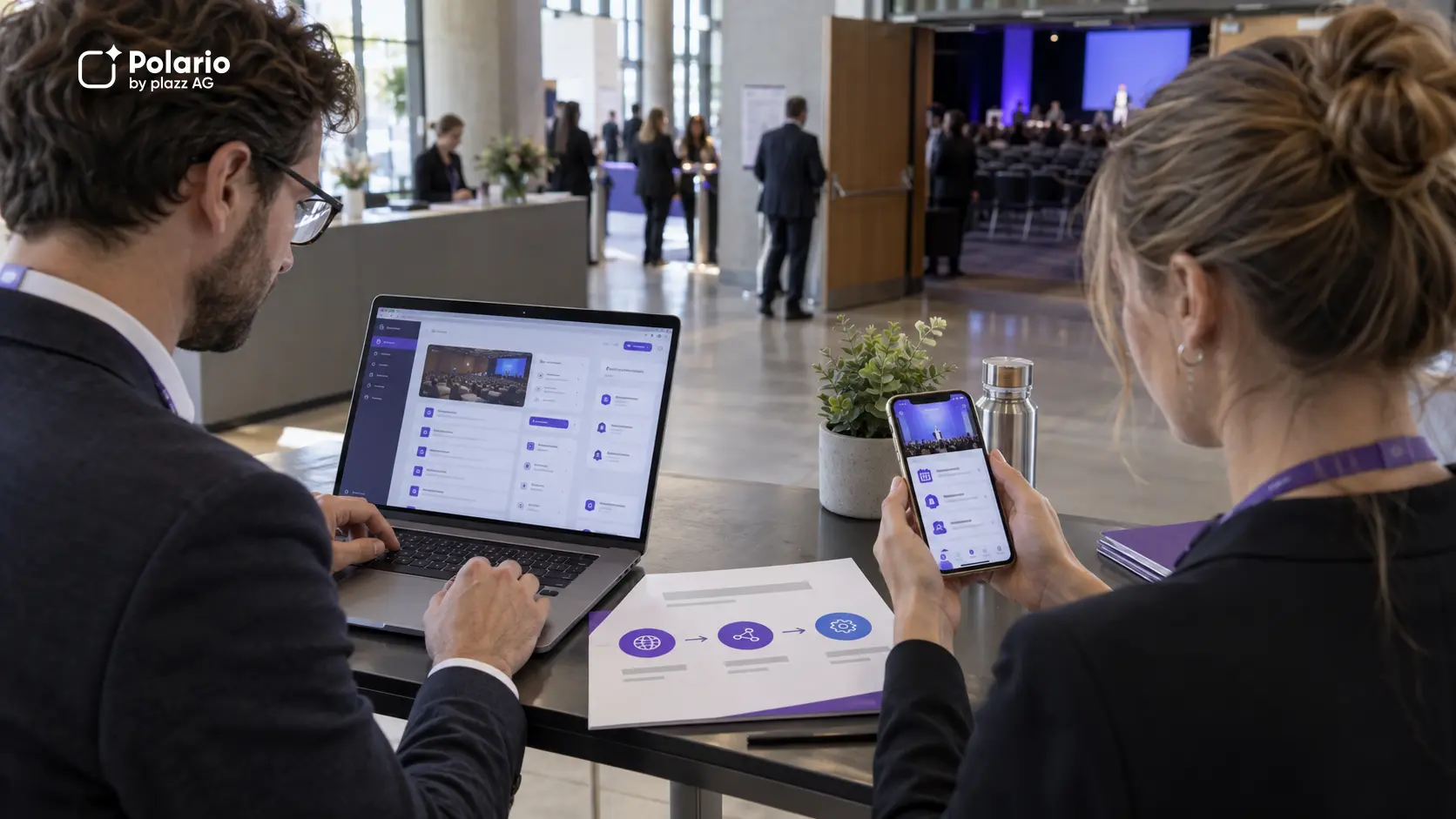
Polario: flexible deployment and a modular event process
The Polario Event App combines the agenda, content, attendees, networking, chat, push notifications, surveys, Q&A, sponsor areas and analytics with a no-code CMS. Organisers can choose between a web app, a native hub app and a bespoke custom app. This allows the access method to be tailored to the duration of the event, brand requirements and budget.
Using registr for attendee management and the check-in app, Polario can streamline the entire process from invitations and registration through to admission, badge printing and app usage. Data and external systems can be integrated via APIs and other integration methods. The service specification should detail which adapters are already in place or need to be implemented on a project-specific basis.
Polario states that its hosting is based in the Google Cloud region in Frankfurt and that data is stored within the EU. Security and data protection requirements are outlined on the compliance page. To give an idea of the budget, Polario publishes entry-level prices on its pricing page of 2,500 euros per event for the web app and 3,000 euros for the Hub version; the Custom App is priced on a case-by-case basis.
Polario is particularly suitable when:
- Whether users should be able to choose between a web app, a native hub app or their own store presence,
- Registration and check-in can be integrated on a modular basis,
- German hosting is an important procurement criterion,
- APIs, roles and content tailored to specific target groups are required,
- a dedicated contact person and project-specific services are required.
Polario describes the services available for set-up and support under ‘Service and Support’.
Cvent: a comprehensive platform for complex event programmes
Cvent positions itself as a comprehensive event marketing and management platform. Its portfolio includes, amongst other things, registration, event websites, Attendee Hub, OnArrival, reporting, integrations and venue sourcing. This makes the provider particularly relevant when international teams wish to bring together numerous events, extensive marketing processes and centralised enterprise governance.
Cvent does not publish standard list prices for its core packages. To ensure a fair comparison, the cost of the required solutions, implementation, integrations, support and internal administration must therefore be calculated together.
Cvent is particularly suitable if:
- many countries, business units and events are managed centrally,
- Event marketing and venue sourcing to the desired extent are included,
- Enterprise integrations and standardised governance are important,
- a comprehensive suite is preferred over a modular app project.
This head-to-head comparison of Polario and Cvent takes an in-depth look at platform features, hosting, processes and pricing.

Polario vs Cvent: The right solution for your eventPolario und Cvent im Vergleich: Die passende Lösung für Ihr Event
Is Polario an alternative to Cvent? Compare the event app, registration, check-in, hosting, features, prices and use cases.
EventMobi: End-to-end modules and multi-event usage
EventMobi combines an event app, event websites, registration, virtual formats, check-in, badge printing, lead capture, networking, gamification and analytics. As well as charging on a per-event basis, the provider offers annual packages for multiple events. This may be of interest to organisations that run recurring events with multiple modules on an international platform.
The German pricing page lists event and annual packages with introductory prices. As individual details on the page and in the FAQs may differ, organisers should request written confirmation of the currently valid price, included products, participant limits and add-ons.
EventMobi names AWS as its hosting partner. The publicly accessible German security page does not specify a uniform European data location for every client project. If processing is required to take place exclusively within the European Economic Area or in a specific region, the data location, backups, sub-contractors and support access must be clearly documented in the contract.
EventMobi is particularly suitable if:
- if an event app and several supplementary event modules are required,
- if individual and annual models are to be compared,
- Whether lead capture, badge printing or virtual formats play a key role,
- An internationally oriented multi-event model is being sought.
A separate comparison of EventMobi and Polario provides a more detailed analysis of the platform, hosting and pricing structure.
EventMobi vs. Polario: Differences in platform, hosting and pricing
Is Polario an alternative to EventMobi? Compare event apps, registration, check-in, hosting, prices, features and use cases.
LineUpr: a browser-based, self-service event app
LineUpr takes a clear web app approach. Participants open the application in their browser via a URL or a QR code. There is no need to download it from the Apple App Store or Google Play Store. Organisers create and manage content themselves via the LineUpr Manager.
Programmes, people, venues, sponsors, news and interactions can be made available depending on the package. Networking, multilingual support, push notifications and other features may be linked to specific tariffs or add-ons. Registration and check-in should be assessed separately as part of the overall process.
LineUpr is particularly suitable if:
- if you want quick access to the browser without a store process,
- the event team handles the set-up and content largely on its own,
- The agenda, information and interaction form the core,
- A self-service solution tailored to specific packages and subscribers is required.
A separate article on Polario and LineUpr highlights the differences between web apps, hub apps and custom apps, as well as their respective operating models.

Comparing LineUpr alternatives: browser-based self-service or a flexible event platform?
Which LineUpr alternative is right for your event? Compare Polario and LineUpr in terms of app model, features, hosting, costs and service.
Eventee: user-friendly self-service with transparent packages
Eventee combines a mobile app, a web app and an event website. Organisers can configure their event themselves and test it before publication. Features include, amongst others, an agenda, networking, Q&A, live polls, a social wall, push notifications, analytics, registration and check-in. White-labelling, custom branding, badge printing and other features depend on the package or add-on selected.
The publicly available pricing structure distinguishes between Essential, Signature and Professional based on the number of participants and team size. This makes it easier to plan your budget at an early stage. Before making a decision, teams should check which features are included in their chosen package and whether the support, integrations and branding options are sufficient for more complex requirements.
Eventee is particularly suitable if: you are looking for a quick-to-set-up app for an in-person or hybrid event with transparent packages.
Swapcard: Networking, exhibitors and on-site processes
Swapcard offers a mobile event app and web app featuring personalised agendas, networking, AI-powered recommendations, meetings, exhibitor areas, lead capture, interactive floor plans, check-in and badge processes. A branded or fully white-labelled app is available, depending on the package and add-ons selected.
The provider combines an annual platform licence with the number of participants and exhibitors. Registration, on-site services, branding and other features may be charged for separately. Swapcard publishes Starter, Professional and Enterprise packages, but does not provide flat-rate total prices.
Swapcard is particularly suitable when: trade fair, exhibitor, networking and lead generation processes need to be integrated within a scalable event platform.
Bizzabo: Event Experience OS for enterprise portfolios
Bizzabo positions its Event Experience OS for in-person, virtual and hybrid events. The platform includes registration, event websites, agenda and session management, a mobile event app, a virtual event environment, networking, sponsor and exhibitor features, analytics and API access. In addition, Bizzabo offers services for onboarding, production and event delivery.
According to the company, the platform is generally offered on an annual subscription basis. Prices depend on the scope and event portfolio and are calculated on a case-by-case basis. As such, Bizzabo is less suitable as an ad hoc tool for a single small event and is better suited to organisations wishing to standardise multiple event formats.
Bizzabo is particularly well-suited when: event marketing, data, virtual formats and a larger enterprise event portfolio need to be managed centrally.
Whova: a comprehensive conference app with community features
Whova provides a mobile event app for iOS and Android, as well as a browser version. Participants can manage programmes, receive updates, network and access virtual content. The provider has enhanced the app with features for registration, the agenda, community engagement, gamification and other conference-related processes.
Whova does not publish standard list prices. According to the provider, pricing depends on the size of the event and the add-ons selected. When comparing options, particular attention should be paid to branding, data location, integrations, support and the distinction between app features and additional functions.
Whova is particularly suitable if you are looking for a feature-rich conference app with an agenda, a community and ways to engage participants.
SpotMe: Enterprise engagement and selectable hosting regions
SpotMe offers a platform with web-based administration tools and event apps for the web, iOS and Android. Key features include personalised agendas, content, streaming, Q&A, surveys, communities, CRM integrations and event analytics. The Starter, Business and Advanced packages differ in terms of, amongst other things, the number of events, integrations and branding.
SpotMe lists Germany, Switzerland, the USA, Singapore and Australia as possible hosting regions. The specific region must be specified in the contract. Prices for the software packages are available on request; individual production and on-site services have published starting prices.
SpotMe is particularly suitable when: enterprise engagement, content, integrations and a contractually selectable hosting region are crucial.
Brella: Matchmaking for B2B events
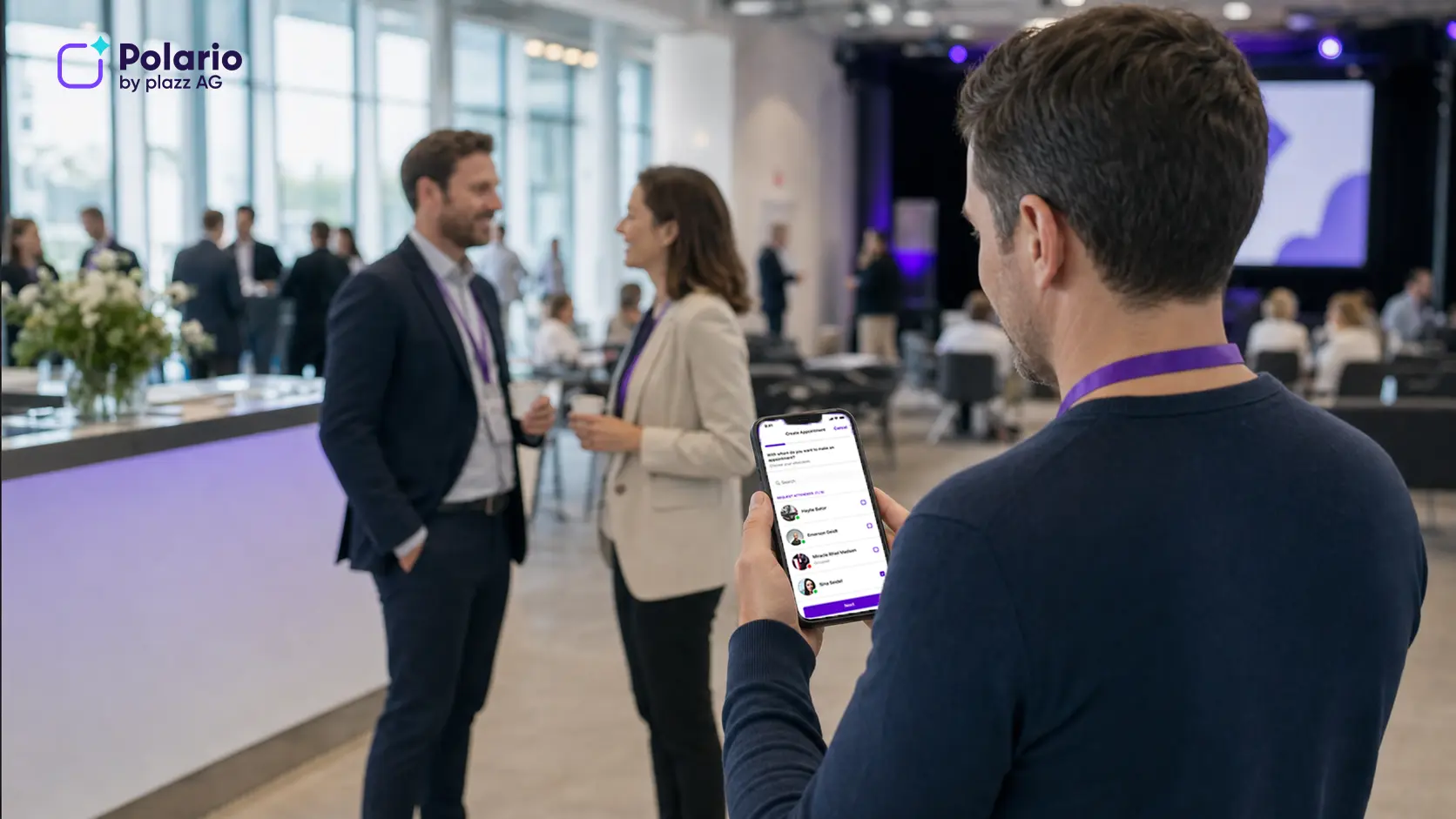
Brella focuses on B2B events where scheduled meetings and measurable networking take centre stage. The platform offers native apps, a web app, an agenda, messaging, intent-based matchmaking, one-to-one and group meetings, hosted buyer processes, sponsorship features, lead capture, analytics, as well as APIs and integrations.
Brella expressly does not describe itself as a general-purpose events app with networking features added as an afterthought. This specialisation is an advantage when meetings are a key indicator of success, but may be overkill for events that are purely informational or internal. The provider states that data is processed on servers within the EU; specific terms and conditions are offered on a case-by-case basis.
Brella is particularly suitable when: high-quality B2B discussions, matchmaking, hosted buyers and sponsor value are the event’s core objectives.
evenito: Event management and guest travel from the DACH region
evenito combines guest management, mailings, event websites, registration, virtual and hybrid formats, interaction, QR code check-in and statistics. The platform is aimed at organisations that wish to map several stages of the guest journey within a single system and standardise events across the organisation.
The Starter, Professional, Premium and Enterprise plans are based on the annual number of events and registrations. Features such as badge printing, payment, SSO, Active Directory and other modules can be added as add-ons. Prospective customers should therefore consider not only the plan tier but also the full scope of the process when calculating costs.
evenito is particularly suitable when: registration, communication, the website and check-in need to be integrated for individual event series or a larger portfolio.
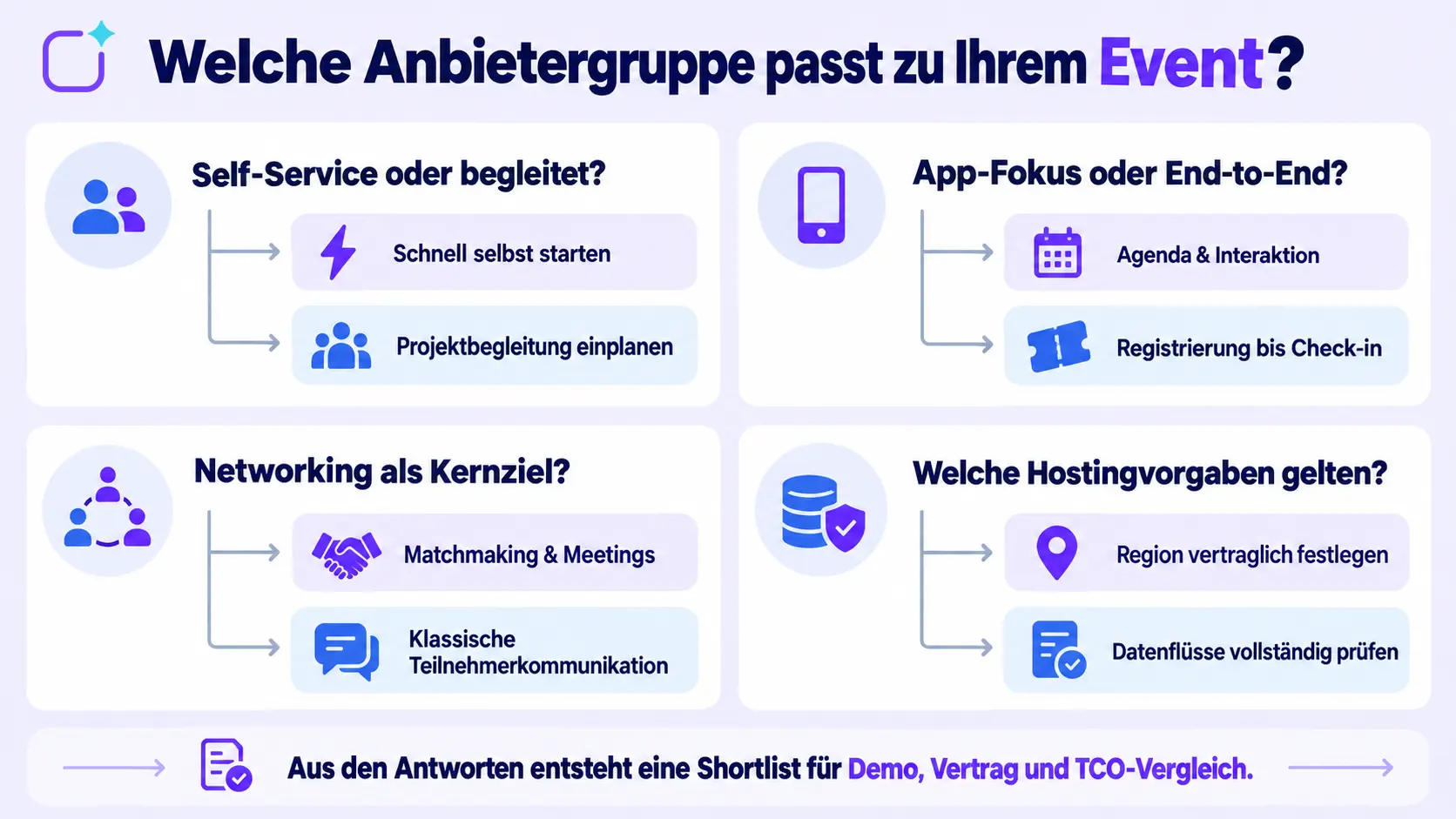
Which event app provider is best suited to which scenario?
| Scenario | Providers you should prioritise when considering | Conclusive evidence |
|---|---|---|
|
A one-off event with quick browser access |
LineUpr, Eventee and Polario Web |
Set-up, package limits, service and internal effort |
|
Web-App plus native App |
Polario, Eventee, Swapcard, Whova, SpotMe or Brella |
App access, push notifications, branding and publication |
|
Your own white-label app in the app store |
Polario, Swapcard, Brella and enterprise offerings from other platforms |
Developer accounts, the Store process, costs and responsibilities |
|
International Enterprise Event Programme |
Polario, Cvent, EventMobi, Swapcard, Bizzabo or SpotMe |
Governance, global processes, integrations and support model |
|
Networking and hosted buyers as the main objective |
Polario, Brella and Swapcard; assess other providers based on the meeting process |
Matchmaking logic, appointment rules, lead data and reporting |
|
Hosting in Germany as a must-have criterion |
Check Polario and LineUpr first |
Contractually guaranteed location for primary data, backups and access |
|
High level of self-service and a streamlined focus on apps |
LineUpr, Eventee and Polario |
Editorial work, templates, support and feature package |
How much will an event app cost in 2026?
Public entry-level prices are only comparable if they reflect the same scope of services. Polario publishes prices for Web and Hub. Eventee lists packages and add-ons. EventMobi specifies event-based and annual models. LineUpr calculates prices based on the package and number of participants. Swapcard combines a licence fee with volume-based pricing. evenito charges on a sliding scale based on events and registrations. Cvent, Bizzabo, Whova, SpotMe and Brella calculate prices for their core offerings on a case-by-case basis.
A reliable cost comparison should include:
- Licence, event or annual fee,
- Participant and event limits,
- Branding and App Store release,
- Premium features and add-ons,
- Registration, check-in, badge printing and lead capture,
- Set-up, migration and content population,
- Interfaces and bespoke development,
- Training, support and on-site services,
- internal editorial and administrative workload,
- Renewal, data export and end of contract.
Have the same scenario calculated for all providers and consider the total cost of ownership over the planned useful life. A low package price is not automatically the best value if it requires a significant amount of in-house work or additional systems.
How to compare hosting and data protection properly
‘GDPR-compliant’ or ‘hosting in Europe’ are not sufficient selection criteria. Instead, please provide evidence of the following:
- 1. Where primary data and backups are stored.
- 2. Which subcontractors are involved.
- 3. Where support and administrative access is carried out from.
- 4. What data is processed during registration, networking and analytics.
- 5. What encryption, role-based access control, logging and deletion mechanisms are in place.
- 6. Which details are contractually guaranteed and supported by evidence.
- 7. How exporting and deletion work once the contract has ended.
If German hosting is required, the requirement must explicitly cover primary data, backups and operational access. The country of origin stated on a marketing page does not replace an assessment of data processing on behalf of a client, technical and organisational measures, or data flows.
Twelve questions to ask before a demonstration and when comparing quotes
- 1. What types of events and how many events should be included each year?
- 2. Is a web app sufficient, or are native apps required?
- 3. Do we need our own App Store listing?
- 4. How are registration data, roles and permissions imported into the app?
- 5. Which features are standard, package-specific or paid add-ons?
- 6. How are changes to the agenda and messages aimed at specific target groups published?
- 7. Which interfaces are already in place, and which ones need to be developed?
- 8. Where are primary data, backups and log data processed?
- 9. Which tasks does our own team take on, and which does the provider handle?
- 10. What are the support hours and response channels during the event?
- 11. How are usage, interaction, check-ins and feedback analysed?
- 12. What are the total costs associated with events, the contract term and internal operations?
12. What are the total costs associated with events, the contract term and internal operations?
Conclusion: The best event app provider depends on the business model
There is no single best event app provider for every organisation. Eventee and LineUpr make it easy to get started with self-service solutions. Brella specialises in matchmaking. Whova caters for feature-rich conference scenarios. Swapcard combines networking, exhibitors and on-site activities. Cvent, EventMobi, Bizzabo, SpotMe and evenito cover event processes and portfolios of varying scope. Polario combines web, hub and custom apps with modular registration, check-in, German hosting and personalised project support.
The most robust selection process involves three steps: defining essential criteria, testing two or three providers against the same scenario, and then comparing their services, data flows and total costs in the contract.
Sources and editorial basis
Polario
- Event App: https://polario.app/de/event-app/
- Types of event apps: https://polario.app/de/event-app-varianten/
- Prices and versions: https://polario.app/de/preise/
- Registration for participant management: https://polario.app/de/registr/
- Check-in App: https://polario.app/de/check-in-app/
- API and Integration: https://polario.app/de/api-integration/
- Compliance: https://polario.app/de/compliance/
- Service und Support: https://polario.app/de/service-support/
- Event Management Software: https://polario.app/de/event-management-software/
- Polario & Cvent: https://polario.app/de/cvent-alternative/
- Polario & EventMobi: https://polario.app/de/eventmobi-alternative/
- Polario & LineUpr: https://polario.app/de/lineupr-alternative/
Supplier sources
- Cvent Platform: https://www.cvent.com/en/platform
- Cvent Pricing: https://www.cvent.com/en/event-management-software/cvent-pricing
- Cvent Trust Center: https://www.cvent.com/en/trust
- EventMobi Platform: https://www.eventmobi.com/de/
- EventMobi Prices: https://www.eventmobi.com/de/preise/
- EventMobi Security: https://www.eventmobi.com/de/sicherheit/
- LineUpr: https://lineupr.com/de/
- LineUpr FAQ: https://lineupr.com/de/faq
- LineUpr Prices: https://lineupr.com/de/pricing
- Eventee Platform: https://eventee.com/
- Eventee Features: https://eventee.com/features
- Eventee Prices: https://eventee.com/pricing
- Swapcard Event App: https://www.swapcard.com/event-mobile-app
- Swapcard Prices: https://www.swapcard.com/pricing
- Bizzabo Platform: https://www.bizzabo.com/product
- Bizzabo Prices: https://www.bizzabo.com/pricing
- Whova Event App: https://whova.com/whova-event-app/
- SpotMe Platform: https://spotme.com/
- SpotMe pricing and hosting regions: https://spotme.com/pricing/
- Brella Event App: https://www.brella.io/event-app
- Brella Company and Security Information: https://www.brella.io/company-information
- evenito Platform: https://evenito.com/produkt/platform-overview
- evenito Prices: https://evenito.com/preise
Frequently asked questions (FAQ)
Which event app provider is the best?
The best provider is the one that meets the prioritised usage scenarios, data requirements and integrations whilst keeping operational costs within reasonable limits. It would not be reasonable to declare a single overall winner without a specific event portfolio, budget and essential criteria.
Which event app is best suited to small events?
For smaller or one-off events, quick browser access, straightforward packages and minimal set-up effort are particularly important. LineUpr and Polario Web are obvious options to consider. The key factors remain the required features and the level of work you need to do yourself.
Which is better: a web app or a native event app?
A web app lowers the barrier to entry because it launches directly in the browser. A native app can be useful for recurring events, visible brand presence and native push notifications. The overview of event app types helps to distinguish between them.
Which providers combine an event app, registration and check-in?
Polario, Cvent, EventMobi, Swapcard and evenito offer solutions for several of these process steps. Evenito can handle registration and check-in, depending on the package. The setup varies depending on the product and module structure. Check the data flow, real-time synchronisation, package limitations and responsibilities in the quote.
Which event app provider is based in Germany?
Polario specifies the Google Cloud region in Frankfurt and data storage within the EU. LineUpr specifies servers in Germany. SpotMe lists Germany as a selectable hosting region. Cvent specifies Frankfurt and Dublin for relevant EU customers; Brella specifies servers within the EU. For all providers, specific data flows and contractual commitments must be checked.
What does an event app cost?
The costs depend on the number of events, the number of participants, the app model, features, branding, integrations and service. You should therefore compare not only the entry-level prices, but also the total cost of ownership for the same scenario.