Skip to content




A community app creates a secure digital space for information, discussion and networking. However, community app providers differ significantly: some are aimed at associations and complex membership organisations, whilst others are aimed at businesses, alumni networks or paid creator communities. There are also significant differences in terms of branding, mobile apps, integrations, hosting and pricing.
In short: Polario, tixxt, Connact, Hivebrite, Circle and Mighty Networks cater to different community scenarios. Polario combines a customisable native app with a web app, a no-code CMS, German hosting and event features. tixxt and Connact focus on associations. Hivebrite is aimed at international organisations. Circle and Mighty Networks are particularly well-suited to course- and subscription-based communities.
This comparison helps you draw up a well-informed shortlist. It is based on publicly available product, price and security information provided by the suppliers. The scope of features and terms and conditions are subject to change and must be checked via a demo, quotation and contract before a procurement decision is made.
Transparency notice: This article appears on the Polario website. Polario is itself one of the providers included in the comparison. The selection criteria and sources are therefore disclosed. There is no universally applicable ranking or ‘best’ provider for every organisation.
What is a community app?
A community app is a digital platform through which a clearly defined community receives information, makes contacts, communicates with one another and takes part in activities. Typical features include news, themed groups, chats, member profiles, directories, documents, events, push notifications and surveys.
Unlike open social networks, the community is owned by the operating organisation. It determines access, content, roles, moderation and data processes. A community app can be made available as a native app for iOS and Android, as a web app, or in both formats.
If you’d like to start by clarifying your strategy, objectives and engagement, you’ll find in-depth Polario guides on ‘Building a Community’ and ‘Community Platform’.
However, the term covers a range of different product categories:
- Community apps for organisations connect members, customers, partners, alumni or business networks.
- Association and membership platforms complement community features with committee work, membership data and complex organisational structures.
- Creator and course communities combine discussion forums with paid memberships, courses, coaching and digital content.
- Customer community platforms facilitate product sharing, support, advocacy and customer loyalty.
A provider is therefore only relevant if its core focus is in line with the planned operating model.

How associations and clubs build an active member community
Building a community within an association or club: practical explanations, strategies and association apps for active members.

Community platform: How to activate members in the long term
How to keep your community platform active in the long term: strategies, content, and measures for greater engagement and member retention.
A concise comparison of community app providers
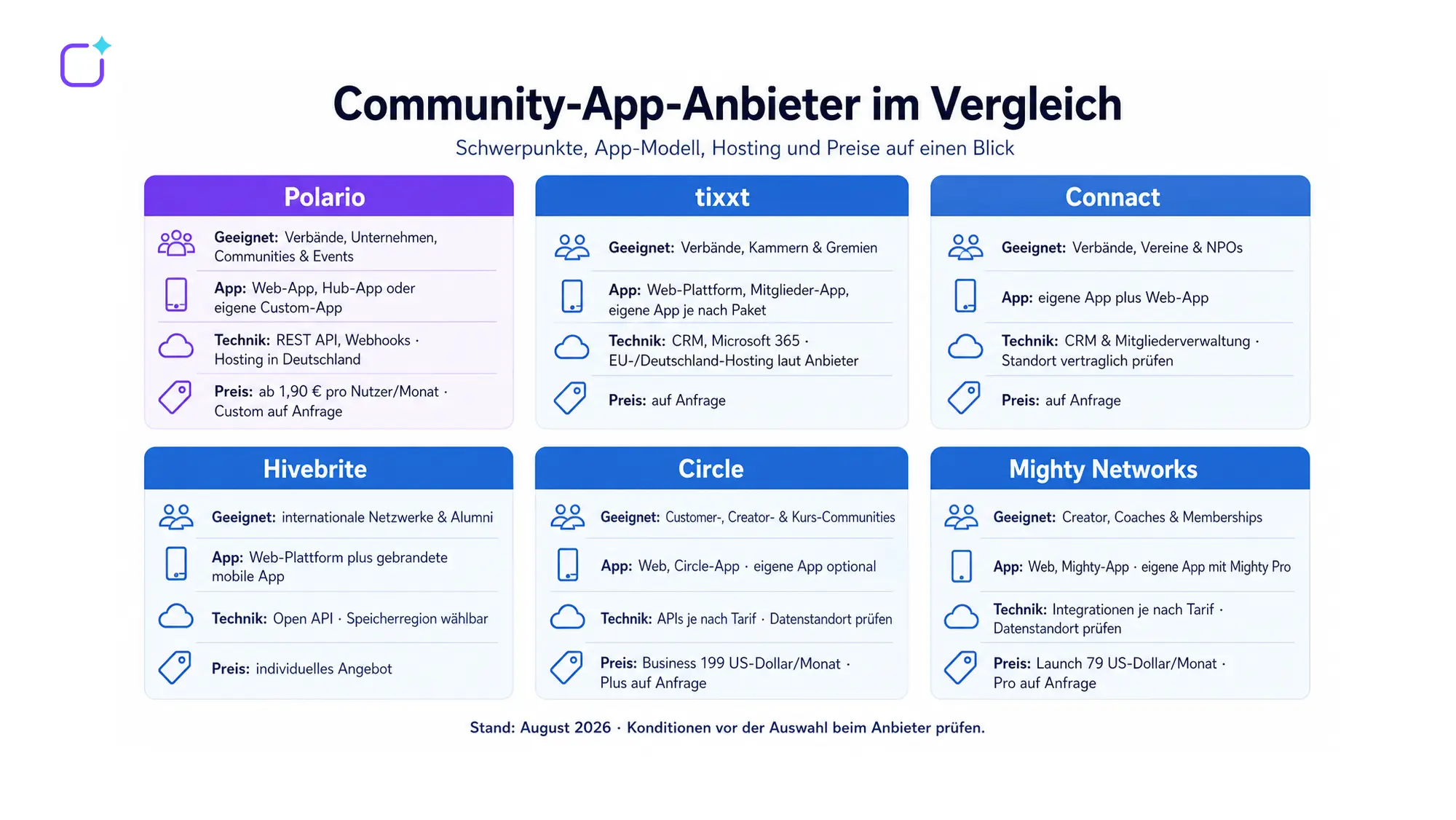
The following table sets out publicly documented key areas of focus. Simply ticking boxes in a long list of features would be less meaningful than asking how well a platform supports the most important use case.
Polario
Polario is suitable for associations, businesses, professional communities and year-round event communities. You can choose between a web app, a native hub app and a bespoke custom app. Polario supports REST API and webhooks and, according to the company, hosts its services in Germany. The community hub starts at €1.90 per user per month; the custom app is priced on a case-by-case basis.
tixxt
tixxt is primarily aimed at associations, chambers, committees and member organisations. The solution comprises a web platform and a members’ app; a dedicated app is available depending on the package chosen. Integration options include CRM and AMS systems, as well as Microsoft 365. Prices are available on request.
Connact
Connact is aimed at associations, clubs, non-profit organisations and multi-tiered membership organisations. It offers a dedicated app and a web app. CRM, membership management, website and newsletter systems can be integrated. Prices and the specific data location should be clarified during the quotation process.
Hivebrite
Hivebrite is particularly well suited to international associations, alumni networks, non-profit organisations and corporate communities. The platform offers a web application and a branded mobile app. Other systems can be integrated via the Open API. According to the provider, the storage region can be selected; prices are calculated on a case-by-case basis.
Circle
Circle is specifically designed for customer, creator, course and membership communities. In addition to the web platform and the standard Circle app, Circle Plus allows for a custom-branded app. The Business plan is priced at US$199 per month; Circle Plus is available on request.
Mighty Networks
Mighty Networks is primarily aimed at creators, coaches, educational providers and paid membership communities. Members use the web platform or the general Mighty app. A bespoke branded app is available with Mighty Pro. According to the provider, the Launch plan starts at 79 US dollars per month; Mighty Pro is offered on a bespoke basis.
This overview is intended to provide an initial guide and does not constitute a comprehensive comparison of services. Features may only be included in certain packages or may incur additional costs. A binding quotation is essential, particularly for white-label apps, APIs, single sign-on, data migration and service levels.
What criteria should you use to compare community app providers?
1. Target audience and community model
An association requires different processes to a coaching service. Clarify whether you wish to connect members, customers, partners, alumni, volunteers or fee-paying course participants. Other relevant factors include membership categories, regional structures, working groups, guest access and whether multiple communities are to be run in parallel.
2. Native app, platform app or web app
With a platform app, members access the community via the provider’s app. A white-label or custom app, on the other hand, appears with its own name, icon and store listing. A web app works in a browser without the need for installation.
The models have different implications for costs, roll-out time, App Store processes and brand perception. For many organisations, a combination makes sense: web access for occasional use and a native app with push notifications for regular activity.
3. Information, exchange and engagement
The basis should not consist of just one feed. Check whether relevant usage scenarios can be modelled:
- news and push notifications tailored to specific target groups,
- Groups, channels, forums, chat and direct messages,
- Member profiles, directories and contact search,
- Calendar, events and bookings,
- Documents, pages and knowledge content,
- Surveys, feedback and forms,
- Moderation, reporting procedures and community rules,
- Analytics for reach, activation and engagement.
4. Roles, responsibilities and organisational structure
A professional community requires more than just ‘Admin’ and ‘Member’. Regions, committees, membership types, partner areas or restricted project groups require granular permissions. Ask whether roles can be managed centrally, assigned automatically and updated via interfaces.
5. Integrations and data maintenance
A provider should not become a second master data system. Key considerations include connections to CRM, membership management, identity providers, newsletters, event management and payment services. When assessing these, check not only whether an API is available, but also who implements the integration, which data flow direction is supported and how errors are monitored.
You can find out more about this topic on the Polario page on APIs and integrations.
6. Data protection, security and hosting
To ensure robust procurement, the data location, subcontractors, encryption, role model, data erasure policy, backups, availability and exit arrangements must be documented. ‘GDPR-compliant’ alone is not a sufficient technical specification.
In the case of international providers, it is particularly important to clarify which hosting region is actually selected for the contract and whether data is transferred to third countries. When dealing with German providers, organisations should also check the specific infrastructure and any subcontractors. Polario outlines its security and operational principles in the area of compliance.
7. Implementation, Operation and Support
The software alone does not create an active community. Ask what services are included for design, configuration, migration, piloting, training, launch and ongoing optimisation. A dedicated point of contact can be more important than an additional individual function, particularly in the case of complex organisational structures.
8. Total cost rather than the entry-level price
Compare options over a consistent time period. The total cost of ownership includes licence or usage fees, set-up, branding, app publication, integrations, migration, training, support and internal operating costs. A low-cost basic plan can end up being more expensive if key features or services are charged for separately.
The six community app providers in detail
Polario: A community, events and organisational app all in one platform
Polario is aimed at organisations that wish to inform, connect and engage their members or external target groups. The platform includes, amongst other things, news, social feeds, chats, groups, directories, documents, calendars, surveys, roles and permissions, as well as analytics. Content is managed via a no-code CMS.
Polario is available as a web app and a native app. Smaller communities can get started within the Polario Hub. For a fully standalone app with its own name, app icon and store listing, there is the Custom version. This allows you to get started quickly at first and, if required, opt for a more customised app model.
There is a particular focus on linking a long-term community with events. Organisations wishing to manage member exchanges, events, onboarding or other use cases on a single platform can manage their projects centrally. According to Polario’s current pricing page, the Hub for small communities of up to 500 users starts at €1.90 per user per month, with a twelve-month contract term. The cost of the custom app is calculated on a case-by-case basis.
Polario is particularly suitable when:
- a native app and a web app are required,
- if a quick hub app or a bespoke custom app is an option,
- the community and recurring events should work together,
- Content is to be managed without the need for programming,
- German hosting and personalised support are important.
You should check the following in more detail: premium features, white labelling, integrations, set-up and support may incur additional costs. The binding scope of services is set out in the quotation.
tixxt: Member portal and collaboration tools for associations
tixxt positions itself as a platform for associations, member organisations, chambers and institutions. In addition to community features, the platform focuses on information management, committee work, documents, collaboration, member services and engagement analysis.
The platform supports posts, groups, chat, direct messages, member directories, calendars and documents. In addition, tixxt highlights features such as CRM connections, Microsoft 365 integration, multi-tiered organisational structures and AI assistance. A mobile members’ app is included in the offering; branding and the option to have an app under your own name depend on the package selected.
tixxt is particularly suitable when:
- an association or chamber is looking for a central membership platform,
- Committees, documents and cooperation are important,
- multi-level organisational structures can be represented,
- Member data is to be synchronised with CRM or AMS systems.
You should check this more carefully: prices are not publicly stated. The tixxt price overview shows differences between packages and allocation quotas, but refers you to a specific quote for detailed terms and conditions.
Connact: a dedicated app for associations, clubs and NPOs
According to its own description, Connact has its roots in the world of associations and is aimed at associations, clubs, NPOs and other structured communities. The solution is implemented as the organisation’s own app and includes, amongst other things, news, group chats, member profiles, a search function, a map, events and documents.
Connact emphasises its integration with CRM, membership management, the website and newsletter tools. The publicly available specification also details admin and sub-admin structures, master data changes and document permissions.
Connact is particularly suitable if:
- if you would like your own association or club app,
- The membership directory, map and group structures are central to,
- where close support is sought within the context of the association,
- existing member processes are to be integrated.
You should check the following in more detail: Specific prices are only available upon enquiry or via a requested price list. The hosting location, scope of interfaces, service levels and customisation included should be specified in the quote.
Hivebrite: an international community platform for larger organisations
Hivebrite is aimed at international associations, alumni networks, non-profit organisations and corporate communities. The platform combines profiles, groups, forums, events, mentoring, memberships and payments with a branded mobile app.
For larger system environments, Hivebrite highlights an open API and integrations with, amongst others, Salesforce, HubSpot, Mailchimp, Stripe and Okta. On the security front, the provider documents role-based access, audit logs, AES-256 encryption and a choice of storage regions in the European Union, the USA, Switzerland or Australia.
Hivebrite is particularly suitable if:
- an organisation with an international focus runs several community programmes,
- whether the focus is on alumni, chapters, mentoring or memberships,
- extensive integrations and enterprise-level security features are required,
- A fully branded mobile app is required.
You should check this more carefully: prices are not publicly listed. For European projects, the hosting region, data flows and contractual documents must be specifically agreed upon.
Circle: Community, content and courses for digital business models
Circle combines discussions, chat, events, courses, live streams, member profiles, gamification and paid memberships. The focus is more on customer, creator and learning communities than on traditional association management.
Members can use Circle on the web, as a desktop app or via the standard Circle app for iOS and Android. A custom-branded app is either included as part of or available as an option in the bespoke Circle Plus package. The provider’s website currently lists the price for the Business plan at US$199 per month; transaction and additional costs, which vary depending on the plan, must be checked.
Circle is particularly suitable when:
- Content, courses, live formats and the community are closely linked,
- where paid memberships or customer education are relevant,
- if a quick self-service start is required,
- to begin with, a general-purpose platform app will suffice.
You should check the following in more detail: Your own brand app is not the same as standard mobile access and is charged separately as part of the Plus package. EU data protection requirements and data flows must be assessed in the contract.
Mighty Networks: Community-based business with courses and monetisation
Mighty Networks is primarily aimed at creators, coaches, learning providers and brands who want to bring together communities, courses, events and paid offerings. Among other features, the platform supports feeds, chat areas, live streams, courses, events, subscriptions and gamification.
Standard plans use the Mighty Networks app, with a customised look and feel for each community. Mighty Pro offers a fully bespoke app for iOS and Android on individual terms. The provider currently quotes US$79 per month for the launch plan, payable annually.
Mighty Networks is particularly suitable if:
- Courses, coaching and paid memberships form the business model,
- The focus is on community engagement and content,
- All it takes is a quick start via an existing platform app,
- There are plans to launch a dedicated app with Mighty Pro at a later date.
You should take a closer look at the following: transaction fees, pricing limits, integrations, your own branded app, and data protection and hosting requirements, as these all affect the platform’s actual suitability and the overall costs.
Which provider is best suited to which area of application?
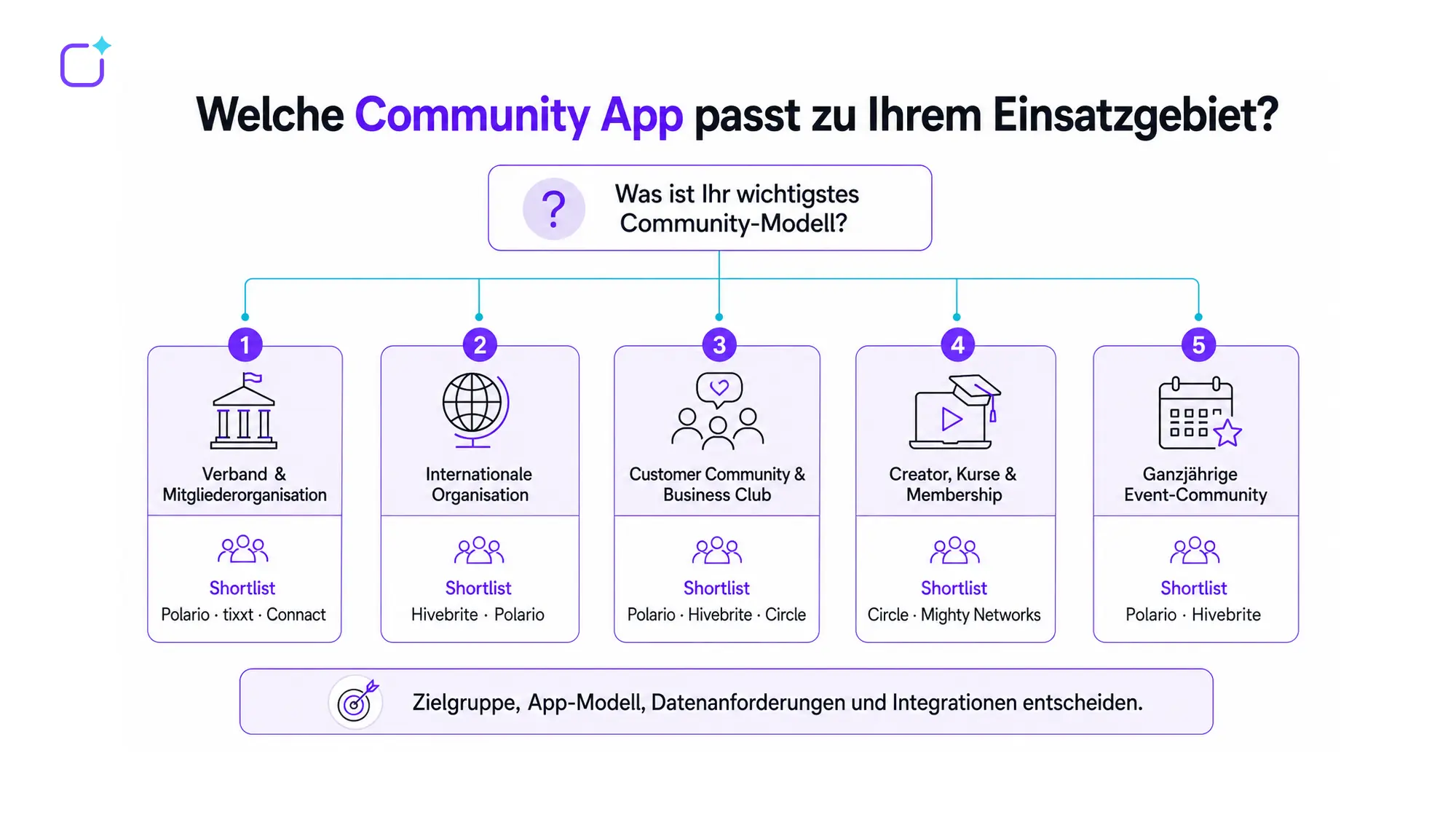
For associations and member organisations
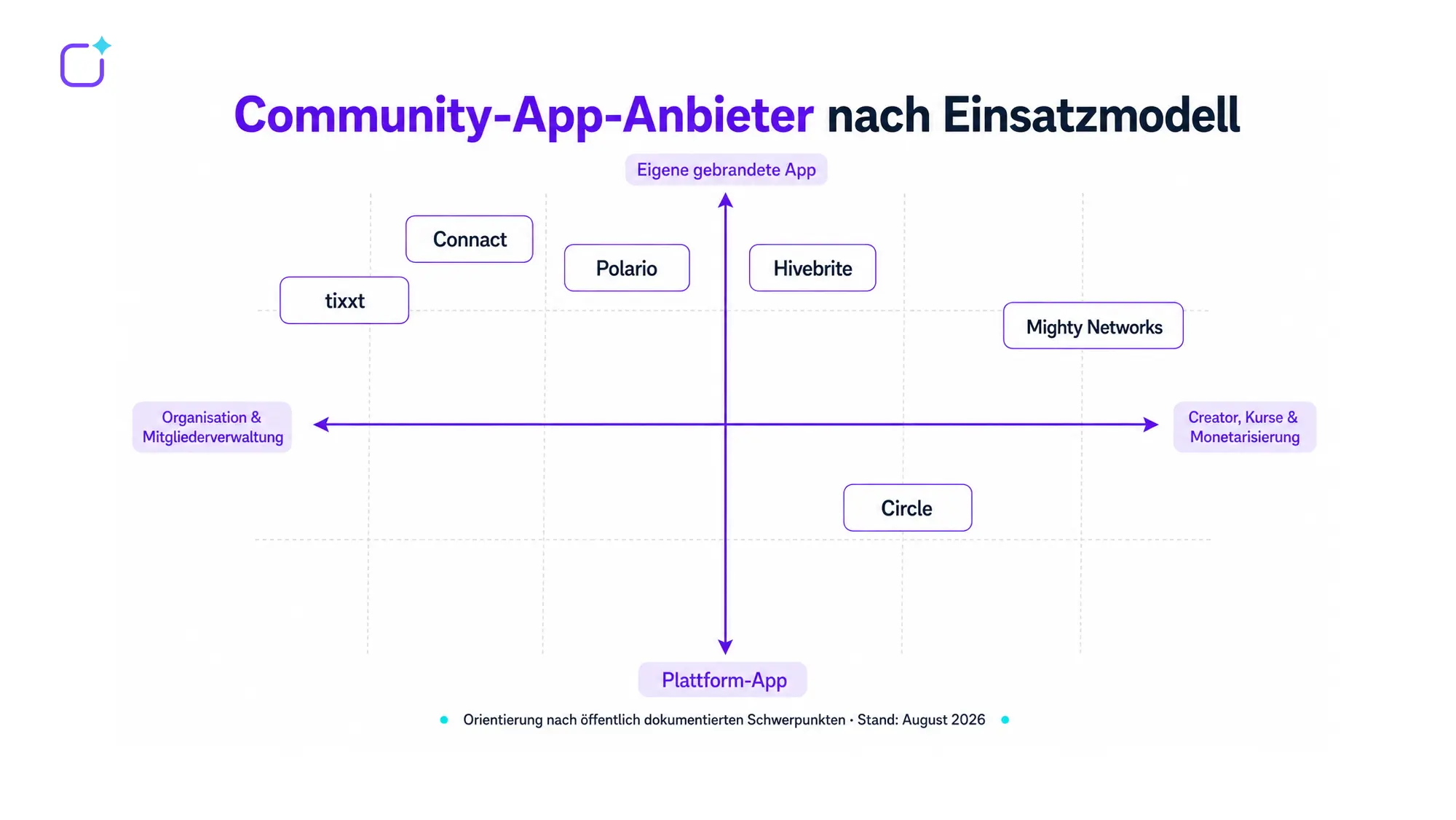
tixxt and Connact are clearly geared towards association and membership structures respectively. Polario is also suitable for associations, but links this use case more closely to flexible app content, events and other organisational scenarios. When drawing up a shortlist, the deciding factor is whether the focus is on committee collaboration and membership management, or on mobile communication, content and event communities.
You can find more detailed information on the Polario page about the community app for associations.
For smaller member organisations, the overview of the Club App is also relevant. This focuses on the typical requirements of clubs and volunteer-led organisations.
For international alumni, non-profit and corporate networks
Hivebrite is geared towards international, often larger community programmes. Polario may be of interest if greater priority is given to a native app, configurable content, a German data centre and personalised project support. The decision should take particular account of integrations, multilingual capabilities, global operational processes and data regions.
For customer communities and business clubs
Polario and Hivebrite cater for organisation-based communities with profiles, content, events and networking. Circle may be a good fit if discussion, content, customer education or course offerings are the main focus. For a business club, additional features such as a members’ directory, appointment booking, event access and customised branding are also relevant.
For creators, coaches and paid learning communities
Circle and Mighty Networks combine monetisation, courses, live streams and community features within a self-service model. A traditional association structure, German hosting or in-depth membership and committee management are not the primary focus of their products.
For year-round event communities
Polario is particularly worth considering when a community is formed around recurring events. The agenda, event content, networking and ongoing communication can all be integrated within a single platform. This means that members do not necessarily have to switch between an event app and a community solution.
How to draw up a robust shortlist of suppliers
1. Identify three priority usage scenarios
Don’t list twenty functions of equal importance. Identify three core tasks, such as keeping members informed, linking regional groups and organising events.
2. Define mandatory criteria
Essential criteria may include a native app, a dedicated store presence, German hosting, SSO, CRM integration, multi-level roles or multilingual support. A provider that does not meet a genuine essential criterion should not be included on the shortlist.
3. Compare costs over three years
Request quotes covering the same scope of work. Take into account set-up, licences, branding, app stores, migration, integrations, training, support and internal resources.
4. Test the use case in a demo
Don’t just show a standard presentation. Give each provider the same scenario: a new person is imported, assigned to a region and an interest group, receives relevant content, and registers for an event.
5. Clarify operation and exit
Ask about responsibilities, service levels, data export, the end of the contract and support for a future migration. A community platform holds key relationships and data; therefore, the exit strategy should be considered as early as the selection phase.
Conclusion: The best community app provider depends on the business model
The comparison does not reveal a linear ranking. tixxt and Connact focus on associations and member organisations. Hivebrite offers a comprehensive international community platform. Circle and Mighty Networks combine community features with courses, content and monetisation. Polario positions itself as a hybrid of a community, organisational and event app – offering web and native apps, no-code management, German hosting and various branding models.
A good decision therefore does not start with the question of which solution offers the longest list of features. It begins with the target audience, usage scenarios, data requirements, app model and operational responsibility. Only then is it possible to meaningfully compare two or three providers through demos, quotations and pilot projects.
Sources and editorial basis
Polario
- Community App: https://polario.app/de/community-app/
- Prices and versions: https://polario.app/de/preise/
tixxt
- Overview of features: https://www.tixxt.com/de/funktionsuebersicht/
- Prices: https://www.tixxt.com/de/preise/
Connact
- Community App: https://connact.app/communities
- Prices: https://connact.app/preise
Hivebrite
- Product Overview: https://hivebrite.io/product-overview/
- Security and Data Protection: https://hivebrite.io/security-and-privacy/
Circle
- Customer Communities: https://circle.so/platform/customer-communities
- Circle Plus: https://circle.so/plus
Mighty Networks
Frequently asked questions (FAQ)
Which community app provider is the best?
There is no single provider that is best suited to every community. Associations require different features and processes to those needed by creator, alumni or customer communities. The target audience, integrations, hosting, app model, support and overall costs determine the appropriate shortlist.
What does a community app cost?
Costs range from standardised self-service pricing plans to bespoke enterprise or white-label apps. In addition to the licence, the comparison should take into account set-up, branding, migration, integrations, training and support. Polario quotes a starting price of €1.90 per user per month for the Hub; other providers quote package prices or provide quotes on request.
Does a community need its own app?
Not always. A web app or a community within the provider’s general app may be sufficient to get started. A standalone app makes sense if brand presence, a dedicated storefront and branded push notifications are important. It usually involves higher costs and additional effort to launch.
What is the difference between a community app and a members’ portal?
A community app focuses on communication, interaction, networking and engagement. A members’ portal often also covers master data, self-service, contributions, committees or administrative processes. Modern platforms overlap in these areas, but prioritise these tasks differently.
What are the minimum features a community app should offer?
Standard features typically include information tailored to specific target groups, groups or discussion forums, member profiles, search functions, notifications, events, roles and permissions, as well as moderation and analytics functions. The actual essential features are determined by the usage concept.
What is the key to data protection?
Organisations should review data locations, sub-processors, encryption, access rights, deletion and export processes, backups and transfers to third countries. A general GDPR statement is no substitute for a data processing agreement or for technical and organisational measures.
How many suppliers should be included on a shortlist?
As a rule, two to four suppliers are sufficient. The key requirement is that they all meet the mandatory criteria. A larger number increases the effort involved in evaluating them without necessarily improving the decision.
How long does it take to launch a community app?
The duration depends on the app model, data migration, integrations, branding, app store approvals, content and internal decisions. A platform app can be launched more quickly than a bespoke white-label app. A realistic project plan should include piloting and roll-out.