 Skip to content





A modern social intranet is much more than just a document repository or a ‘bulletin board’; it is the digital heart of your company. However, simply introducing new software does not guarantee success. Companies often face the challenge that, although the platform is technically ready, the workforce is reluctant to accept it.
Wie verwandeln Sie Ihr Intranet in einen lebendigen Ort des Austauschs? Und woran erkennen Sie, ob sich die Investition tatsächlich lohnt? In diesem Artikel stellen wir Ihnen drei bewährte Strategien vor, um die Akzeptanz zu maximieren, und zeigen Ihnen, mit welchen Kennzahlen Sie den Erfolg messbar machen.
3 strategies to promote the use of your social intranet
In order for the social intranet to optimally promote collaboration and employee engagement, it is important to provide targeted support for its use. Here are three proven strategies to increase employee participation:
Make sure your employees know how to use the social intranet effectively and what features it has. Provide training and training materials to help them realize the full potential of the intranet.
Actively encourage your employees to use the new platform by communicating the added value and benefits to them. Organize training, workshops or info sessions to raise awareness of the platform. Also offer incentives such as rewards or recognition for active use and contribution to collaboration.
Gather regular feedback from employees to better understand their needs and wishes in relation to the social intranet. Use the feedback to continuously improve the platform and adapt it to the requirements of the users.
By specifically training, encouraging, and engaging employees in the optimal use of the social intranet, you can ensure that it is used effectively and that the desired results are achieved. A well-used intranet promotes internal communication, collaboration and employee engagement, which has a positive impact on the company’s productivity and success.
Measuring the impact of a social intranet
A social intranet offers many benefits for companies, but how can success be measured? There are several criteria that should be considered to measure impact.
Measuring usage rates and employee engagement is a key indicator of the success of the new platform. High usage and engagement rates show that it is actively used by employees and offers added value.
Key figures for the analysis are:
- Number of registrations
- Frequency of use
- Sessions duration
- Interactions with posts, comments and likes
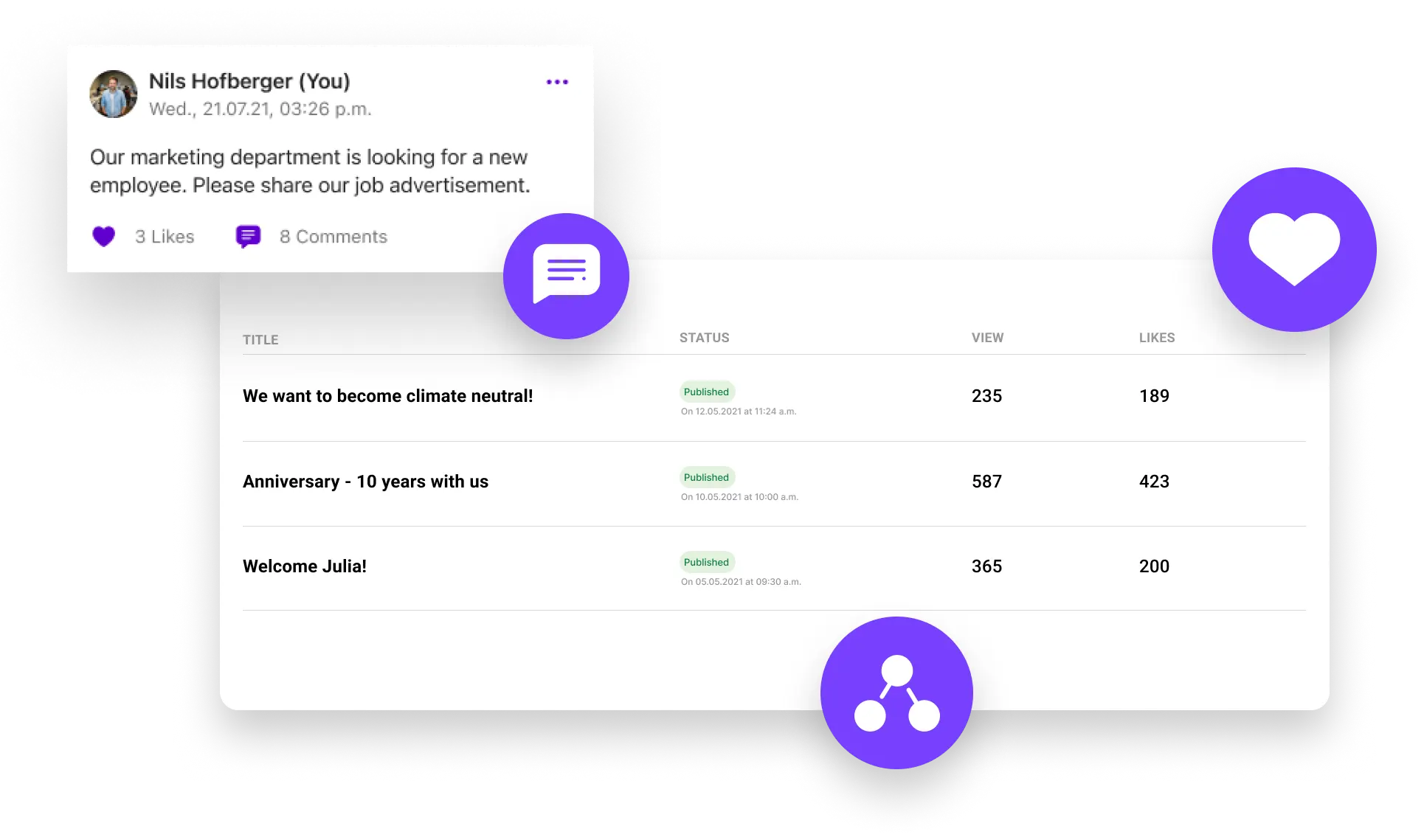
A social intranet is designed to improve information sharing and collaboration within the company. To evaluate the effectiveness of collaboration, it is important to analyze the following metrics:
- Number of shared information, documents and posts
- Analysis of collaboration features such as collaborative editing of documents, team projects or discussion forums
The opinion of employees is a valuable indicator of the success of a social intranet. Surveys, feedback forms or regular discussions with employees can be used to find out how they perceive the platform, what benefits it offers and where there is potential for improvement.
The implemented intranet solution also serves as a platform for knowledge management. For this reason, it makes sense to also measure the contribution to organizing and sharing knowledge.
Important KPIs for this are:
- Number of knowledge articles created and shared
- Number of accesses to knowledge resources
- Evaluation of the quality of the knowledge provided
A successful social intranet should also have a positive impact on the company’s business goals. This can be measured, for example, through the analyses of KPIs such as the improvement of internal communication, the efficiency of work processes, employee retention or increased productivity.

What is a social intranet?
Increase efficiency and teamwork! Find out how a social intranet can take your internal communication to the next level.
Frequently asked questions (FAQ)
Why is our social intranet not being used?
Often, it is not the technology that is at fault, but rather the lack of a ‘why.’ If employees do not recognise the personal added value or have not received training, they will not use it. Active community management (see Strategy 2) is crucial here.
Which KPI is the most important?
There is no single KPI. The number of logins is a good starting point, but only the interaction rate (comments, likes, shared documents) shows whether people are actually working or just ‘reading’.
How often should we seek feedback?
At least once a year in a large survey, but ideally continuously through small feedback buttons or open discussion groups directly on the intranet.

