 Skip to content





Today, a social intranet for companies is much more than just a digital notice board. It brings together information, communication and collaboration in one place – provided you choose the right solution. Choosing a social intranet should therefore be a structured process with the right focus. The aim of the following article is to help you achieve this structure.
Why a social intranet is important for companies
Today, companies are under considerable pressure to provide employees with targeted information, bring them together across silos and make knowledge available, regardless of whether colleagues are working in the office, from home or in the field. Traditional intranets quickly reach their limits here: they are often static, difficult to maintain and rarely used.
This is exactly where a modern social intranet for internal communication comes in. It combines top-down information (e.g. company news, guidelines, campaigns) with bottom-up participation (e.g. comments, feedback, communities, idea collections). This creates a digital space where content is not only consumed but actively shaped, and where teams can collaborate on projects.
At the same time, a social intranet provides centralised access to applications, documents and processes: from the HR portal and knowledge databases to project spaces. This reduces tool proliferation, facilitates onboarding and strengthens identification with the company.
Those who compare social intranets early on and specifically look for a solution that fits their own culture lay an important foundation for employee retention, productivity and a modern, transparent corporate culture.
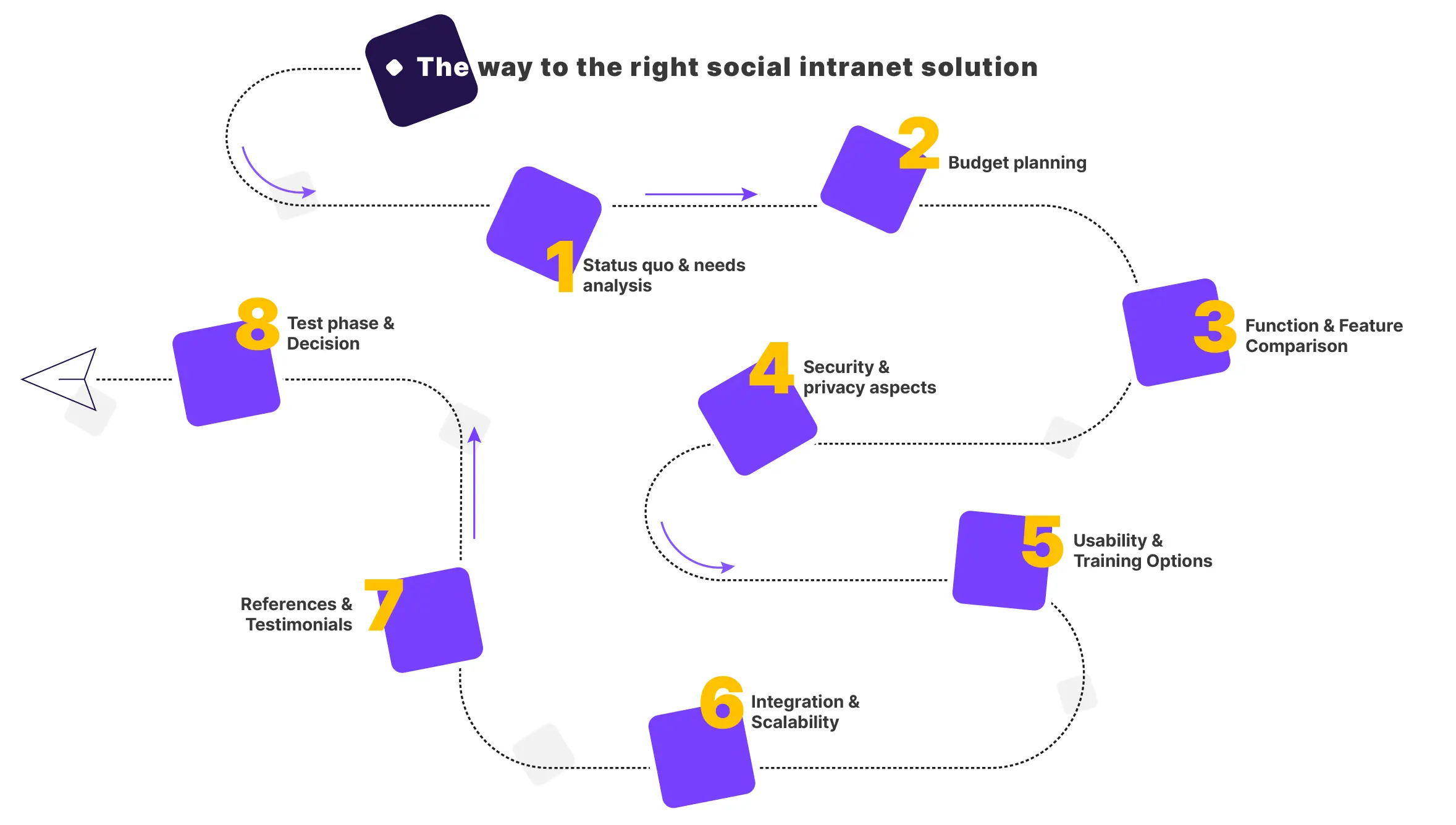
Social intranet selection steps
Choosing a social intranet is not purely an IT purchase, but rather a strategic project that affects communication, HR, specialist departments and management alike. To ensure that you don’t get stuck on individual features, but instead find a solution that really suits your company, it’s worth taking a structured approach.
In the following eight steps, we show how to analyse the initial situation, define requirements, compare providers and solutions in a well-founded manner, and finally plan the introduction of a social intranet.
Step 1: Inventory and needs analysis
Start by defining your requirements and goals for a social intranet. Consider what functions and features you need to improve collaboration and communication in your organization. In the requirements analysis, you should define the most important use cases, e.g. onboarding new employees, cross-departmental project work or internal corporate communications campaigns.
Step 2: Budget planning
Set a budget for the implementation and maintenance of a social intranet. Consider both the initial cost and possible ongoing costs.
Step 3: Function and feature comparison
Machen Sie eine Liste der Social Intranet-Lösungen, die Ihren Anforderungen entsprechen. Compare the functions and features of the different providers and see if they meet your needs.
Step 4: Security and data protection aspects
Ensure that the selected social intranet offers robust security measures and data protection policies. Verify that it meets your internal security standards and meets all necessary compliance requirements.
Step 5: User-friendliness and training opportunities
Test the user-friendliness of the various social intranet solutions. Make sure that the system is intuitive to use and does not cause any problems for your employees. Also find out about the provider’s training and support options.
Step 6: Integration and scalability
Check whether the selected social intranet can be seamlessly integrated into your existing IT infrastructure. Make sure it scales easily to support future business growth.
Step 7: References and testimonials
Read customer references and testimonials from other companies that are already using the social intranet you are considering. This can help you get a better understanding of the reliability and performance of the solution.
Step 8: Test phase and decision
Conduct a trial period with the best social intranet candidates. Have employees from different departments test the system and gather their feedback. Based on the information gathered and your evaluation criteria, make an informed decision and select the right social intranet for your business.
Remember that each step should be tailored to meet the specific requirements and circumstances of your organisation.
Making the right choice
Choosing a social intranet is a long-term decision: it influences how well information flows, how effectively teams work together and how strongly employees feel connected to the company. Approaching the process in a structured manner, clearly defining requirements and comparing different social intranet solutions significantly reduces the risk of making the wrong decision.
The eight steps described above serve as a guideline. From taking stock and comparing functions and providers to the test phase with real users. This ensures that the social intranet you choose for your company is not only technically suitable, but also culturally accepted and improves internal communication in the long term.
Frequently asked questions (FAQ)
What is a social intranet and where can I find a basic introduction?
A social intranet is a modern evolution of the classic intranet. It combines centralised information, applications and documents with interactive features such as comments, likes, communities and collaboratively edited content.
You can find a detailed introduction to functions, advantages and typical application scenarios in our basic article on the topic of social intranets.
How do I go about defining requirements for a social intranet?
Start by taking stock: What tools do you currently use for internal communication and collaboration? Where are there gaps or duplicate structures? The next step is to work with communications, HR, IT and selected departments to define use cases such as onboarding, project work, location communication or knowledge management.
Derive specific requirements from this, e.g. must-have functions (news, search, role and rights management, mobile use) and nice-to-have features (social streams, integrations, surveys). This list of requirements forms the basis for comparing social intranet solutions in a structured manner and classifying offers.
Who should be involved in choosing a social intranet?
Selecting a social intranet for companies is an interdisciplinary project. In practice, a core team consisting of the following has proven successful:
- Corporate Communications / Internal Communications
- HR (e.g. for onboarding, culture, employee retention)
- IT (architecture, security, integration)
- Representatives from specialist departments
- Works council and data protection, if required
This ensures that technical requirements, user needs and compliance aspects are all taken into account. At the same time, acceptance is established at an early stage because key stakeholders are involved in the introduction of the social intranet.
How many providers should I shortlist?
In practice, it has proven useful to first create a long list of 6–10 potential providers and then narrow this down to 3–4 solutions based on your requirements. For this shortlist, you should:
- conduct structured product demonstrations,
- perform a functional and integration comparison based on your checklist,
- Check references and experiences of similar companies.
- Clarify questions regarding operation, security, support, and further development.
A rated scoring model (e.g. weighting according to functions, UX, integrations, costs, roadmap) helps to make decisions transparent and to be able to understand later why a solution was chosen.
How long does it take to select and implement a social intranet?
The duration depends on the size of the company, the complexity of the IT landscape and decision-making processes. Typical guidelines:
- Preparation & requirements definition: 4–8 weeks
- Market review, demos & provider comparison: 6–10 weeks
- Test phase/pilot with selected user groups: 4–8 weeks
- Roll-out and change measures: another 2–4 months
All in all, you should expect the process to take roughly 6–12 months, from the initial structured analysis to the company-wide rollout. It is important not to skip the test phase, as this is the only way to determine whether the social intranet will really be accepted in everyday use.
What are some typical mistakes made when choosing a social intranet?
Common stumbling blocks include:
- Focus exclusively on functions rather than use cases and user needs
- Selection as a pure IT project without involvement of communications, HR or specialist departments
- Missing or too vague requirement definition
- No clear plan for content, governance and responsibilities
- Underestimation of change management and internal communication during roll-out
How can we measure the success of our social intranet?
Define clear goals and key figures during the selection process, e.g.:
- Reach and usage (logins, active users, mobile usage)
- Interactions (comments, likes, participation in communities)
- Speed of information distribution (e.g. for important company announcements)
- Use of central use cases (e.g. onboarding, knowledge articles, project rooms)
- Qualitative employee satisfaction with internal communication (surveys).
Viele Social Intranet Lösungen bieten integrierte Analytics. Ergänzend eignen sich Pulse Surveys und Feedback-Schleifen mit Pilotgruppen, um regelmäßig zu prüfen, ob das Social Intranet die gewünschte Wirkung entfaltet. Nutzen Sie diese Daten, um die Plattform kontinuierlich weiterzuentwickeln statt sie nach dem Go-live sich selbst zu überlassen.

