Skip to content





The demands placed on associations have changed significantly in recent years: members expect fast, digital communication, boards are struggling with growing administrative workloads, and voluntary work still needs to remain attractive. Many organisations are therefore faced with the question: do we need a Member App, and if so, which one?
The market for apps for clubs has become confusing: different Member App providers, some offering specialised solutions, different pricing models and feature packages. This article helps those responsible in the board, office and organisation to maintain an overview and systematically check which Member App really suits their own club.
If you’d like to find out how a modern club app meets these requirements in practice, you can find further insights here:
Why clubs need a Member App today
Typical challenges without a digital solution
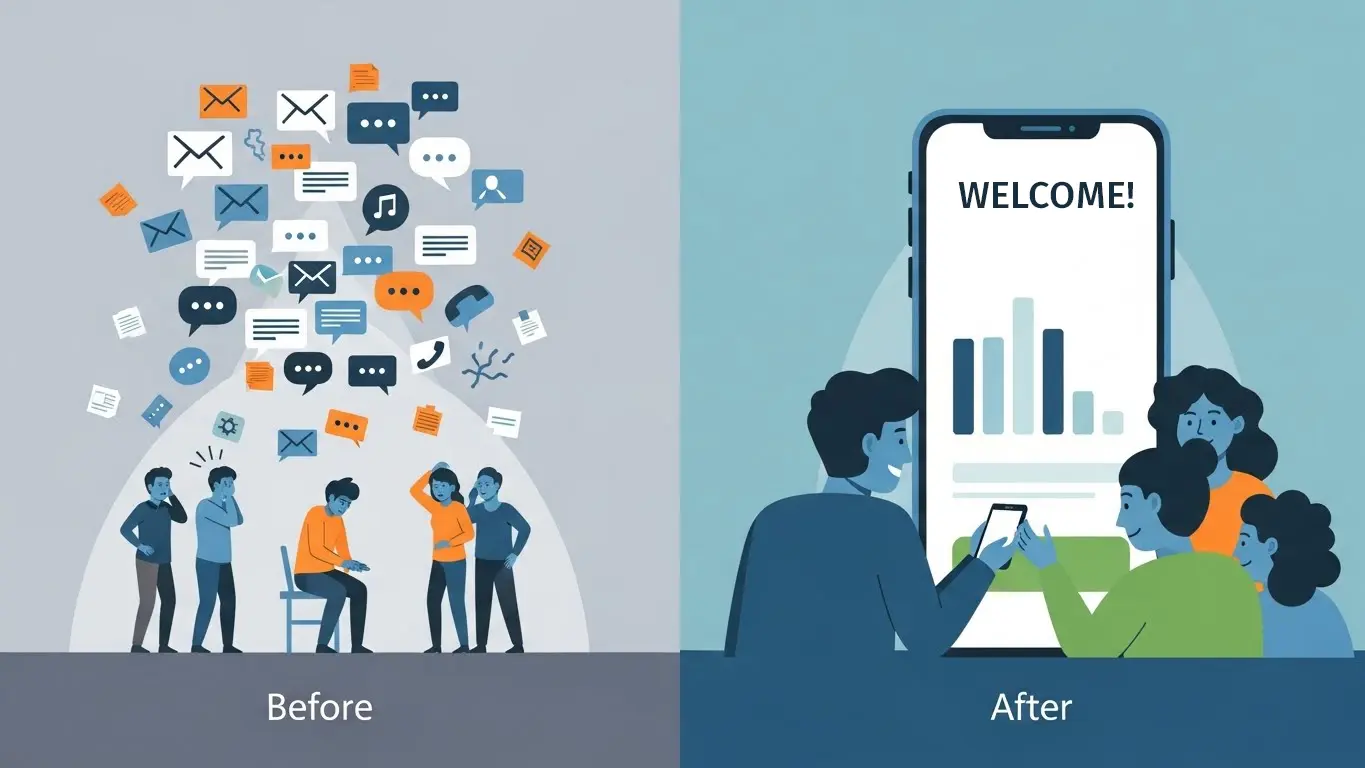
Many clubs still work with WhatsApp groups, Excel lists and email distribution lists in parallel. The result:
- Information is lost or only reaches some of the members
- The board spends a lot of time on queries, manual maintenance and coordination.
- Events are communicated late or incompletely
- Members feel poorly informed and less involved
Volunteers in particular invest a lot of time anyway. Without a central platform for communication and organisation, the workload increases and with it the risk that important people will leave the association.
A Member App bundles these channels into one system and creates a uniform infrastructure for internal communication, events and member management.
Advantages of a modern Member App
A modern Member App or club software app addresses precisely these challenges and offers several concrete advantages:
- Centralised communication: All relevant information is gathered in one place – instead of five different chats.
- Structured member management: Master data, groups, roles and authorisations are clearly displayed in a member management app.
- Efficient event management: appointments, training sessions, rehearsals, meetings and events can be planned, published and communicated directly via the app.
- Higher participation: Push notifications and clearer information increase the likelihood that members will actively participate.
- Transparency for the board and organising teams: those responsible can see more quickly how many people are registering, which groups are active and where adjustments need to be made.
- Professional external image: Many club apps also offer modules for public communication, e.g. news or event overviews.
Digital club management is therefore becoming a strategic tool, especially for clubs that are growing or already have many members: it relieves the burden on key personnel, reduces friction losses and improves the member experience.
What clubs should look for when choosing a Member App
The market for Member App providers is growing steadily, but not every solution is suitable for every club. That’s why boards, departments and project teams should clearly define which requirements are truly relevant before making a decision. The following criteria help to compare options in a structured manner and filter out unsuitable tools at an early stage.
Functionality of a Member App
A good app for clubs should not only look attractive, but also reliably map the most important processes in everyday club life. Typical core functions that clubs should pay attention to:
- Member management: digital master data, groups, roles & permissions
- Communication: chat, push notifications, news feed
- Calendar & dates: Training sessions, rehearsals, meetings, events
- Documents & files: centralised access for all relevant roles
- Attendance and re-registration functions: e.g. for training or events
- Volunteer and task management: to-do lists, responsibilities, deadlines
The combination is particularly popular:
Member App with member management
It saves time and significantly reduces the error rate associated with manual spreadsheets.
Data protection & GDPR compliance
Since associations process personal data, GDPR compliance is not optional. Therefore, pay particular attention to:
- Server location (ideally: EU or Germany)
- Clear roles & rights (who sees what?)
- Encrypted data transmission
- Auditable consent processes
- Comprehensible deletion concepts
Some associations decide against solutions from abroad because the legal situation is unclear. A Member App provider should be able to explain transparently at any time, upon request, how and where data is processed.
User-friendliness & mobile experience
A Member App will only be successful if it is easy to understand and simple to implement. Therefore, pay attention to the following:
- Intuitive operation
- Clear navigation
- Clear mobile display
- Low training costs
- Quick acceptance among older members
Many clubs report that an overly complex app fails in everyday use, even if it can actually do everything. The focus should therefore be on practical usability and quick implementation.
Cost models & price transparency
The costs of Member App vary considerably from provider to provider. Common models:
- Freemium: Basic functions free of charge, premium modules subject to a fee
- Price per member or per active user
- Modular prices: functions can be booked individually
- Club size: Small vs. large clubs
It is not only the price that is important, but also price transparency:
- Are there any additional costs for support?
- Can modules only be booked as a package?
- How easy is it to terminate the contract?
Comparison of Member App providers
The market for Member App is diverse: some solutions specialise in sports clubs, while others are aimed at cultural associations, fire brigades or large umbrella organisations. Instead of simply naming ‘the best solution’, it makes more sense to highlight the most important comparison criteria and use them to evaluate which Member App is best suited to which club.
ClubDesk
Target group: Small to medium-sized associations
Strengths:
- Simple operation
- Clean membership management
- Integrated website function
- Broad range of functions without strong specialisation
Assessment:
ClubDesk is often praised for its structure and clarity. Clubs looking for a solid, not overly complex solution will find what they are looking for here.
Click here to visit the Clubdesk website.
easyVerein
Target group: Medium-sized and larger clubs
Strengths:
- Extensive administrative logic
- Automation & Role Management
- Modern cloud application with app
- Good scalability
Assessment:
One of the most frequently mentioned solutions in the field of ‘digital club management’. Ideal for clubs that need more than ‘just an app’ and want to map their administration cleanly.
Click here to visit the easyverein website.
Polario
Target group: Clubs of all sizes, from small teams to complex multi-sport clubs
Strengths:
- Fully modular design, functions can be flexibly activated or expanded
- Scalable all-round solution covering both simple and demanding use cases
- No rigid specifications or fixed process logic
- Intuitive interface for members, powerful tools for management teams
- Customisable structure (groups, roles, workflows)
Assessment:
Polario offers a highly customisable Member App that can be tailored precisely to the needs of each club, from minimalist setups to comprehensive administration and communication processes. Clubs benefit from not being tied to rigid structures, but can design the app to be as simple or complex as their everyday needs require.
Find out more about Polario as an app for clubs here.
Spond
Target group: Sports clubs, teams, training groups
Strengths:
- Good usability for mobile use
- Very strong communication and group functions
- Free to use
Assessment:
Spond is a favourite among sports clubs and youth teams. However, it is less suitable if comprehensive membership management is required.
Click here to visit the Spond website.
SportMember
Target group: Sports clubs
Strengths:
- Scheduling, training organisation
- Team and group functions
- Integrated member and role management
Assessment:
A good choice for sports clubs that need to coordinate many training groups and teams. More sports-specific than club-neutral.
Click here to visit the Sportmember website.
Campai
Target group: Large clubs, associations, organisations with complex structures
Strengths:
- Distinctive role and authorisation management
- Administration up to association level
- Modular extensions
Assessment:
Campai is powerful and ideal for larger organisations, but may be too complex for smaller associations.
Click here to visit the Campai website.
Vereinsplaner
Target group: Small to medium-sized associations, music and cultural associations
Strengths:
- Intuitive appointment and task management
- Simple communication channels
- Clear focus on coordination and organisation
Assessment:
Lightweight solution with a focus on collaboration. For complete management, it is advisable to look to other providers.
Click here to visit the Vereinsplaner website.
Choosing a member app
The decision on the best Member App does not start with the provider, but with clarifying your own needs. Clubs should first define their requirements, processes, and target groups. Only then can a serious assessment be made as to which solution is best suited.
Which is the best Member App?
The question of which is the best Member App is often asked. However, there is no universal answer. What works best for a sports club may be less suitable for a cultural association or a fire brigade. The individual circumstances are always decisive.
Criteria for determining the ‘best’ solution for your own club:
- Desired range of functions (communication, member management, event management)
- Number of members and groups
- Internal structures (departments, youth, divisions)
- Requirements for GDPR & IT security
- Need for automation
- Budget and licensing model
The best solution is therefore not the one with the most features, but the one that best suits the structure and working methods of the association.
Member App by size
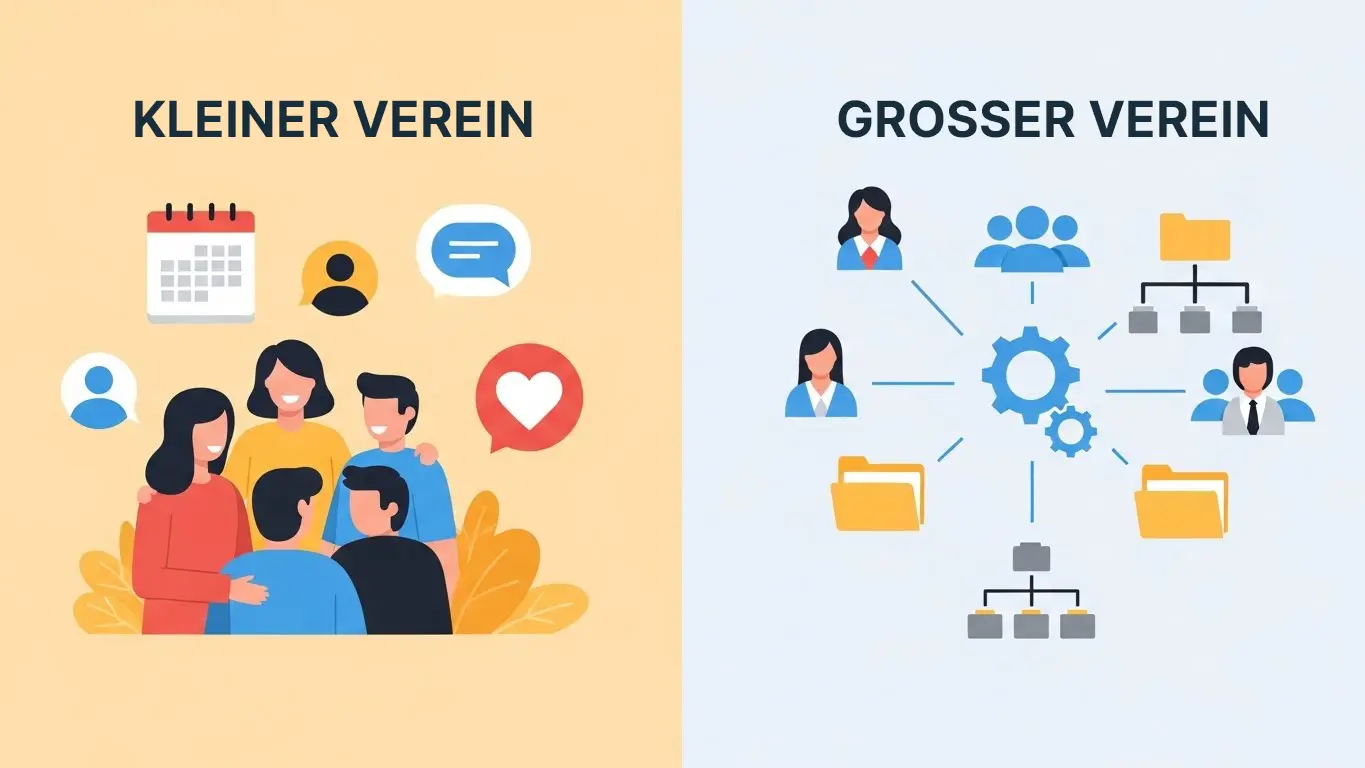
Clubs vary greatly in terms of organisation, structure and resources. It is therefore worth filtering providers according to club size.
For small clubs
- Focus on simple, clearly structured functions
- Affordable or free entry-level models
- Minimal barriers to entry
- Intuitive usability for all age groups
Small clubs benefit particularly from apps that bundle communication and appointments without complex administrative logic.
For large clubs
- Detailed member and role management
- Automated processes (contributions, invitations, reminders)
- Extensive group logic (teams, departments, divisions)
- Integrations with existing systems
- Defined workflows for the Executive Board and administrative office
If you coordinate a large number of people or multiple departments, you should choose an app that offers scalability and technical stability.
Typical experiences from practice
Many clubs share similar impressions when they introduce a Member App or test providers.
What is often rated positively:
- Noticeable relief for the Executive Board
- Less messenger chaos
- Clear feedback processes for appointments
- Better internal communication
- Higher participation in events
What is sometimes referred to as a challenge:
- Older members need support initially
- Functions only become useful when everyone actively participates.
- Support is limited for very inexpensive apps.
- More complex systems require structured onboarding
This empirical data helps clubs develop realistic expectations and strategically plan the introduction of an app.
Use cases: How different clubs use a Member App
Associations vary greatly in terms of structure, size and working methods. The use cases for a Member App are correspondingly diverse. The following use cases show how different organisations successfully use digital solutions in their everyday work – and which functions are particularly valuable.
sports clubs
Sports clubs benefit particularly from clear processes relating to training and match operations. Training times change frequently, teams need to be coordinated, and feedback is crucial.
Typical applications:
- Managing multiple teams with their own groups
- Organise training and match schedules centrally
- Quick push notifications when changes occur
- Participation queries for training & match day
- Exchange of match reports, results and photos
Advantage:
The app reduces WhatsApp chaos and ensures structured, traceable communication, which is particularly important for youth teams and multiple coaching teams.
Music and cultural associations
Music clubs, choirs and cultural groups often have a different rhythm to sports clubs. Here, the focus is on joint projects, performances and long-term scheduling.
Typical applications:
- Rehearsal schedule & attendance lists
- Organisation of concerts, events, workshops
- Provision of sheet music or documents
- Structured internal exchange between register groups
Advantage:
Thanks to centralised scheduling, all members know what is coming up at any given time, including rehearsal phases, performance schedules and organisational tasks.
youth organisations
Youth organisations benefit from digital tools to organise activities and involve parents.
Typical applications:
- Planning excursions, camps and group sessions
- Easy communication with parents
- Publication of important documents (consents, packing lists)
- Group chats with roles & moderation
Advantage:
Structured communication, clear responsibilities and a platform where parents and carers alike can stay informed.
Large clubs & multi-sport clubs
Larger organisations with multiple departments require significantly more structure and automation.
Typical applications:
- Complex role and member management
- Automated workflows
- Decentralised communication per department
- Reporting for the Executive Board and the administrative office
- Coordination of numerous appointments and resources
Advantage:
A digital platform creates standardisation, reduces administrative effort and improves internal transparency.
Choosing a member app
Choosing a Member App is a strategic decision. It influences internal collaboration, communication and administration for many years to come. The following checklist helps board members, project teams and administrators to systematically check which solution really suits the club.
Making the right choice
The market for Member App is diverse, and the requirements of clubs could hardly be more different. That’s why there is no universal ‘best Member App’, only the solution that best fits your own structures, processes and resources. It is crucial that clubs clearly define their needs, carefully examine the range of functions and data protection, and then compare providers that really suit their size and working methods.
A digital Member App provides noticeable relief, improves internal communication and increases member participation, regardless of whether it is a sports, cultural or multi-sport club. Those who take a structured approach, utilise test phases and consider the experiences of other clubs will quickly find out which solution offers the greatest added value.
Choosing the right club app always depends on your club’s specific needs – from communication processes and membership structure to organisational workflows. It is crucial to select a solution that can be flexibly adapted and covers both simple and complex use cases. This is exactly where Polario comes in: a modular club app that adapts precisely to your structure and brings all key processes together on a single platform.
👉 Find out here exactly how Polario can be used in your club:
Frequently asked questions (FAQ)
How much does a Member App cost?
The costs vary depending on the provider, range of functions and size of the club. Many apps offer freemium models for small clubs as well as paid packages starting at just a few pounds per month. Larger clubs usually pay for advanced administration, role models and automation. Clear price transparency is important to avoid hidden additional costs.
What features should a good Member App have?
The most important functions include: member management, calendar & scheduling, chat or news feed, document storage, and role and group logic. Depending on the association, additional features such as automation, payment or website integration may be useful.
Which Member App is suitable for small clubs?
Small clubs usually need a straightforward, easy-to-use app with clear basic functions. Solutions with freemium models or inexpensive starter packages are often sufficient. Intuitive operation is more important here than maximum functionality.
Which Member App provider is the best?
There is no such thing as a universally ‘best’ Member App. The optimal solution depends on the structure, size, processes, and budget of the club. The best app is the one that simplifies your daily work routine the most and reliably covers the most important functions.
How secure are club apps?
Reputable providers ensure GDPR compliance, European server locations, encrypted data transmission and clear authorisation models. Clubs should always check how the provider stores, processes and secures data.
How long does it take to launch a Member App?
The implementation usually takes a few days to a few weeks, depending on the complexity of the association. Smaller associations can often start immediately, while larger organisations first need to import members, define roles and clarify internal processes.
What are the typical advantages of a Member App?
The most frequently cited advantages include:
- less communication chaos
- more efficient scheduling
- transparent administration
- Discharge of the Executive Board
- higher member participation
Many clubs also report that their internal structure has improved significantly.
Are club apps also suitable for older members?
Yes, provided that the app is simple and clearly structured. Good providers value intuitive usability. Clubs should nevertheless provide short introductions or explanatory videos.
Can you manage multiple departments or groups in one app?
Yes, almost all modern club apps support multiple groups, teams or departments. Important criteria: flexible roles, group-based communication and clear permissions.