Skip to content




Whether it’s a company, association, club, or business community, the challenge is similar everywhere: the community platform has been introduced, everything works technically, but the members remain passive. There is little interaction, hardly any discussions, events are poorly attended, and content fizzles out.
In this article, you will learn how to strategically set up your community platform so that members don’t just visit once, but remain active in the long term, regardless of whether they are employees, members of an association, active club members, or participants in a business community.
What does “active community” mean on a community platform?
Depending on the type of organization, “activity” looks slightly different, but there are still common denominators. An active community platform shows, among other things:
- Regular logins (e.g., weekly or around important topics/dates)
- Your own contributions: posts, questions, comments, testimonials
- Participation in events: webinars, association conferences, club formats, virtual meetups
- Use of specific features: Groups, chapters, working groups, media library, document storage
❗Important: Activity is more than just reading. Especially for associations, clubs, and business communities, added value arises when members share knowledge, contacts, best practices, and interests.
The phases of member activation in the community platform
Regardless of whether your community consists of customers, employees, volunteers, or association members, the activation journey is similar:
- Awareness & interest: The person learns about the community platform (e.g., during onboarding, at a conference, upon becoming a member).
- Onboarding & first login: Access data, first login, initial orientation.
- First interaction: Like, comment, question, participation in an event.
- Regular use: The platform becomes part of everyday work or club life.
- Committed role / Ambassador: Members moderate groups, lead working groups or chapters, and organize events.
Depending on the phase your target group is in (e.g., new club members vs. long-standing association members), you will need different activation measures.
Onboarding: The most important lever for activation
Structured community onboarding is the point at which it is decided whether members will “accept” the platform or leave again after their first login.
Expectation management for different target groups
Even before logging in for the first time, it should be clear that:
- Companies & business communities: “What business advantages do I have?” (e.g., lead sharing, best practice exchange, industry knowledge)
- Associations: “How does the platform help me with advocacy, networking, and professional work?”
- Clubs: “How does the community platform make organization, communication, and volunteering easier for us?”
Communicate clearly:
- Value proposition (“What specific benefits does the platform offer me?”)
- Target group & content (“Who is active here and why?”)
- Expected behavior (“How can I contribute?”)
Guided in-app onboarding
Take advantage of the possibilities offered by your community platform:
- Guided tour upon first login
- Checklist: Fill out your profile, join relevant groups/working groups/chapters, write an introductory post
- Automated welcome messages (e.g., from the community manager, chapter lead, or association board)
This is where “activating members in the community” begins in concrete terms: the first steps must be simple, clear, and motivating.
Welcome areas & introduction threads
Set up a central location:
- "New to the association/club? Introduce yourself!"
- “Welcome to our business community – start here”
- “New employees in the company network”
This area should:
- be clearly visible in the dashboard
- be moderated regularly
- actively used by board members, community managers, or ambassadors
Content strategy: Relevant content for companies, associations, and clubs
Without relevant content, there is no activity — but it’s not just about quantity, it’s about finding the right fit for your community platform.
Contents along the member journey
Plan content according to member type.
Companies / Business Community:
- Industry insights, studies, market analyses
- Use cases, best practices, partner offerings
- Q&A on products, solutions, projects
Associations:
- Technical information, position papers, legislative updates
- Working group updates, upcoming events, tenders
- Reviews of events, conferences
Interactive formats instead of one-way communication
Good formats for increasing engagement on the community platform:
- AMA sessions (“Ask me anything”) with experts, board members, or management
- Live Q&A after association conferences or club meetings – directly on the platform
- Discussion threads on industry developments, legislative proposals, association decisions
- Challenges (e.g., “Share your best project/your most successful approach to recruiting members”)
Editorial plan for community content
A community editorial plan helps to maintain activity:
- Weekly fixed formats (e.g., “Question of the Week,” “Project of the Month,” “Member Spotlight”)
- Monthly highlights (e.g., focus topic, specialist webinar, member meeting)
- Seasonally planned topics (e.g., budget phase, start of the season in the club, annual conference in the association)
Utilize social features: Encourage micro-engagement
Community platforms offer many opportunities for small, quick actions — ideal for people with busy careers or volunteers with limited time.
Likes, reactions, and short comments
Encourage low-threshold interactions:
- Clearly visible Like or Reaction buttons
- Standard phrases (“I agree,” “Interesting approach,” “Good question”)
- Active response from community managers to a member's first interaction
Mentions & Direct Messages
Use @mentions to highlight relevant knowledge:
- “@Anna (Association Management) – can you link the current position here?”
- “@Thomas (company) – you have a customer case study on this, right?”
- “@Julia (association) – you had a similar project, would you like to tell us about it?”
Direct messages help with:
- 1:1 networking (e.g., between member companies)
- Follow-ups after events
- Quick coordination in voluntary work
Groups, Working Groups & Chapters
Associations and business communities in particular benefit from structured spaces:
- Specialist groups & working groups
- Regional or national groups
- Industries, clusters, key topics
Clubs can use, for example:
- Divisions (youth, seniors, individual sports)
- Project groups (summer party, fundraising, digitization)
This enables members to find relevant content and contacts more quickly, which is a key driver for long-term engagement.

Young and older association members sit at the table, looking at their association app, with the web version of the association app visible in the background.
The digital notice board combines information and dialogue and strengthens modern communication in companies, administration and education.
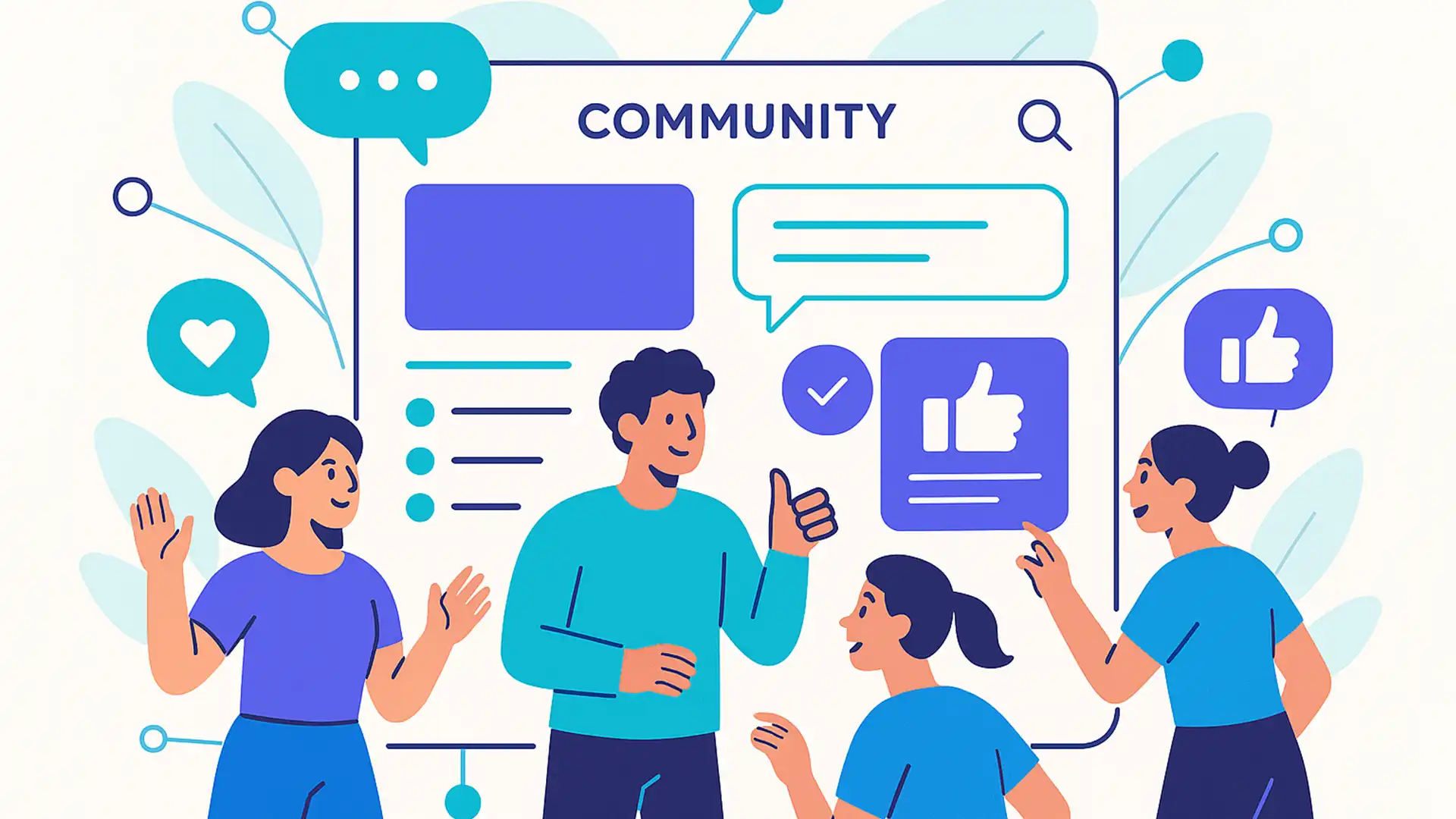
Readers become contributors: this is how genuine community engagement is created
How to increase community engagement and activate passive members with clear incentives and everyday communication channels.
Gamification & Recognition: Making Motivation Visible
Gamification in the community platform can create additional motivation, especially for business communities and volunteers — when used correctly, without appearing overly playful.
Badges, points, and levels
Typical elements:
- Points for posts, replies, shared documents, hosted events
- Badges for milestones (1st post, 10th reply, 1st event host, 1 year of membership)
- Levels/roles (e.g., “Newcomer,” “Contributor,” “Expert,” “Chapter Lead”)
Important: Reward behavior-related activities:
- Helpful answers
- Knowledge processing
- Active support of other members
Visibility for active members
Recognition works equally well in companies, associations, and clubs:
- “Member of the Month” or “Best Practice of the Month”
- Short interviews with active member companies or dedicated volunteers
- Mention in the newsletter or at in-person events
Events as activation boosters – directly on the community platform
Events are central to associations, clubs, and business communities anyway — integrated into the community platform, they become a catalyst for activity.
Integrate or dock live events
It is ideal if you can integrate livestreams or digital events directly into the community platform:
- Livestream + chat/comment function in the same interface
- Event-specific rooms with documents, presentations, voting
- Recordings in an internal media library for companies, associations, and clubs
Preparation and follow-up on the platform
More activation through:
- Pre-event threads: “What questions should we definitely address at the annual conference?”
- Live chat during the event: Q&A, surveys, feedback
- Post-event discussion: “What are you taking away from this? What will you implement in your company/organization?”
Roles & Ambassador Programs: Distributing Responsibility
Long-term activation is successful when responsibility is distributed — this is particularly important in associations with many members, clubs with volunteers, and business communities with chapters.
Define role model
Possible roles:
- Community Manager / Office: Strategy, Moderation, Key Figures
- Group and working group leaders: Responsible for individual specialist or regional groups
- Ambassadors / Chapter Leads: Multipliers in companies, regions, or associations
- Subject matter experts: Contribute specialized content, e.g., law, technology, industry knowledge
Structure the Ambassador Program
A program may include:
- Clear tasks (e.g., 1 post per week, 1 event per quarter, activate 3 members per month)
- Exclusive benefits (e.g., access to beta features, exclusive briefings, stage time at events)
- Visible recognition (badges, mentions at events, certificates)
Comparison: Social media group vs. own community platform
Many organizations start with LinkedIn or Facebook groups. However, they quickly reach their limits when it comes to long-term activation.
| Social media group | Own community platform | |
|---|---|---|
|
Visibility |
Dependent on the algorithm |
Predictable visibility for members |
|
Structure |
A feed, little depth |
Groups, working groups, social feeds, media library |
|
Data Sovereignty |
At the platform operator |
At the company / association / club |
|
Integration |
Limited business integrations |
SSO, CRM, member management, event platform |
|
Target group separation |
Difficult to separate cleanly |
Individual areas by status, role, region |
|
Branding |
Social media brand in the foreground |
Individually configurable |
|
Activation in the long term |
Volatile, externally controlled |
Strategically plannable, measurable, and controllable |
Conclusion: Community platform + clear activation strategy = engaged members
A community platform is more than just an additional communication tool. It is a digital space where relationships, knowledge, and collaboration between people and organizations can flourish. However, for this to succeed, companies, associations, clubs, and business communities need more than just a technically sound solution: a clear strategy for gradually introducing members to usage, exchange, and engagement is crucial.
Long-term engagement arises when members experience tangible benefits in their everyday lives: when questions are answered more quickly, best practices are easy to find, contacts can be made in a targeted manner, and events are not isolated but embedded in ongoing discussions. This includes well-designed onboarding, relevant and regularly recurring content, well-structured groups and working groups, and formats that explicitly encourage interaction.
It is equally important to distribute responsibility and visibility across multiple shoulders. Role models, moderation teams, and ambassador programs ensure that the community platform does not depend on one central person, but is supported by a network of committed members. Those who link these elements to clearly defined metrics and continuously review and adjust their measures will gradually develop a vibrant, self-sustaining community that creates real added value in terms of expertise, organization, and economics.
Frequently asked questions about the community platform & member activation
How can I activate members in a community platform in the long term?
Long-term engagement occurs when members see clear benefits in their community platform and have regular reasons to return. The following factors are crucial:
- A structured onboarding process with clear first steps
- Relevant content for the respective target group (e.g., specialist knowledge, best practices, event information)
- Interaction opportunities such as questions, surveys, discussions, events
- Visible recognition for active members (e.g., roles, badges, mentions)
Important: Activation is not a one-time campaign moment, but rather a continuous process in community management.
How often should we post on our community platform?
For most organizations, a rhythm of 2–3 planned posts per week makes sense—supplemented by spontaneous posts on current topics, projects, or events.
More important than frequency alone is a clear content structure: recurring formats (e.g., “Question of the Week,” “Case of the Month”) help members quickly understand the added value of the community platform and keep coming back.
How long does it take for a community platform to become truly active?
Realistically, it takes 6–12 months for a community platform for companies, associations, or clubs to really take off. During this time:
- usage routines become established among members
- First multipliers and ambassadors become visible
- You can use key figures to identify which formats work.
A community platform is a long-term relationship and membership tool, not a short-term campaign tool.
What content works best on a community platform?
Content that directly addresses specific challenges faced by members works best, for example:
- Practical how-tos, checklists, and best practices
- Q&A sessions with experts, board members, or management
- Short video or event formats followed by discussion on the community platform
- Posts that specifically address a target group (e.g., “Question for association board members…,” “How do you solve this in your member companies…?”)
Purely one-way news without any opportunity for interaction generates significantly less engagement.
What role does email play in activating the community platform?
Email is an important tool for bringing members back to the community platform. The following have proven effective:
- Digest emails (weekly or biweekly) with the most important articles and events
- personalized notifications about new posts in relevant groups
- Event invitations and reminders with deep links to the community
This means that the community platform remains the central place for exchange, while emails serve as “reminders and door openers.”
Does gamification work in a community platform for associations and clubs?
Yes – gamification in community platforms can also work well for associations and clubs if it is implemented in a serious manner and tailored to the target group. Examples of useful applications include:
- Badges for posts, replies, event moderation, or long-term membership
- Point or level systems for qualitative contributions
- Visible rankings (“Top contributors of the month”)
It is important that gamification reinforces meaningful behavior—such as sharing knowledge or supporting others—and not just “quantity for quantity’s sake.”
How much internal resources do we need for professional community management?
For a community platform in a B2B or association context, you should plan for at least one clearly defined role for community management—with fixed hours or a percentage of a full-time position. Typical tasks include:
- Content planning & editorial plan
- Moderation of discussions
- Support for group leaders and ambassadors
- Monitoring of key figures (MAU, posts, response times, etc.)
The larger and more heterogeneous the community, the more important it is to have a role and responsibility model that involves several people.
How does an internal employee community differ from an external business community?
The mechanics of the community platform are similar, but the motivation of the members differs:
- Internal employee community: Focus on collaboration, knowledge sharing, project work, onboarding, internal communication.
- External business community/association: Focus on networking, professional positioning, market and industry knowledge, representation of interests, business opportunities.
This results in different content formats, tones, and activation levers—e.g., more project-related content internally and more industry and specialist topics in external business communities.
How do we deal with critical or negative comments on the community platform?
Critical contributions are part of a vibrant community platform. Important factors include:
- Clear, pre-communicated community guidelines / netiquette
- Objective, transparent moderation instead of hasty deletion
- Distinction between constructive criticism (welcome) and rule violations (e.g., personal attacks, discriminatory content)
Dealing with criticism professionally strengthens trust in the community platform and shows that dialogue is genuinely desired.